
Bitfinex Review 2026
Considering Bitfinex? This comprehensive review breaks down its fees, safety, regulation, and trading features so you can decide if the exchange is right for you.


Bitfinex was launched in 2012 as a cryptocurrency exchange that specialised in spot trading, margin, and derivatives markets. This exchange supports over 400 trading pairs with deep liquidity and advanced order types. Massive trading volumes with competitive slippage across popular crypto pairs like BTC/USDT have helped the platform cement its place as a mainstream success.
After a major 2016 security breach, the platform has strengthened security measures, and such a breach has not reoccurred ever since. This Bitfinex review is based on publicly available data, platform features, track record, and user-relevant information to help readers assess the exchange’s credibility and safety.
In this comprehensive Bitfinex exchange review, we examine fees, security, legitimacy, trading tools, and regulatory considerations to determine whether Bitfinex is a suitable platform in 2026
Key Takeaways
Bitfinex is a long-standing cryptocurrency exchange primarily used by professional and high-volume traders.
The platform offers advanced trading and charting tools, a wide range of order types, and deep liquidity for technical and high-risk traders.
Fee structures are quite competitive but may be complex for beginners due to the advanced trading offerings and payment system.
Regulatory compliance is not available in all jurisdictions, and the exchange is not accessible in certain countries due to local trade regulations.
Bitfinex may not be suited to beginners or users looking for simple fiat trading and integration.
Table of Contents
Bitfinex at a Glance
| Founded | 2012 |
| Native Token | UNUS SED LEO (LEO) |
| Listed Cryptos | Derivatives-focused |
| Trading Pairs | ~400 |
| Supported Countries | 180+ |
| Deposit Fees |
Crypto – Free Fiat (ACH) – 1% fee OpenPayd (EUR/USD) – €5/£5 flat fee |
| Transaction Fees | Free |
| Withdrawal Fees |
Crypto – Free (network fees may apply) Fiat – 0.1% Express Fiat – 1% |
| Mobile & Desktop Apps | Available |
| Customer Support | 24/7 |
| Regulation | Astana Financial Services Authority (AFSA) |
What Is Bitfinex?
Operated by iFinex Inc., Bitfinex is a professional-grade cryptocurrency exchange, tailored for high-volume and experienced technical traders. The deep liquidity and advanced nature of its trading tools make it an ideal crypto exchange for institutional trading.
Bitfinex is significantly different from beginner-oriented platforms. While those platforms are focused on simple user interface, simple buy and sell functionalities, and educational features, Bitfinex exchange specialises in detailed order books, multiple execution options like stop, limit, and others, and customizable margin settings.
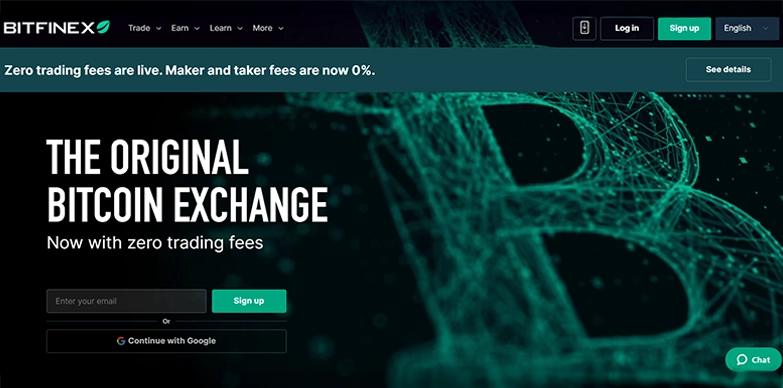
Historically, and even in the current crypto market, Bitfinex has been and is still a major player in global crypto liquidity. Particularly in major crypto pairs like BTC/USD and ETH/USD, Bitfinex moves massive liquidity. Many Bitfinex reviews show that its order books are often deep, allowing large trades with quite low slippage. More so, the exchange is a leading USDT (Tether) reserve, contributing to its influence in broader market flows.
Despite historical network breaches such as the notable 2016 hack and Tether regulatory scrutiny, technical and high-volume traders continue to favour Bitfinex due to its advanced trading interface, margin funding market, competitive fees for high-volume accounts, and strong USDT liquidity. This set of traders prioritises execution depth and trading flexibility over simple custodial options; hence, Bitfinex remains relevant in global crypto markets today.
Pros and Cons
- Deep liquidity for major trading pairs (ETH/USDT, BTC/USDT), as the order depth books are huge and suitable for high-volume trades
- Advanced trading options: margin trading, lending trading, derivatives, and multiple order types
- A custom pair-to-pair funding system for borrowing and lending capital via margin funding
- Tiered trading fees for high-volume trades benefit institutional and professional traders
- The major security hack that resulted in a loss of 119,756 BTC still affects the exchange’s reputation to date
- Complex user interface; suits experienced and technical traders more
- The platform faced strong regulatory scrutiny linked to the use of Tether (USDT)
- Not available to U.S retail customers because of regulatory restrictions
Supported Assets and Markets
Spot Trading
This exchange supports hundreds of crypto trading pairs, including major assets like Bitcoin (BTC), Ethereum (ETH), and other high-market-cap coins. It also incorporates mid-range altcoins and other emerging DeFi assets; hence, users can access a wide variety of crypto assets from just a single trading platform.
Bitfinex is particularly popular for its liquidity depth on its major pairs (BTC/USDT, ETH/USDT). Together with other major trading pairs, Bitfinex exchange reviews show that the platform has tight spreads and robust order book depth, which help reduce slippage on large orders. This setup then helps high-volume traders to trade seamlessly. Overall, Bitfinex’s liquidity is majorly in its core trading pairs, while liquidity on smaller and newer pairs varies according to ecosystem usability.
There is also a mix of fiat and crypto trading pairs, allowing users to trade directly against fiat currencies. Users can, for instance, trade against the Euro and the US Dollar on supported pairs, with more straightforward entry and exit points — no need to convert to a stablecoin first. This model also expands trading flexibility when it comes to crypto pairs against stablecoins like USDT and USDC.
Bitfinex’s spot trading combines a wide asset class with particularly deep liquidity in major markets and useful fiat pairings, making it suitable for active traders for ease of execution and asset variety.
Derivatives & Perpetual Contracts
Bitfinex offers a wide range of derivatives, with perpetual swaps foremost amongst its offerings. The way perpetual swaps work is that they track the price of an underlying asset without a fixed expiry date. Hence, these swaps allow traders to hold positions indefinitely as long as adequate margin and funding are provided.
Liquidity observations indicate that its perpetual contracts are available in BTC, ETH, XRP, and other major crypto tokens. The pricing of these contracts, however, is tied to the spot markets through a funding rate model that keeps the contract price aligned with underlying values.
Leverage availability on Bitfinex’s perpetual contracts varies by assets and market conditions. But due to regulation considerations and internal risk controls, it is more conservative than its major competitors. It should be noted that leverage will always increase the risk of liquidation, even though it can multiply profits when it goes according to the set position.
Especially at high leverage settings, portfolio assets can be wiped out in no time when the market moves against the set position. Hence, traders should monitor positions dynamically while employing risk management tools.
Leveraged products are suitable for experienced and technical traders who understand derivatives pricing, funding rates, and risk management. More so, they can be very effective for short-term hedging against inflation and profit scalping. On the other hand, perpetual contracts are not suitable for newbies, long-term investors, and low-risk traders who are not technically secure.
Tokenized Securities

With Bitfinex Securities, the exchange is expanding beyond traditional crypto trading. This securities platform offers tokenised securities, thereby bringing regulated financial assets onto blockchain rails in digital token form. Tokenised securities are essentially traditional investment assets such as debts, shares, and funds. You then have these trades as blockchain tokens for faster payments, transparency, and fractional ownership, while still complying with securities regulations.
Bitfinex Securities operates under licenses such as the Astana International Finance Centre (AIFC) in Kazakhstan and El Salvador. Also, stringent attention is paid to KYC and AML requirements for investors and issuers before allowing participation. Prospective investors must complete identity verification and meet applicable eligibility standards. Unlike crypto trading, investor protection and regulatory compliance are essential and a core foundation.
This regulated structure means that tokenised securities offerings are not commonplace in crypto exchanges. Because of the regulatory requirements involved, most crypto exchanges focus on spot trading to avoid the rigours of licensing and operational disclosure. Hence, only a few exchanges like Bitfinex launch true tokenised assets.
Bitfinex Securities’ offerings are part of a broader trend where traditional finance and blockchain meet. However, the jurisdictional restrictions and compliance checks mean that access is limited, unlike crypto trading.
Trading Experience & Tools
Trading Interface
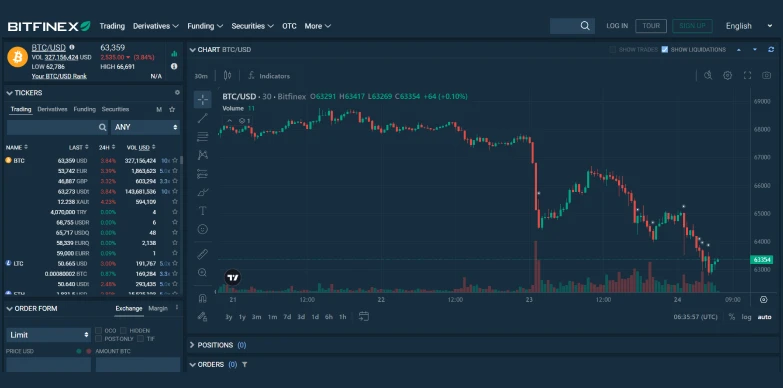
Bitfinex offers a professional trading dashboard to aid the trading of active and professional traders. When you log in to the Bitfinex platform, a comprehensive interface meets you with key elements such as order entry panels, position tracking, and market data within a single window. This trading setup prioritises efficiency and real-time decision-making over simplicity, distinguishing it from more beginner-focused platforms.
Bitfinex employs an advanced charting interface that suits technical analysis. Traders can access a wide range of technical indicators, timeframes, and drawing tools directly on the price chart. The order book is displayed adjacent to the charts and order entry areas, giving instant visibility into bid/ask liquidity at multiple price levels. This depth view is very useful for evaluating market pressure and making larger executions with minimal slippage; this is because it works in real-time.
The interface is also very customizable. Users can detach, resize, or reorganise panels to suit their workflow. For instance, users can enlarge the chart while minimizing the trade history interface, or vice versa. Users can also save workspace layouts, switch between light and dark modes, and adjust data refresh rates. With multi-monitor support, the interface is very adaptable and especially useful for high-volume traders who focus on execution speed and information density rather than easy navigation.
Bitfinex’s trading interface is built for performance and depth. With its professional-standard charting, detailed order book, and flexible customisation that supports complex trading strategies, technical analysis traders tend to favour it.
Order Types & Advanced Tools
Bitfinex supports a wide range of order types that cater to the needs of both fundamental and advanced traders:
- Market orders. Users can immediately execute orders at the best available price for quick entry or exit when speed beats price precision.
- Limit orders. This allows traders to specify a target price, offering control over execution costs in less volatile market cycles.
- Stop orders. These orders trigger a market or limit order when a set price point is reached. This is especially useful for risk management or breakout entries.
- Trailing stop orders. This one adjusts the stop level as the market moves in the desired direction. Hence, you lock in profits while protecting your account from reversal losses.
Bitfinex also offers more technical orders, such as scaled and algorithmic orders, for advanced market execution:
- Scaled orders– this splits up large orders into multiple incremental orders across a price range. Institutional investors and high-volume traders particularly benefit from order, as it helps reduce market impact and average execution prices.
- Algorithmic orders- this automates trade according to time or volume criteria. When traders want to match the average market price over a period, this order is very suitable to reduce slippage in thin markets.
Practical Use Cases
A day trader can use trailing stop losses to secure profits as the market price rises. Also, a crypto big-mover can use a scaled order to sell large amounts of crypto to avoid moving the market in sharp directions. For algorithmic orders, institutional traders can use them to rebalance assets, thereby distributing executions evenly throughout a session.
With these high-tech order offerings, Bitfinex users can automate precise trades, thereby scaling the crypto exchange market beyond simple buy and sell actions. Hence, trade entries can now be calculated and controlled for better performance and risk management.
Paper Trading
Paper trading on Bitfinex allows users to simulate trading in a risk-free environment using virtual funds. Users set up a paper account or use sandbox mode in the interface to place orders, monitor positions, and observe hypothetical P&L without risking real money. Since this interface is a simulation of the live platform, including the same order types and tools, paper trades are like real trading actions.
Benefits of Strategy Testing
Strategy testing is very important to master trading techniques and learn market dynamics, and paper trading makes all these possible. It allows traders to test new ideas, practice order types, and refine risk management rules in real market conditions without financial risks.
Strategy testing can especially help beginners to have confidence in navigating Bitfinex’s complex interface. On the other hand, it can help experienced traders to adjust execution tactics before applying them live.
Limitations
However, there are limitations when compared to live trading. As useful as paper trading is for strategy testing, it does not capture live trading factors like slippage, latency, funding fees, or the emotional state of mind tied to live trading.
More so, liquidity can vary in live order books, and execution prices may vary under market stress. All these factors put together mean that paper trading may not translate directly to live trading results.
Overall, we can conclude that Bitfinex’s paper trading model is good for practical learning and trade testing purposes, but it cannot fully replicate the risks and experiences of live trading actions.
Margin Trading & Margin Funding
Bitfinex’s margin trading allows users to borrow funds to amplify their trading positions, increasing both potential profits and losses. On the other hand, the platform’s margin funding model is a peer-to-peer mechanism that provides the capital used in margin trading. Hence, we have other users lending funds to traders in exchange for interest.
This lending model works by lenders advertising offers with specific amounts, duration, and interest rates. Traders then take these offers to finance their leveraged positions. If the market moves in the trader’s favour, the lender earns interest; however, lenders may face partial losses if the position is liquidated.
The rate of interest put on these funds fluctuates based on market demand; high demand equals high interest. On the borrower’s side, there is usually an agreement for automatic liquidation if losses go beyond certain levels. The agreement is to protect the lender’s funds, but it can wipe out the trader’s capital in no time, especially with high leverage.
If you don’t understand the mechanisms of leverage, risk management, or liquidation triggers, margin trading is not for you. Low-risk and beginner traders also want to avoid margin trading or margin funding due to the high risks involved.
Thalex Derivatives Integration
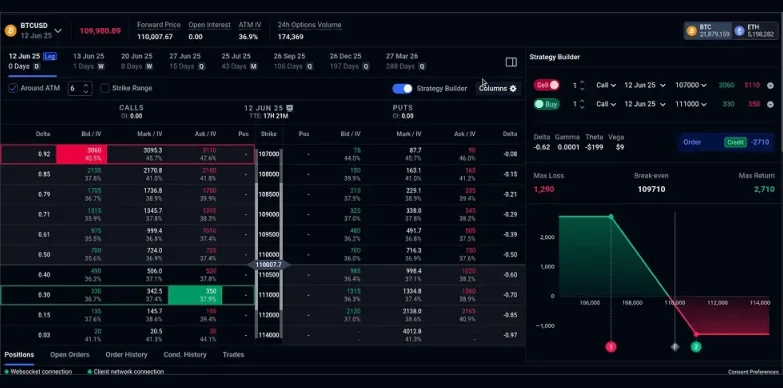
Bitfinex has integrated Thalex, a decentralized derivatives protocol, to expand its derivatives offerings with on-chain options and structured products. Consequently, derivatives traders can now access options markets, including calls and puts from major crypto assets, and directly from the Bitfinex interface, while settlement and execution occur via Thalex’s DeFi infrastructure.
This Thalex integration is especially useful for professional traders, as it gives them flexibility and risk management tools beyond perpetual swaps and futures. Option models allow traders to reduce account exposure, implement volatility strategies, and customise payoff profiles that are not possible with linear derivatives alone. Without requiring a separate wallet, Bitfinex’s trading interface and Thalex’s on-chain derivatives can deepen strategy breadth.
Fees Breakdown
Trading Fees
Bitfinex uses a maker-taker fee structure to incentivise liquidity provision. Maker fees are for adding liquidity, while taker fees are for removing liquidity, thereby encouraging traders to place limit orders that improve depth.
The platform’s fees are generally tiered, that is, they are volume-based. Hence, higher 30-day trading activity reduces both maker and taker rates. This is why large-volume and institutional traders get significant discounts compared to base volumes, which supports cost efficiency for active participants.
On spot markets, base maker-taker fees start quite competitively within the market, and volume tiers can lower costs further. The same applies to derivatives, where futures and perpetuals have tiered rates with makers generally paying less than takers. Derivatives fees are often tied to market trends, though exact percentages often depend on asset type and volume tier.
Overall, Bitfinex’s fee model rewards high-volume and market-making activity, while traders with lower volume pay standard rates for execution on both spot and derivatives markets.
Deposit & Withdrawal Fees
Bitfinex does not charge crypto deposit fees, but the crypto network charges users blockchain fees for withdrawal, which vary by cryptocurrency and network congestion.
Fiat deposits and withdrawals are also available via bank rails and supported local payment providers. Each of these providers has custom fees and minimums, which can also be tiered according to the amount of the transaction. For Fiat withdrawals, Bitfinex may apply a small internal fee for certain fiat withdrawals, and processing times depend on banking rails.
We can conclude that crypto deposits are cost-efficient, but withdrawals attract varying network fees, while fiat transactions incur third-party fees and timing that users should verify before initiating transactions.
LEO Token Fee Discounts
Holding UNUS SED LEO (LEO) on Bitfinex gives trading fee discounts. The more LEO tokens you hold, the more discounts on your maker and taker fees. There are also additional rewards and discounts on derivatives and lending markets for LEO token holders. Holding LEO is especially beneficial and cost-effective for high-volume or frequent traders whose fee savings outweigh the token price’s volatility.
However, the downside to holding exchange tokens like LEO is that their value depends on the exchange’s performance. That is Bitfinex’s performance as an exchange will either pump or dump the LEO token. More so, if the token price falls, fee savings may be offset by capital losses. With this kind of token, concentration risks and platform dependency are also key considerations because it is mainly the exchange users who hold them.
Account Creation, KYC & Restrictions
Account creation on Bitfinex begins with basic registration using email and password, allowing limited trading and small withdrawals. To increase your withdrawal limit and trading volume, more verification is required.
Verification levels increase with identity checks, document uploads, and proof of address. As you scale up in verification level, larger fiat deposits and withdrawals are unlocked, full trading access, and margin products become accessible. On Bitfinex, there are the basic plus level, intermediate level, and full access levels. So, depending on your verification level, you get access to the available platform features.
When it comes to KYC requirements, they vary by jurisdiction and regulatory obligations, as Bitfinex employs strict checks to meet AML compliance and fiat access rules. Bitfinex restricts services in certain regions like the U.S due to local securities and crypto regulations to ensure legal operations.
Security & Custody Model
Custody Structure
Bitfinex uses a custodial custody structure where users keep their funds on the platform, controlled and stored by the exchange. Users’ funds are mainly kept in cold wallets offline, while a very small percentage is kept in hot wallets for liquidity and withdrawals.
When contrasting this Bitfinex model to self-custody, it means that users hold their private keys and control their assets directly in a personal wallet. This is in contrast to Bitfinex’s users, whose funds are kept and controlled by the platform’s security and internal controls. With self-custody, counterparty risks are reduced, but personal operation responsibilities increase.
Security Measures
Since Bitfinex stores the majority of its customer funds in offline wallets, exposure to online hacks is reduced as only a small portion is left online for liquidity and ecosystem management.
For improved security, the platform supports two-factor authentication, withdrawal confirmations, and IP monitoring to avoid fund manipulation and fraud. Internally, Bitfinex uses multi-signature wallet structures, access controls, and periodic security reviews to manage operational and counterparty risks.
Historical Security Incidents
Bitfinex experienced a major hack in 2016, when about 119,756 BTC were stolen. The exchange, in turn, issued BFX recovery tokens to affected customers and later repurchased them, fully compensating victims of the fraud attack. Since then, Bitfinex has employed high-tech security mechanisms with enhanced cold storage protocols, multi-signature wallets, internal audits, and stricter access controls; no major hack has been reported ever since.
Mobile App & Platform Access

Bitfinex’s mobile app provides core trading features, real-time charts, order placements (market, limit, stop), and portfolio tracking in iOS and Android, making it easier for on-the-go traders to access from anywhere.
However, even though the mobile versions mirror many desktop functions, the desktop version has deeper charting, better interface customisation, and advanced order types. The mobile app is the best for quick entry and exit positions, monitoring trades, and basic order management, but the desktop version is the best for technical analysis and strategy testing.
Additional Products & Ecosystem
Beyond trading, Bitfinex offers a variety of services, including staking and soft staking, where holders earn tiers while retaining asset flexibility. There is also peer-to-peer lending and borrowing, where users participate in margin funding markets with interest rates set by supply and demand.
Bitfinex also supports crypto payments and merchant solutions, enabling businesses to accept digital assets and services as remuneration. There are also research and analytics tools, such as market insights, charts, and order book data, that allow traders to make informed predictions and trading decisions.
Customer Support & Help Resources
Bitfinex provides customer support through an email-ticket system, and live chats are usually 24/7. However, response time may vary according to jurisdiction and time zone. Depending on the issue and complexity, solutions can be proffered in hours to days.
There are also helpful pieces of information on the Help Centre, which contains extensive documentation, FAQs, step-by-step guides on account setup and verification, security protocols, and trading enquiries. This section makes self-help accessible and speeds up problem resolution.
Bitfinex Exchange vs Major Alternatives
| Exchange | Spot Trading | Derivatives / Advanced Tools | Liquidity & Asset Variety | Regulation & Safety | Best Fit |
|---|---|---|---|---|---|
| Bitfinex | Wide range | Advanced margin and derivatives | High liquidity on core pairs | Moderate (limited public oversight) | High-volume experienced traders |
| Binance | Extensive markets | Strong futures & options | Very high global liquidity | Mixed; global compliance evolving | Active traders prioritizing low fees |
| Kraken | Spot and margin | Derivatives | Good liquidity on core assets | Proof-of-reserves with a strong regulatory framework | Security-oriented and fiat traders |
| Coinbase | Easy spot offerings | Basic (advanced via Advanced Trade option) | Good for major tokens | Strong regulatory compliance (US market) | Beginners and regulated investors |
Bitfinex stands out for professional trading depth and derivatives, but is behind Binance in market size and both Kraken and Coinbase in regulatory transparency. Consequently, the best cryptocurrency exchange for you depends on your preference. You can look up our best crypto exchanges hub page for more information.
Who Should Use Bitfinex?
Professional, high-volume, and institutional traders are best suited to the offerings of the Bitfinex exchange. Why? This is because of the deep liquidity in derivatives and the advanced margin on its pairs.
It is not ideal for beginner traders, low-risk traders, or users seeking simple spot trading with firm regulatory compliance, as the platform’s complexity and flexibility in regulatory oversight do not suit their needs.
Our Methodology: How We Reviewed Bitfinex
We reviewed Bitfinex based on publicly available data, direct testing, and broader market context to help readers make an informed assessment of the platform, in line with our detailed review methodology.
First, we did hands-on testing to evaluate trading execution, deposits, order types, fee structure, UI/UX responsiveness, and withdrawal processes to verify the core functionality of the system. Next, we did a comparison against other exchanges, looking at parameters such as spot liquidity, derivatives depth, fee competitiveness, and regulation to contextualise use strengths and limitations.
We then did a security analysis, which showed the 2016 hack that occasioned security upgrades such as cold storage and 2FA. To conclude, we carried out user feedback analysis to assess community sentiments from user reviews and forum sites. This gave us a clear understanding of feature gaps, risk exposures, and support responsiveness.
The result is this balanced and practical review that provides a comprehensive overview of the real-world experience using Bitfinex. You can then choose whether or not the exchange is for you.
Final Verdict
Bitfinex is a professional-grade crypto exchange offering deep liquidity, advanced order types, margin and derivatives trading, and diverse asset access, making it well-suited to high-volume experienced traders. However, it has limited regulatory oversight, and the platform’s reliance on custodial storage is risky; therefore, long-term viability depends on periodic security upgrades and checks.
For traders seeking advanced tools and flexibility. Bitfinex is a good choice, but for low-risk traders, beginners, and regulatory-first traders, they should go for similar, more regulated alternatives.
FAQs
Is Bitfinex legit?
Yes. It is a regulated cryptocurrency exchange with AFSA licenses in El Salvador and Kazakhstan.
Is Bitfinex safe for trading?
Yes, it employs safety protocols such as 2FA, cold wallet storage, multi-signature wallets, withdrawal whitelisting, and other measures.
Does Bitfinex require KYC?
Yes, it is required at all account levels except at the “Basic Access” (view-only) level.
Is Bitfinex available in the US?
No. Due to regulatory restrictions, the platform is not available to U.S. retail users.
Is Bitfinex good for beginners?
It is not advised for beginners due to its complex derivatives interface and advanced offerings.
How do Bitfinex fees compare to other exchanges?
It is one of the first derivatives exchanges to offer zero fees in maker-taker trading. So, it offers very competitive fees compared to other exchanges.
See less
