
CEX.IO Review 2026
CEX.IO is a compliance-focused crypto exchange that prioritizes fiat accessibility, regulatory transparency, and beginner-friendly trading over advanced derivatives and high-risk trading tools.


CEX.IO is a regulated cryptocurrency exchange founded in 2013 and headquartered in London. In this CEX.IO review, we analyze the platform’s fees, regulation, security practices, and trading features to determine whether CEX.IO is legit and safe for crypto investors in 2026.
It operates as a FinCEN-registered Money Services Business (MSB) and holds over 30 U.S. state money transmitter licenses, establishing a strong legal foundation. However, while the platform has no public record of major security breaches, its legitimacy is tempered by a lack of Proof of Reserves, creating a transparency gap.
CEX.IO is legally compliant and regulated, though its refusal to publish full reserve data may give risk-averse users pause. It is best for casual traders and long-term investors seeking a regulated on-ramp, but it is not ideal for derivatives traders or those requiring verifiable proof of funds.
Key Takeaways
Founded in 2013 with no publicly reported exchange hacks.
Registered MSB with FinCEN; holds 30+ U.S. MTLs.
Mid-range maker–taker fees; higher instant buy spreads.
No published Proof of Reserves.
Standard security tools (2FA, cold storage).
Best for beginners and fiat on-ramps; limited advanced trading features.
CEX.IO at a Glance (2026 Overview)
| Founded | 2013 |
| Native Token | None |
| Listed Cryptos | 100+ cryptocurrencies |
| Trading Pairs | 200+ spot pairs |
| Supported Countries | 100+ countries; 30+ U.S. states |
| Deposit Fees | Crypto: Free; Bank: Usually free; Card: Fees apply |
| Transaction Fees | Maker–taker; from ~0.25% |
| Withdrawal Fees | Crypto: Network fees; Bank: Varies |
| Mobile & Desktop Apps | iOS, Android, Web platform |
| Customer Support | 24/7 ticket & help center |
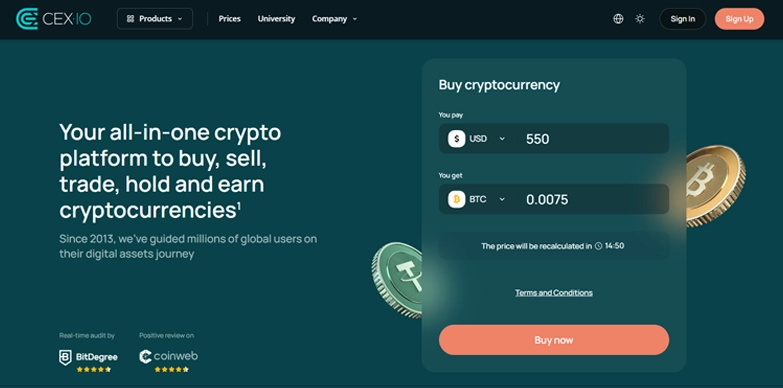
Sign up now and explore regulated crypto trading with secure fiat on‑ramps and multi‑asset access.
Is CEX.IO Legit or a Scam? (2026 Analysis)
1. Regulatory Structure
CEX.IO operates under multiple regulatory registrations rather than a single overarching financial charter.
FinCEN (U.S. MSB)
- What it is: Registration with the U.S. Treasury as a Money Services Business.
- What it allows: Operation in the U.S. with mandated Anti-Money Laundering (AML) and Know-Your-Customer (KYC) protocols.
- What it does NOT mean: It is not a securities broker (SEC-regulated) and does not offer FDIC insurance on funds.
State Money Transmitter Licenses (U.S.)
- What it is: State-level permits to transmit money and digital assets.
- What it allows: Legal transaction processing within specific states.
- What it does NOT mean: It does not equate to a federal banking charter or federal oversight.
Lithuania VASP (EU)
- What it is: Registration as a Virtual Asset Service Provider.
- What it allows: Operation of crypto exchange and custody services under EU AML frameworks.
- What it does NOT mean: It is not a bank and is not subject to bank capital requirements or supervisory standards.
2. What These Licenses Actually Mean
Users often misinterpret CEX.IO’s regulatory labels. While its MSB, MTL, and VASP registrations prove compliance with anti-money laundering laws and legitimize its operations, they do not imply bank-level supervision.
These licenses allow money transmission and crypto services but do not provide federal banking charters, SEC oversight, or mandatory Proof of Reserves. In short, CEX.IO is a legally compliant financial entity, but it is not regulated like a bank or a public company.
3. Legal Operation Scope
CEX.IO is not a global platform. The platform has imposed restrictions in Canada, Japan, Singapore, and other countries with intricate or changing cryptocurrency rules since its inception. The restrictions exist because they indicate which regulations the platform can operate under, rather than indicating any platform issues.
Exchanges operating in regions without licenses or regions with excessive compliance requirements will restrict their services. Users who plan to investigate CEX.IO in 2026 must confirm their geographic eligibility before creating an account. User-submitted CEX.IO reviews show availability limitations due to regional compliance regulations.
4. Transparency Gaps
CEX.IO’s structure indicates transparency as its essential element for achieving balanced assessment results. CEX.IO has not published any Proof of Reserves audit, which has public verifiability since 2026. CEX.IO fails to provide asset ownership information through cryptographic attestations due to a lack of shared detailed reserve information about its assets.
The collapse of major exchanges in 2022 triggered an industry-wide shift toward Proof of Reserves (PoR), where platforms publish cryptographic data to verify the client assets they hold.
As of 2026, CEX.IO has not published any PoR, leaving users without public, verifiable confirmation of its asset holdings. However, it is essential to clarify that a PoR attestation is not the same as a full financial audit; it confirms wallet ownership at a snapshot in time but does not assess liabilities or overall solvency.
While CEX.IO details its security measures, such as cold storage and encryption, the absence of PoR creates a transparency gap for users seeking to verify reserves independently. The transparency gaps between organizations do not constitute evidence of wrongdoing, but they create problems for users who need to assess exchange risks.
Clear Verdict (2026)
So, is CEX.IO legit? Since 2013, CEX.IO has operated legally by maintaining regulatory registrations and strict AML compliance across all approved regions.
Security & Asset Protection (2026)
Cold Storage Model
The company reports that CEX.IO protects 98% of its customer funds in cold storage through offline wallets. However, it does not disclose its cryptographic Proof of Reserves to the public.
Account Security Features
Two-factor authentication (2FA) is required for withdrawals, adding a security layer for account access and fund transfers. CEX.IO does not disclose its withdrawal whitelisting, anti-phishing code, and IP-based login restriction features to the public, unlike certain competing platforms. The organization established its bug bounty program in 2024 to help users report security vulnerabilities.
Security Comparison Table
This table compares CEX.IO’s security features against three leading exchanges. While CEX.IO employs industry-standard cold storage and mandatory 2FA, it lags behind competitors in implementing advanced user protections and public transparency measures.
| Feature | CEX.IO | Binance | Kraken | Coinbase |
|---|---|---|---|---|
| Cold Storage | ~98% claim | Majority offline | Majority offline | Majority offline |
| 2FA | Mandatory for withdrawals | Mandatory for withdrawals | Mandatory | Mandatory |
| Withdrawal Whitelist | Not standard | Yes | Yes | Yes |
| Anti-Phishing Code | No | Yes | Yes | Yes |
| IP Restriction | Limited | Yes | Yes | Yes |
| Public Proof of Reserves | No | Yes | Yes | Limited disclosures |
Insolvency & Custody Risk Analysis
The CEX.IO review shows that counterparty and custody risks need to be evaluated to determine whether CEX.IO operates legally. CEX.IO holds user funds in segregated accounts, but full protection in insolvency is not guaranteed. Users would become unsecured creditors in the event of a bankruptcy.
There is no known bankruptcy precedent involving CEX.IO, and no FDIC-style or comprehensive crypto insurance is publicly disclosed. Regulators have cautioned against implying coverage. All custodial crypto platforms face counterparty risk because their exchanges must fulfill obligations.
Fees Explained
The CEX.IO fee structure begins at 0.15% maker and 0.25% taker for spot trading—rates that are generally higher than Binance standard fees but lower than Coinbase retail tiers. However, the true cost lies in funding. Card deposits carry a hefty ~4.99% fee, while bank transfers vary by region and provider.
| Deposit Method | Typical Fee | Cost on $1,000 Deposit |
|---|---|---|
| Card (Debit/Credit) | ~4.99% | ~$49.90 |
| Bank Transfer (Wire/SEPA) | Varies ($10–$50) | $10–$50 |
When combined with a 0.25% taker fee (~$2.50) for buying BTC, total transaction costs on a $1,000 card deposit can range from $50 to $90.
Liquidity & Execution Quality
CEX.IO delivers enough liquidity support for retail traders, but its liquidity capacity does not reach the standards of Tier-1 exchange operations. The exchange’s 24-hour volume numbers show smaller figures than those of the worldwide leading exchanges, which results in increased slippage problems for traders making large purchases.
This review shows that the exchange operates as an appropriate platform for retail users who need fiat currency access and want to follow regulatory requirements, while institutional users who need substantial liquidity should choose bigger trading platforms.
Trading Experience
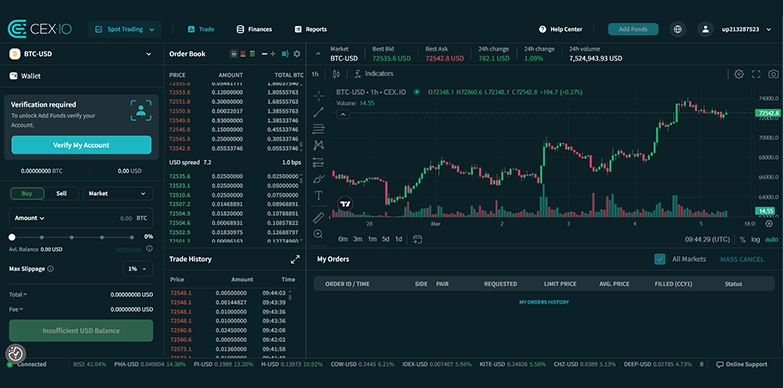
The core trading experience at CEX.IO is functional but notably limited. While it supports over 150 assets and standard market, limit, and stop-limit orders, advanced traders will find the toolkit sparse. The platform lacks chart customization tools, and critical order types like TWAP, OCO (One-Cancels-Other), or grid bots are absent—features commonly expected for sophisticated strategies.
Margin trading is available in select regions, offering 10x leverage. For example, a trader using $1,000 to control a $10,000 position faces liquidation if the position loses 10% (a $1,000 loss), wiping out their initial margin. While this mechanism is standard for leverage, it underscores the elevated risk.
Staking & Savings – Yield Risk Transparency
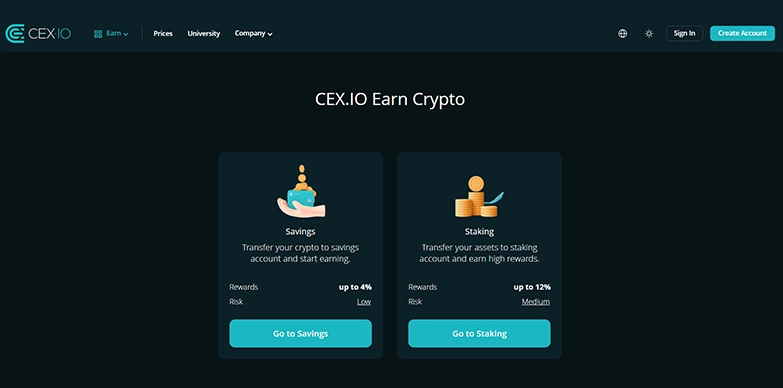
CEX.IO offers staking and savings products for passive income, with 2026 rates advertised up to 12% for ATOM, ~10% for DOT, ~5% for SOL, and ~4% for USDT. However, these rates are variable, not fixed, and subject to change.
Users must distinguish between the two products:
- On-chain staking: Requires locking assets for a set period; rewards come from network validators. This carries a slashing risk—penalties imposed by the blockchain for validator misbehavior.
- Flexible/savings: No lock-up; funds can be withdrawn anytime. Rewards come from platform lending, exposing users to counterparty risk rather than network risk.
Fiat Gateway Strength
The main characteristic of the CEX.IO exchange service is that it lets users handle fiat currencies. Users can fund accounts through credit and debit cards, ACH transfers, SEPA, SWIFT wires, and selected digital wallets such as Apple Pay or Google Pay in supported regions.
The system creates an improved experience for new users onboarding through its implementation. The system requires users to complete KYC verification through mobile application identity verification. The CEX.IO reviews the document verification process and creates onboarding problems, which assist organizations in meeting their AML compliance requirements.
CEX.IO is structured primarily as a regulated fiat gateway. The compliance process becomes challenging for users who need to protect their privacy or who want to keep their documentation requirements low.
Product Ecosystem
CEX.IO’s broader ecosystem offers a feature known as subaccounts. These let users combine their digital asset investments while keeping their trading risks separate. It also has an educational platform called University, which provides customers with fundamental and advanced cryptocurrency knowledge.
The compliance tools for the Travel Rule function, in accordance with international AML regulations, help the platform comply with evolving global AML regulations.
The CEX.IO debit card has been offered in the EEA, though onboarding has faced regulatory scrutiny, including KNF-related concerns. The organization has also established Travel Rule compliance solutions to adapt to developing international legal requirements.
CEX.IO vs Major Exchanges (2026 Comparison)
| Exchange | Best For | Regulation | Fees (Spot Base) | Proof of Reserves | Advanced Trading |
|---|---|---|---|---|---|
| CEX.IO | Regulated fiat access, retail onboarding | MSB (FinCEN), 30+ US MTLs, EU VASP | 0.15% maker / 0.25% taker | No public PoR | Margin up to 10x (restricted regions) |
| Binance | High liquidity, global altcoin access | Multiple global licenses (varies by region) | ~0.10% base | Yes | Futures, options, deep derivatives |
| Kraken | Security-focused traders | US & EU regulated entities | ~0.16% / 0.26% | Yes | Futures, margin, and advanced order types |
| Coinbase | US compliance & institutional access | US public company, multiple licenses | Higher retail spreads; Advanced ~0.4%+ | Limited transparency reports | Advanced Trade, derivatives (region-based) |
| OKX | Derivatives & global traders | Regional registrations (varies) | ~0.08%–0.10% | Yes | Extensive futures & options |
This CEX.IO exchange review shows that the platform’s greatest strength lies in its regulatory compliance. Compared with many platforms listed in our guide to the best cryptocurrency exchanges, CEX.IO focuses more on regulated fiat access and beginner-friendly onboarding rather than high-volume derivatives trading.
The platform provides less liquidity and fewer sophisticated trading features than competitors like Binance and OKX, but its fee structure at basic trading tiers can be lower than that of Coinbase. Overall, CEX.IO positions itself as a compliance-focused retail exchange rather than a derivatives-heavy trading platform like Binance or OKX.
Who Should Use CEX.IO? (2026 Assessment)
Suitable for:
The platform offers first-time crypto buyers two main advantages through its user-friendly interface and built-in payment processing. The platform enables users to access fiat on-ramp through CEX.IO’s card, ACH, SEPA, and SWIFT services.
The tools, along with their available features, meet the needs of moderate traders who engage in spot markets and use margin trading on their preferred platforms. The platform’s review discussions about the CEX.IO exchange show that users consider the onboarding process one of its main benefits.
Not ideal for:
Traders who want to trade futures or options will find no available native solution. The exchange offers only basic order types, which limit algorithmic and high-frequency trading because its liquidity is lower than that of Tier-1 exchanges. Institutional desks that need complete order book access and Proof of Reserves transparency will select larger trading venues as their optimal choice.
Pros and Cons
- Strong fiat gateway (cards, ACH, SEPA, SWIFT)
- Operating since 2013
- Licensed in 30+ US states
- Beginner‑friendly interface
- Regulated registrations (MSB, EU VASP)
- No public Proof of Reserves
- No native futures trading
- Limited advanced order types
- Some missing security features (e.g., no standard withdrawal whitelist)
- Mandatory mobile KYC verification
Our Methodology: How We Reviewed CEX.IO
This review follows the evaluation standards defined in our review methodology, which outlines how we test exchanges for regulation, security, transparency, trading functionality, and real user experience. The framework ensures each exchange review is based on consistent testing and comparable data across platforms.
1. Platform Testing
We created and verified accounts to test onboarding, KYC, deposits, trading execution, fees, mobile performance, and withdrawals. This helped confirm whether common CEX.IO review claims match actual user experience.
2. Competitive Comparison
We benchmarked CEX.IO against Binance, Kraken, Coinbase, and OKX across regulation, liquidity, Proof of Reserves transparency, order types, and fiat support to identify strengths and limitations.
3. Security & Custody Review
We evaluated publicly stated security policies, including the 98% cold storage claim, account protection features, custody structure, and the absence of public Proof of Reserves. This helps assess solvency and counterparty risk.
4. User Feedback Analysis
We analyzed user feedback to identify recurring issues such as verification delays, fiat deposit experience, customer support quality, and fee transparency across the exchange’s operating history.
Final Verdict: Is CEX.IO a Good Exchange in 2026?
- Legitimacy: Yes. Operating since 2013. Registered MSB with FinCEN. Holds multiple U.S. Money Transmitter Licenses. EU VASP registration. No major exchange-level hacks reported.
- Regulation: Moderate. Licensed as an MSB and VASP but not under bank-level or securities exchange supervision.
- Transparency: Needs improvement. No publicly verifiable Proof of Reserves. No audited financial statements.
- Best For: Retail beginners. Simple fiat access via credit card, ACH, SEPA, and SWIFT. Clear fee disclosures.
- Risk Tier: Mid-tier regulated exchange. Long operational history but transparency and regulatory depth remain limited.
Simple Trust-Tier Model
- Tier 1 (High Trust): Public audits, Proof of Reserves, strong financial disclosure, top-tier regulatory oversight.
- Tier 2 (Moderate Trust): Licensed exchange with partial transparency and regional regulation.
- Tier 3 (Higher Risk): Limited regulation, low transparency, short operating history.
Classification: CEX.IO fits Tier 2 – Moderate Trust.
The CEX.IO exchange review shows that it operates at Tier 2 or Tier 3. The company maintains significant regulatory registrations and provides strong access to fiat currencies, yet fails to disclose its financial records through public audits and does not offer cryptographic Proof of Reserves verification.
Frequently Asked Questions
Is CEX.IO Safe?
CEX.IO uses cold storage, two-factor authentication, and AML controls, but crypto market and custodial risks still apply.
Does CEX.IO Have Proof of Reserves?
CEX.IO has not published publicly verifiable Proof of Reserves audits as of 2026.
What Are CEX.IO Fees?
CEX.IO charges volume-based trading fees, spreads on instant buys, plus deposit and withdrawal fees.
Does CEX.IO Support Margin Trading?
Margin trading is available in select regions with up to 10x leverage, but is restricted in many jurisdictions.
Can US residents use CEX.IO?
CEX.IO operates in more than 30 U.S. states through money transmitter licenses, but availability depends on local regulatory approvals.
See less