

OKX Review 2026
OKX positions itself in 2026 as a global crypto‑native powerhouse — combining deep liquidity, professional‑grade derivatives, and an integrated Web3 ecosystem within a single, security‑focused platform.


In today’s market, OKX has established itself as one of the market’s leading cryptocurrency exchanges. The exchange is particularly dominant in derivatives trading and ranks among the top exchanges globally by volume. More so, OKX Exchange has niched itself for competitive trading fees, offering some of the lowest rates on the market.
When it comes to liquidity, OKX has a variety of options for both retail and institutional investors. Standing out among its competitors, OKX has evolved from its trading-only foundation into a hybrid crypto and Web3 ecosystem, as it now has an integrated Web3 wallet that allows users to interact with dApps, NFT marketplaces, and other DeFi protocols. All these features combined make it ideal for users who want to access full crypto trading functionalities while leveraging the broader blockchain ecosystem.
Key Takeaways
OKX Exchange is one of the world’s largest crypto exchanges by derivatives volume, with about $22 billion in daily transaction volume as of January 2026.
OKX offers one of the cheapest trading fees for both spot and futures, while maintaining deep liquidity across all markets. Hence, it is now the go-to platform for day-to-day crypto use.
OKX Exchange now features an integrated custom OKX wallet supporting DeFi, NFTs, and multi-chain access. Users can now interact directly with these interfaces through the OKX ecosystem.
OKX is a security-oriented exchange, as it has proof of reserves and risk control mechanisms in place. With this compliant framework, it’s among the widely used platforms among active traders based on volume and liquidity metrics in the market.
With its DeFi usabilities such as deep-liquidity dApps market, NFT integration, DeFi protocols support, and wide-variety spot trading, OKX is best suited for active traders, Web3 users, and advanced investors.
Table of Contents
OKX Exchange at a Glance
| Founded | 2017 |
| Native Token | OKB (a deflationary ecosystem token) |
| Listed Cryptos | Over 350+, including BTC, ETH, and SOL |
| Trading Pairs | Over 500+ |
| Supported Countries | US, UK, Australia, Canada, South Korea, and other Asian, European, and African countries |
| Deposit Fees | Crypto & Fiat (ACH) – Free, Credit card – 3–6% + 1.5% foreign transaction fee |
| Transaction Fees | Spot (Maker about 0.08%; Taker about 0.10%) Futures (Maker about 0.02%; Taker about 0.05%) |
| Withdrawal Fees | Crypto: Varies according to different network fees ACH (Bank): Free |
| Mobile & Desktop Apps | Supported on iOS and Android; fully-functional website |
| Customer Support | 24/7 |
| Regulation | MiCA (Europe), FinCEN (US), MPI License (Singapore), VASP Compliant |
Our Take on OKX Exchange
OKX Exchange provides a professional-grade trading environment for all traders, backed by strong global liquidity that makes smooth execution possible even during sharp price corrections. OKX’s derivatives offer perpetuals, options, and futures, and other complex tools like chart depths, risk management tools, and technical order types for advanced traders.
That being said, it is not ideal for absolute beginners as it has some complex navigation and tools. It is also restricted in certain regions due to compliance. Hence, it is better suited for globally active and experienced users.
Who OKX Is Best For & Who Should Consider Alternatives
Best For:
OKX is best suited for active and professional traders who seek a high-performance crypto environment with deep liquidity, tight spreads, and advanced execution tools. If you prefer fast-paced trade execution, you will like OKX’s robust infrastructure, which is designed to handle high volumes without sacrificing speed or reliability.
This exchange is also suitable for derivatives and options traders, as it is renowned for its deep futures, perpetuals, and options markets. This platform has provided high-volume users with detailed analytics, advanced order types, and effective risk management tools to accommodate leverage, hedging strategies, and technical market positioning, rather than the conventional buy-and-hold strategy.
OKX also ticks the box for NFT, DeFi, and Web3 users looking for a unified ecosystem. This is because OKX has integrated a custom non-custodial Web3 wallet that allows seamless interaction with dApps, cross-chain assets, NFTs, and other DeFi protocols on-chain. Hence, it suits traders who want to switch smoothly between centralized spot trading and decentralized DeFi offerings.
OKX also brings international users seeking broad market access on board with its strong global reach and support for numerous trading pairs across multiple regions. On the whole, OKX suits globally-aware crypto users who want advanced trading capabilities combined with deep Web3 functionalities all in one ecosystem.
Consider Alternatives:
If you are a newbie who wants to start investing through ultra-simple buying applications, OKX might feel too complex for you. You might want to consider alternatives like Coinbase and Bybit, which offer simple buying interfaces.
Users in the US or heavily restricted jurisdictions should also consider alternatives, as OKX’s availability and advanced features can be limited by some local regulations in the US and other regions. Hence, they might want to go for a local fully-licensed exchange instead.
Also, investors who prioritize fully regulated, fiat-heavy platforms where seamless fiat on-ramps, clear legal protections, and strict compliance are grounded may opt for options like Gemini, Coinbase, or Kraken. In essence, if your priorities are seamless fiat integration, strong local regulations, and a simple user interface, you are better off with other exchanges than OKX.
OKX Exchange Overview & Evolution
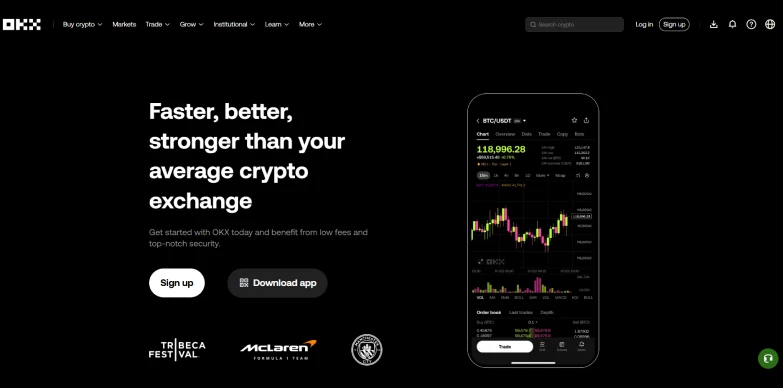
OKX Exchange began in 2017 as OKEx, a global cryptocurrency company with a strong focus on professional trading and international markets, before rebranding to OKX in 2022 as it expanded beyond traditional crypto exchange. From its early growth in Asia, the platform steadily built a worldwide presence, serving millions of users across Europe, the Middle East, and other regions.
This exchange is a major player when it comes to spot and derivative markets, particularly futures, perpetuals, and options, where it is recognized for deep liquidity and advanced trading infrastructure.
Over time, OKX also evolved into the on-chain market, recently launching a non-custodial Web3 wallet that allows users to interact with DeFi offerings like NFTs, dApps, and others without leaving the OKX ecosystem.
When compared with Binance’s scale-first approach, Coinbase’s regulation-first foundation, and Kraken’s security-led positioning, OKX is leading the market in all-round crypto usability with a strong blend of derivatives expertise and Web3 integration.
OKX has placed its ecosystem in the strategic position of building Web3 infrastructure for evolving crypto usability, supporting dApp developers, cross-chain tools, and decentralized access. The platform can support both retail and institutional crypto users, while contributing significantly to the global adoption of blockchain through scalable, open digital systems.
How to Get Started on OKX (Quick-Start Guide)
To get started on the OKX exchange, you visit the OKX website or app to create an account. Sign up using your email or phone number, then create a strong password and confirm your registration through the verification link or code that will be sent to you.
Next, you do your KYC verification, where you submit basic personal information and upload a government-issued ID. This verification usually takes minutes and sometimes hours, depending on your region and account level. You can also unlock higher withdrawals as you upgrade your account level, while gaining full access to the exchange.
To secure your account and funds, enable two-factor authentication, set up anti-phishing codes, secure your withdrawal address whitelist, and review login notifications to protect your account from hacks. You are now ready for your first trade.
You can deposit via crypto or supported fiat on-ramps, then navigate to the trading interface. You can trade spots or derivatives with your selected trading pair, while using a market or limit order depending on your trading strategy. You want to start with small amounts to build up your confidence and perfect your strategy with the built-in charts and risk management tools.
As a beginner, you particularly want to start with demo trading, review the fee structure, learn about the order types, and also learn the exchange’s interface before increasing your position or using leverage and margin rules.
Security & Trust: How Safe Is OKX Exchange?
Track Record & Custody Model
OKX’s custody model is built around strong cold storage practices and clear asset segregation to protect customer funds. OKX holds a larger portion of its users’ funds in offline cold wallets to reduce the risk of losses and hacks. It is only a small percentage that is left in hot wallets to support daily withdrawals and ecosystem liquidity.
Since OKX separates its customers’ funds from ecosystem funds, its client balances remain intact even during market shocks or internal disruptions. OKX’s ecosystem guide focuses on system resilience, real-time monitoring, and layered security controls, rather than relying on a single safeguard.
The exchange puts in place internal controls, withdrawal risk checks, and periodic infrastructure upgrades to make sure it delivers all trading and DeFi functions on time. For OKX users, it is designed to reduce custody and operational risk, though losses remain possible.
Proof of Reserves (PoR)
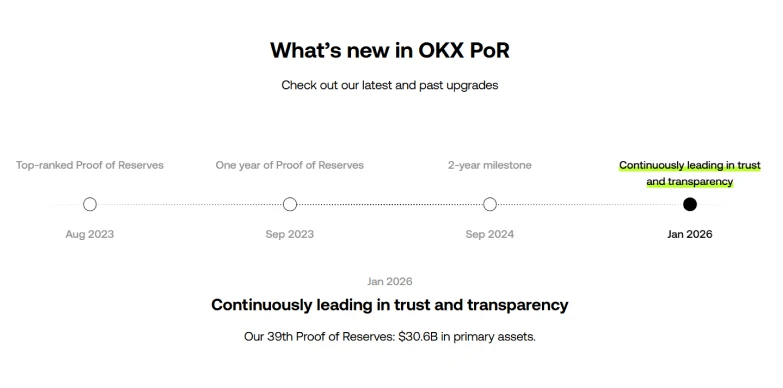
OKX Exchange uses Merkle Tree verification to provide transparent proof of reserves, allowing users to cryptographically confirm that their balances are included in the platform’s total liabilities, while still keeping their personal information anonymous.
OKX proof of reserves audits cover major assets like Bitcoin, Ethereum, and other widely held tokens, showing that in-chain reserves exceed or match customer balances. Users can verify these reserves by logging onto the OKX PoR page, after which they download the Merkle Tree hash. They can then check their individual account hash against published wallet addresses.
This model builds user trust, enables independent verification, and stamps OKX’s commitment to transparency, accountability, and responsible asset management globally.
Account Security Tools
To protect against unauthorized access and fund losses, OKX incorporates a robust set of account security tools. The exchange has both mandatory and optional two-factor authentication to protect logins, authentication, withdrawals, and all sensitive account actions, with support for app-based authenticators.
OKX also has anti-phishing codes that allow users to differentiate actual OKX emails and messages, as opposed to scam emails and social engineering attacks. It also incorporates a withdrawal whitelist by restricting transfers to pre-approved addresses only.
With its device management algorithm, users can also monitor active sessions, remove unknown devices, and receive alerts for new logins. All these systems now give users account flexibility while maintaining protection across everyday trading, long-term asset storage, and account recovery.
Compliance and Risk Considerations
With compliance, OKX works on a region-by-region licensing system. Hence, it operates under different regulatory frameworks depending on local laws and market requirements. OKX holds approvals and licenses in several jurisdictions while restricting or limiting services where regulations are unclear or restrictive. OKX has licenses such as MiCA, VASP, FinCEN, MPI, and other jurisdictional licenses.
OKX takes regulatory transparency seriously; it clearly shows limitations and communicates which products, features, or regions are unsupported. Hence, you can understand access boundaries before deciding to join the platform, as regulatory laws vary from one jurisdiction to another. We can then say that OKX is among the best crypto exchanges on the market in 2026.
One Platform, Multiple Products: The OKX Ecosystem
OKX Main Trading Platform
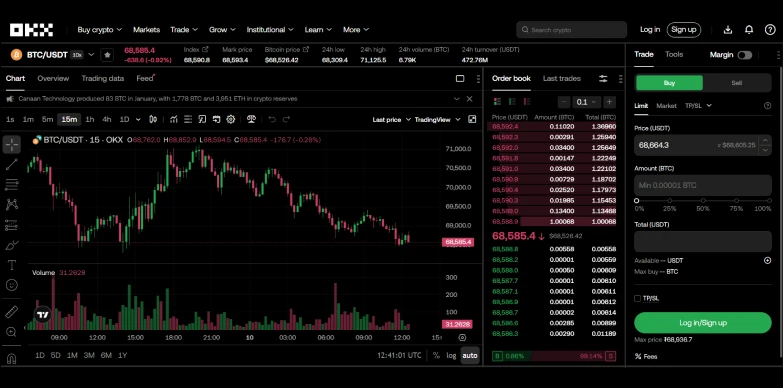
OKX’s spot and derivatives interface is optimized for performance, fast execution, deep order books, and advanced charting across both markets. More so, with a variety of trading pair options, users can spread their trades over spot and derivatives positions.
While OKX’s trading interface can be complex if you are new to crypto trading, the platform generally supports beginner-friendly views for simple spot trades, while advanced modes unlock professional tools like complex order types, leveraged controls, and detailed analytics. All these ecosystem tools provide users with adequate knowledge to eventually become adept in the trading environment.
OKX Wallet (Web3 & Self-Custody)
OKX wallet is a non-custodial, self-custody Web3 wallet, as users fully control their private keys and on-chain assets. This wallet supports a wide range of blockchains and networks, including Solana, Bitcoin, Ethereum, Polygoin, and multiple layer-2 chains.
Also, through its integrated Web3 wallet, users can access NFT marketplaces, DeFi protocols, and other decentralized assets directly without leaving the website or app. In essence, OKX is a unified gateway for on-chain activities of all kinds.
OKX Earn & On-Chain Products
OKX separates its CeFi Earn and DeFi Earn offerings to clarify custody and risks. Its centralized finance (CeFi) Earn products are managed by its ecosystem itself, with yields coming from platform-based activities and carrying counterpart risks.
Through its decentralized finance (DeFi) Earn products, on the other hand, it connects users directly to on-chain protocols through its integrated Web3 wallet. Here, users retain custody but face smart contract and protocol risks. With the differences clearly disclosed, OKX emphasizes that returns are not guaranteed and users may lose funds depending on market conditions and technical vulnerabilities.
OKX Jumpstart & Launchpad
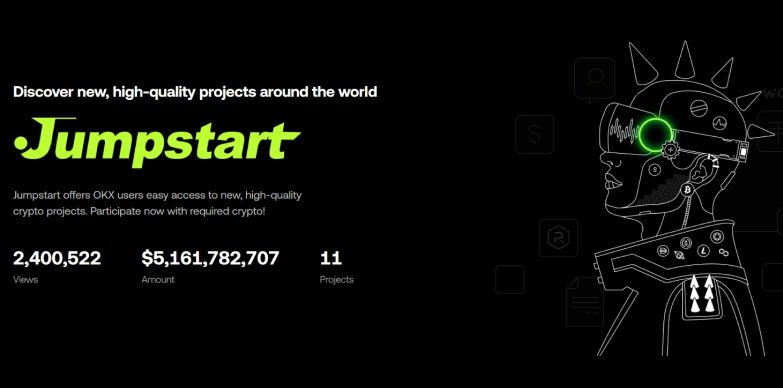
OKX token launch mechanics typically involve curated sales or subscription-based models where users commit assets during a fixed window and receive allocations based on rules such as caps, holding requirements, or lottery weighting. But it is also important to note that some launches use staking or snapshot methods to reward participants.
Historically, performance has been mixed— some tokens see strong early momentum, while others retrace quickly after listing. Most times, this depends on the ecosystem use case, community hype, and general online presence.
Risks associated with these launches include uncertainty over allocations, limited liquidity, post-listing volatility, and lockups. Since it is already disclosed that participation does not guarantee profit, and that new tokens carry higher risks, investors should research teams, tokenomics, timelines, and disclosures carefully.
Asset Coverage & Market Access
Cryptocurrency Markets
OKX supports over 350+ cryptocurrencies, covering major assets like Bitcoin, Ethereum, Solana, and a wide range of altcoins and new DeFi tokens. This exchange is also known for its deep liquidity, especially across major trading pairs like BTC/USDT, ETH/USDT, and major derivatives markets to ensure tight spreads and reliable execution. This combination of broad asset support and strong liquidity makes OKX good for both high-volume traders and users seeking diverse market options.
Stablecoins & Fiat Access
OKX supports multiple fiat on-ramps through third-party payment providers, allowing users to buy crypto using bank transfers, cards, and local payment methods, depending on the region. Fiats supported include USD, CYN, EUR, AUD, GBP, and other currencies.
However, with OKX, there is a stronger Fiat support in parts of Europe, Asia, and other emerging economies, while access is limited or unavailable in some heavily regulated jurisdictions like the U.S.
When it comes to regional availability, OKX is global but applies country-specific restrictions on individual accounts and features to comply with local regulations. Hence, OKX is suited to users who understand the legal crypto requirements of their particular jurisdiction.
NFTs & On-Chain Assets
With its NFT marketplace, OKX users get access to high-performing NFTs pulled from major marketplaces into a single interface. Users can now compare prices, discover collections, and trade NFTs more efficiently without switching between markets.
Also, OKX provides strong cross-chain trading support, allowing users to interact with NFTs and assets across several blockchains and networks. This multi-chain approach reduces friction, improves liquidity access, and makes the platform especially appealing to users who actively move between ecosystems rather than staying locked into one chain.
Derivatives, Futures & Options Trading
OKX Exchange is renowned for its perpetual futures markets, offering deep liquidity, tight spreads, and a wide range of contracts tied to major and emerging crypto assets. These perpetual options support both long and short positions with flexible margin modes. With options trading, users can hedge volatility or express directional views through calls and puts, supported by professional-grade analytics and Greeks.
One thing you should also note is that leverage on OKX varies according to jurisdiction, with stricter caps applied in more regulated regions to comply with local laws. To manage risks, the exchange has included a robust margin control system, auto-deleveraging mechanisms, liquidation buffers, and real-time risk indicators. All these help traders to monitor risk exposures and manage positions carefully.
Fees & Pricing Structure
Spot Trading Fees
OKX uses a maker-taker fees model, where market makers who add liquidity to the ecosystem generally pay lower fees while takers who remove the liquidity pay higher fees. Hence, the ecosystem now has deeper order books and tighter spreads.
Traders can further reduce costs through OKB-based discounts, with fee levels improving based on OKB holdings and trading volume. So, if you are an active, high-frequency trader, OKX will charge you lower marginal fees with consistent liquidity benefits.
Futures & Options Fees
OKX’s derivatives fee levels are structured in such a way that traders with higher 30-day volume or larger OKB holdings receive lower fees on futures and perpetuals. This tired maker-taker model rewards active derivatives traders with meaningful cost savings as they level up.
Compared with major competitors, OKX offers competitive derivative fees just like Binance, as opposed to Coinbase, which does not use volume-based tiering. Kraken’s fees are quite affordable too, but OKX’s combination of tier depth and OKB-linked discounts frequently results in more aggressive pricing for high-volume users.
Deposits & Withdrawal Fees
OKX’s Fiat vs crypto costs differ based on how you fund and move assets. Buying crypto with Fiat basically involves third-party payment providers and comes with on-ramp fees that may vary by region and transfer method (bank transfer, card, etc.), attracting higher fees than crypto-to-crypto trades. However, once on the platform, crypto-to-crypto trading costs are generally more competitive —especially with tiered maker-taker pricing and OKB-linked discounts.
On the other hand, network fees are like gas fees paid whenever the asset moves from one account to another, for instance, bridging funds between networks. Network fees vary by the network load and underlying consensus mechanism; hence, they can fluctuate differently from the platform’s flat fees. OKX will usually show you the charges for both fees so you can guard your transaction expenses before trading or transferring assets.
Staking, Earn & Passive Income
OKX Exchange offers varying assets for staking. You can choose from the popular tokens, such as ADA, SOL, and ETH, or from other altcoins according to your particular staking needs and ecosystem suitability.
There are fixed assets and flexible assets on the staking board. With the fixed ones, your assets are locked over a period of time to compound profits, while the flexible option allows withdrawals at any time but with variable rewards.
When it comes to APY yielding, it fluctuates according to the asset hype and market conditions. Even though OKX charges commissions on these options before paying out, always note that it is a competitive option that is not guaranteed.
Just as it is with every yield product, OKX earns that users risk liquidity slumps that can plummet asset value. Hence, before signing up for this investment mode, users are urged to evaluate protocol security, lock-up durations, and asset volatility.
User Experience & Platform Usability
Both the mobile app and web interface deliver a high-quality user experience. However, both are clearly designed with different users in mind— the web platform offers expansive dashboards, advanced charting, and deep market tools that advanced traders love, while the mobile app is more of an on-the-go experience.
For beginners, OKX can be challenging to navigate at times because of the advanced tools. But over time, the simple UI and educational prompts help users get familiar. For professional traders, OKX includes powerful features such as customizable layouts, advanced order types, granular risk management, derivatives and options interfaces, and real-time depth data both on web and mobile.
Customer Support & Reliability
For reliability, OKX has multiple support channels, including in-app live chat, email support, and a comprehensive help center with guides and FAQs. While support is generally responsive, response time and reputation may vary due to network congestion, region restrictions, and the complexity of the issue.
When it comes to platform stability, OKX has maintained a strong record of uptime and reliability, even during sharp market volatility that affects the whole market. Though no ecosystem is immune to delays and network disruptions, IKX carries out periodic infrastructure maintenance to ensure major outages are rare.
Pros and Cons
- Renowned among OKX’s pros are its deep liquidity and low fees, which help ensure tight spreads and cost-efficient trading, especially for high-volume spots and derivatives activity. Also, its derivatives suite is renowned in the market for robust perpetuals, futures, and options markets backed by advanced order types and risk tools.
- Additionally, OKX features an integrated Web3 wallet that gives users seamless access to DeFi apps, NFTs, and other dApps on-chain. This feature particularly appeals to both advanced traders and web3 enthusiasts.
- Certain countries face restricted access or reduced feature availability due to compliance requirements. This has caused OKX to be more beneficial in certain regions than others. Also, the platform’s advanced tools and layout can sometimes feel too complex for newbies, and it might take some effort and time to get familiar with its use cases.
- For OKX, Fiat on-ramps and payment options are less extensive than those of exchanges focused on the US market. Hence, some users find it hard to fund their accounts due to limited fiat support.
OKX Vs Competitors
| Metric | OKX Exchange | Kraken Exchange | Coinbase Exchange |
|---|---|---|---|
| Fees | Competitive tiered fees with OKB discounts Especially great for derivatives |
Moderate fees with a simple and easy structure | Higher fees, especially on its basic buy interface |
| Regulation | Region-based; not uniformly regulated | Strong Compliance focus | US-Centric (Highly regulated) |
| Features | Integrated Web3 wallet Deep spots and derivatives options |
Solid security OTC Offerings Futures trading |
Limited advanced tools Basic trading Simple UI |
| Target Users | Web3 users and Active professional traders | Security-first traders | Beginners and regulated fiat users |
Our Methodology: How We Reviewed OKX Exchange
In our OKX crypto exchange review, we employ a custom methodology that starts with platform testing, where reviewers open accounts, navigate the web and mobile interfaces, and execute spot and derivative trades. All these are done while the reviewers are evaluating execution speed, order reliability, and system stability during different market conditions.
We then do a fee comparison, which involves analyzing OKX’s maker-taker structure, derivatives pricing, OKB discounts, and withdrawal costs. We then compare them against those of major competitors to ascertain cost efficiency.
A security assessment is then done, focusing on cold storage practices, proof-of-reserves reporting, account protection tools like 2FA, withdrawal whitelists, and the exchange’s overall risk management framework.
To round off, we then do a user experience evaluation to check interface design, simplicity for new users, quality of educational resources, and customer service responsiveness. Altogether, our review methodology produces a balanced view of OKX’s performance, safety, and suitability for different types of crypto users.
Final Verdict
OKX’s long-term remains positive as it continues expanding both centralized trading and decentralized services, strengthening its derivatives leadership while growing its Web3 ecosystem through multi-chain support and integrated wallets.
In the current market, OKX exchange stands out for its robust derivatives suite, deep liquidity, competitive fees, and seamless DeFi integration through its Web3 wallet.
For traders and Web3 enthusiasts, it offers professional-grade markets and on-chain markets, but it is important to balance opportunities with awareness of regulatory variability and learning curves for beginners.
Overall, OKX is a solid choice for professional users who value expert tools and ecosystem width, while users who favor fiat-centric and simple buy-sell exchanges might want to go for a beginner-focused and trading-first platform.
OKX Exchange Review: FAQs
Is OKX safe to use in 2026?
Yes! OKX is considered safe and secure with strong regulatory compliance models. The platform is also licensed in major jurisdictions for legal crypto trade.
Is OKX legal in my country?
To find this out, you just have to check your local crypto laws to be sure compliance requirements have been met by OKX in your country.
What are OKX trading fees compared to Binance and Kraken?
Compared to Binance and Kraken, OKX offers competitive fees depending on the user level, trade frequency, and OKB holdings. Though Binance can be generally cheaper, OKX is way cheaper if OKB holdings are particularly high.
Does OKX support futures and options trading?
Yes. OKX offers futures and options trading in its derivatives market, popularly known for its deep liquidity.
Is OKX suitable for beginners?
Yes, in the long run, beginners can get a hang of the platform’s functionalities through its educational resources. However, at first, the platform’s interface might seem complex for beginners.
What is the OKX wallet, and is it non-custodial?
OKX is a multi-chain cryptocurrency wallet. Yes, it is a non-custodial wallet, as it gives users full control over their assets and private keys.
Does OKX offer staking and passive income?
Yes! OKX offers extensive staking and earning options for passive income with flexible savings and fixed-term deposits.
How long do OKX withdrawals take?
It depends on the withdrawal method. Crypto withdrawals take anywhere from minutes to hours. For wire deposits, they take between 3 and 5 business days.
Does OKX have a native token?
Yes, OKX has a native token called OKB. This is the utility token of the exchange, as it is the token used to payout benefits and ecosystem rewards.
See less
