
Poloniex Review 2026
An in-depth, risk-aware Poloniex exchange review focused on fees, security, and suitability for altcoin and futures traders in 2026.


When a cryptocurrency exchange loses $126 million to hackers and pays back every single user, that’s worth noting. After Poloniex survived its November 2023 security breach, the platform has since restored withdrawals, pledged reimbursements, and emphasized upgraded safeguards.
Now in 2026, Poloniex has carved out a clear niche as a crypto-only exchange built for altcoin trading, derivatives, and lower-fee structures tied to the TRON ecosystem.
This Poloniex review is particularly useful for crypto-native traders, altcoin traders, and futures traders comfortable with leverage risk. It may not suit fiat users who rely on bank transfers or card payments, complete beginners, or U.S. residents.
Key Takeaways
Poloniex is best suited for experienced altcoin traders who prioritise low fees and access to lesser-known tokens.
Spot trading fees can drop to around 0.08% when holding TRX, making it cheaper than many major exchanges.
Basic trading is possible without mandatory KYC, though higher limits and derivatives require verification.
Security has improved since the 2023 hack, with restored withdrawals, reimbursements, and enhanced safeguards.
No fiat deposits or withdrawals — Poloniex remains a crypto-only exchange.
Not available to U.S. users, limiting global accessibility compared to regulated platforms.
Table of Contents
- Poloniex Overview
- Poloniex Safety, Security & 2023 Hack Explained
- Fees Breakdown: Spot, Futures, Lending & Withdrawals
- Supported Cryptocurrencies, Liquidity & Markets
- Trading Features: Spot, Margin & 100x Futures
- Deposits, Withdrawals, KYC & Fiat Limitations
- Pros, Cons & Poloniex vs Top Exchanges
- Final Verdict & FAQs
Poloniex at a Glance
| Founded | 2014 |
| Native Token | None (Supports TRON TRX ecosystem) |
| Listed Cryptos | 400+ (varies by region) |
| Trading Pairs | 500+ |
| Supported Countries | 100+ (excluding US, China, sanctioned regions) |
| Deposit Fees | Free (crypto only) |
| Transaction Fees | 0.020%-0.145% / 0.100-0.155% spot; 0.01%-0.075% futures |
| Withdrawal Fees | Network-dependent |
| Mobile & Desktop Apps | Web, Android, iOS |
| Customer Support | Email, ticket system, live chat |
| Regulation | Seychelles registration (unregulated) |
What Is Poloniex?
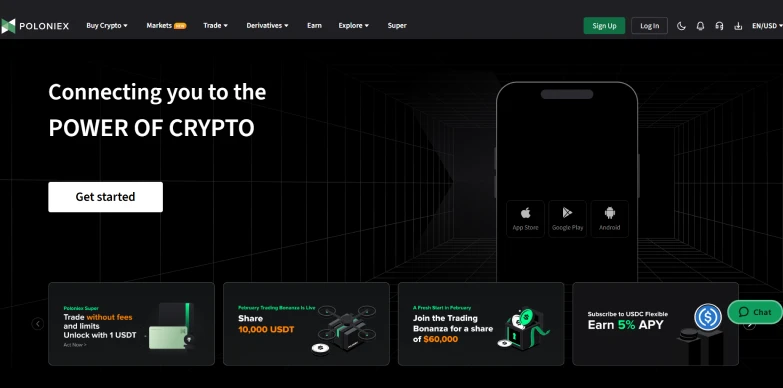
Poloniex is a centralized crypto exchange that operates as a custodial trading platform where users deposit digital assets and execute trades through spot markets, perpetual futures contracts, margin positions, and peer-to-peer lending services.
Unlike most broker-style exchanges that integrate fiat gateways and target retail onboarding, Poloniex maintains a crypto-native structure. This distinction is important because exchanges that support fiat typically operate under more visible regulatory frameworks.
Poloniex, by contrast, focuses on trading functionality instead of fiat conversion services. That positioning places it closer to derivatives-oriented exchanges than beginner-focused retail platforms.
The platform centers on spot trading, USDT-margined perpetual futures, lending, and early listings of emerging tokens.
Poloniex History, Ownership & Evolution
Poloniex is a centralized crypto exchange that operates as a custodial trading platform where users deposit digital assets and execute trades through spot markets, perpetual futures contracts, margin positions, and peer-to-peer lending services.
Unlike most broker-style exchanges that integrate fiat gateways and target retail onboarding, Poloniex maintains a crypto-native structure. This distinction is important because exchanges that support fiat typically operate under more visible regulatory frameworks.
Poloniex, by contrast, focuses on trading functionality instead of fiat conversion services. That positioning places it closer to derivatives-oriented exchanges than beginner-focused retail platforms.
The platform centers on spot trading, USDT-margined perpetual futures, lending, and early listings of emerging tokens.
Security Infrastructure
Poloniex uses standard exchange security practices. The majority of user funds are kept in cold storage wallets to reduce exposure to online attacks. Only the minimum necessary amounts are kept in hot wallets for daily operations.
Account-level protections include two-factor authentication, anti-phishing codes, email withdrawal confirmations, and IP whitelisting. The platform maintains DDoS protection and monitors for suspicious activity patterns.
The 2023 Hack: What Happened & What Changed
On November 10, 2023, blockchain security firms detected massive unauthorized withdrawals from Poloniex’s hot wallets. Over one hour, attackers drained $126 million across 357 transactions from a single wallet.
Poloniex suspended all withdrawals immediately after detecting the breach. Third-party security audits were commissioned, and withdrawals resumed on November 30, three weeks after the incident. The exchange assured users that trading operations remained unaffected and that all customer funds would be reimbursed.
Since the hack, the exchange has made improvements through enhanced cold storage procedures, additional multi-signature requirements, and improved monitoring systems.
Proof of Reserves & Transparency
Following the hack, Poloniex implemented monthly Proof of Reserves using Merkle tree cryptographic proofs. This allowed users to verify that their account balances are included in published reserves.
Proof of Reserves confirms the exchange holds sufficient assets, but doesn’t prove the absence of hidden liabilities or prevent future mismanagement.
Regulatory Status
Poloniex operates as an unregulated exchange registered in Seychelles without oversight from major financial authorities like the SEC or FCA. This positioning is intentional, allowing it to offer services that would be restricted under compliance frameworks.
Following its 2019 spinoff from Circle, Poloniex ceased all U.S. operations to avoid ongoing regulatory compliance costs and potential enforcement actions.
Operating without major regulatory oversight means there’s no government-backed investor protection, no deposit insurance, and no regulatory complaint mechanisms for disputes.
Getting Started on Poloniex (Step-by-Step)
Account Registration
Creating an account requires only an email and a password. You can visit poloniex.com, click “Sign Up,” enter your email, create a password, and then verify via email code.
Use a unique password and consider a password manager. Enable two-factor authentication on your email address for extra security.
If you have a referral code, enter it during registration to receive a 10% fees discount.
KYC Levels Explained
Poloniex uses a tiered account system with different features and limits based on verification level.
Level 1 (Email Verification Only):
- $10,000 daily withdrawal limit
- Full spot trading access to all listed pairs
- No margin trading access
- No fiat purchases via third-party providers
- Limited account recovery options if access is lost
Level 2 (Full KYC Verification):
- $500,000 daily withdrawal limit
- All Level 1 features plus margin trading
- Fiat purchase access via Simplex and Mercuryo
- Priority customer support with faster response times
For most traders who want basic spot or futures trading with moderate position sizes, Level 1 should be enough. However, anyone wanting margin trading features or planning to move large amounts must complete full KYC.
Account Security Setup
After registration, immediately enable two-factor authentication before depositing any funds. We recommend using Google Authenticator over SMS-based 2FA.
Set up an anti-phishing code. This unique code appears in all legitimate emails from Poloniex, allowing you to identify phishing attempts.
For maximum security, enable withdrawal address whitelisting. This feature requires you to pre-approve specific wallet addresses for withdrawals. Any withdrawal to an address not on your whitelist will be automatically blocked.
Poloniex Platform Interface & User Experience

The Poloniex web platform uses a traditional exchange interface optimized more for spot and margin trading. The layout features a price chart, order books showing buy and sell orders, and order entry fields.
The platform integrates TradingView’s charting engine, providing professional-grade technical analysis tools. Traders can access dozens of technical indicators such as RSI, MACD, and custom indicators.
The order book displays real-time buy and sell orders with depth visualization showing market liquidity at various price levels. The interface also shows recent trades, allowing traders to gauge market momentum and order flow.
Mobile App Experience
Poloniex offers native mobile apps for iOS and Android devices with almost identical features to the desktop platform.
The main limitation of the mobile version is the screen size. Detailed technical analysis and simultaneous order-book monitoring get more challenging on smartphone screens.
Poloniex’s interface design clearly favors intermediate to advanced traders. The platform doesn’t offer guided tutorials, simplified trading modes for beginners, or extensive educational content explaining how to use different features.
Supported Cryptocurrencies & Markets
Poloniex supports over 400 cryptocurrencies with more than 500 trading pairs. The exchange heavily focuses on altcoins, often listing tokens much earlier than major competitors.
Most trading pairs are denominated in USDT (Tether), which makes up the majority of trading volume. The platform supports stablecoins like USDC, DAI, and USDD (TRON’s algorithmic stablecoin). It also supports crypto-cross pairs like ETH/BTC and various altcoin/TRX pairs, reflecting its alignment with TRON’s ecosystem.
Liquidity varies across pairs. Major pairs like BTC/USDT and ETH/USDT maintain deep liquidity comparable to tier-2 exchanges with tight spreads. Many altcoin pairs still suffer from wide spreads, low trading volume, and high slippage risk for larger orders.
Comparison Snapshot
Compared to competitors, Poloniex lists a similar number of tokens to Bybit (over 450 tokens) but fewer than Binance (over 500 tokens and 1500 trading pairs).
Trading Features on Poloniex
Spot Trading
Poloniex spot trading allows users to buy and sell crypto for immediate settlement at current market prices. The platform supports market orders executed instantly at the current price, limit orders, and stop-limit orders.
Major pairs like BTC/USDT and ETH/USDT typically maintain spreads under 0.1% with adequate order book depth for orders up to several hundred thousand dollars. Altcoin pairs often show wider spreads ranging from 0.5% to 2% or more.
Margin Trading
Poloniex offers cross-margin trading with up to 3x leverage on major assets, including BTC, ETH, TRX, and select altcoins. Margin trading allows users to borrow funds to increase position sizes.
Users must maintain sufficient collateral in their margin account. If the account balance falls below the maintenance margin requirement, positions may be automatically liquidated.
Poloniex charges interest on borrowed funds calculated hourly based on prevailing market rates. Currently, BTC and ETH charges 3.65% annually.
Futures & Perpetual Contracts
Poloniex futures markets support USDT-margined perpetual contracts with leverage up to 100x on pairs including BTC/USDT, ETH/USDT, and XRP/USDT.
The futures platform uses a maker-rebate model where liquidity providers (makers) actually receive a small rebate. This structure incentivizes limit orders that add liquidity.

Risk Disclaimer: Futures trading with high leverage is extremely risky and statistically unsuitable for most traders. The majority of retail traders lose money trading leveraged derivatives.
Risk Disclaimer: Futures trading with high leverage is extremely risky and statistically unsuitable for most traders. The majority of retail traders lose money trading leveraged derivatives.
Poloniex Fees & Trading Costs
Spot Trading Fees
Poloniex uses a maker-taker fee model with tiered pricing based on your 30-day trading volume and TRX or HTX token holdings.
Base rates for users with zero trading volume and no TRX holdings are 0.2% for both maker and taker orders. Accounts holding TRX or HTX tokens receive a 30% discount.
Volume-based tiers further reduce costs for active traders. Users who trade $10,000 in 30-day volume pay 0.115% maker and 0.1250% taker, and 0.0140%/0.0450% for $500,000 volume.
Futures Fees
Poloniex futures fees operate on standard rates of 0.01% maker and 0.075% taker for all users, regardless of trading volume or TRX balance. Opening a $10,000 futures position with a market order costs $5 in fees. Using a limit order that gets filled earns you $1.50 as a rebate credited to your account.
Poloniex’s futures fees are slightly higher than exchanges like Binance (0.02% maker, 0.05% taker) but lower than some alternatives.
Lending Fees
Poloniex takes 15% of all interest earned through its P2P lending market. If you lend USDT at 10% APR, you net 8.5%. Lending carries real risk as extreme volatility can cause borrower defaults if collateral drops below the loan value before liquidation.
Deposit & Withdrawal Fees
All cryptocurrency deposits to Poloniex are completely free. When making withdrawals, fees vary per asset and can change due to network congestion or other factors.
Withdrawals typically process within 4 hours, though Poloniex has stated that withdrawals may require manual review, extending to 24 hours for better security.
Deposits, Withdrawals & Fiat Limitations
Poloniex operates as a crypto-native platform without fiat deposit or withdrawal. You cannot send fiat currencies directly to Poloniex via bank transfer, wire transfer, or ACH.
Users can deposit any of the more than 400 cryptocurrencies listed on Poloniex, including stablecoins like USDT and USDC, along with BTC, ETH, and TRX.
Higher withdrawal limits require identity verification.
- Level 1: $10,000 daily ($50,000 with 2FA)
- Level 2: $500,000 daily ($1M with 2FA)
Third-Party Fiat On-Ramps
Poloniex does not offer any native fiat-to-crypto on-ramp. Instead, it partners with third-party payment processors Simplex and Mercuryo to enable cryptocurrency purchases using credit and debit cards. These integrations let users buy a limited selection of crypto with fiat currency.
Poloniex Earn, Lending & Passive Income
Poloniex offers a Peer-to-peer lending market where users lend crypto to margin traders for interest. Lenders specify the asset, amount, duration (2-60 days), and annual interest rate. Borrowers opening margin positions automatically match with the best offers.
Lending supports over 100 assets, including BTC, USDT, and TRX. USDT lending is particularly popular since lenders earn interest without exposure to price volatility. Typical yields are around 0.01%-1% APY for BTC and 2%-10% for USDT.
Risk Factors
Borrower default risk exists if extreme volatility causes collateral value to drop below the loan value before liquidation. Lending volatility exposes you to price risk because the principal value in USD can decline despite earning interest.
Poloniex API, Bots & Advanced Tools
Poloniex provides REST API and WebSocket feeds for algorithmic traders. Developers can place orders, manage margin positions, retrieve historical data, and monitor balances.
The platform integrates with third-party bots, including 3Commas, Cryptohopper, and TradingView strategy alerts. Native grid trading bots automate buy-low-sell-high strategies across predefined price ranges.
API requests are rate-limited to prevent abuse, with limits varying by endpoint and VIP tier. During extreme volatility, response times can be reduced, and execution may lag.
Customer Support & Community Feedback
Poloniex offers customer support through a ticket-based system, direct email support, live chat, and a help center with articles covering common questions.
User reviews show clear variation in response times. Simple inquiries through live chat typically receive responses within a few hours. Ticket resolution ranges from 24 hours for straightforward issues to several weeks for complex problems.
Common complaints from users based on reviews and Reddit discussions include slow responses and generic or template responses that don’t address specific problems.
Poloniex keeps an active social media presence on X (Twitter) and Telegram. The official Telegram channel provides announcements for new token listings, system maintenance, and trading events.
Trustpilot gives a 1.3/5 rating, and about 63% of the reviews are 1-star, with regular complaints about frozen accounts, withdrawal delays, poor customer support, and suspected price manipulation. Positive reviews (15% at 4-5 stars) cite low fees, great altcoin selection, and successful trading experiences.
Poloniex vs Top Crypto Exchanges (2026 Comparison)
| Feature | Poloniex | Binance | Coinbase | Kraken |
|---|---|---|---|---|
| Spot Trading Fees | 0.14-0.2% | 0.1% | 0.4-0.6% | 0.16-0.26% |
| Listed Cryptocurrencies | 400+ | 500+ | 200+ | 500+ |
| Futures Leverage | Up to 100x | Up to 125x | Up to 50x | Up to 50x |
| KYC Requirement | Optional ($10K limit) | Mandatory | Mandatory | Mandatory |
| Native Fiat Support | No | Yes | Yes | Yes |
| US User Access | No | No | Yes | Yes |
Where Poloniex Wins
Poloniex takes the edge in altcoin variety, low trading fees, no-KYC access, and 100x futures leverage for experienced traders.
Where It Loses
Poloniex falls short due to its lack of native fiat support, limited beginner resources, and unregulated status without investor protections.
Poloniex may suit traders prioritizing token diversity and fee efficiency, while larger exchanges offer deeper liquidity and more comprehensive compliance frameworks.
For more exchange comparisons across different use cases, check our list of the best crypto exchanges.
Pros and Cons
- Ultra-low fees for holding TRON ecosystem tokens in your account.
- Strong altcoin coverage, including numerous early-stage projects, meme coins, and niche tokens.
- High futures leverage up to 100x on perpetual contracts
- No mandatory KYC for basic trading.
- History of security incidents involving the November 2023 hack and the 2014 breach.
- No native fiat deposits or withdrawals.
- Slow customer support.
- Not available for US users.
Who Should Use Poloniex (And Who Shouldn't)
Poloniex works best for experienced traders who already know their way around crypto exchanges. The platform is suited for experienced altcoin traders seeking tokens unavailable on other exchanges, privacy-conscious users, TRX holders, or traders who want access to high-leverage futures.
That said, the platform may be the wrong choice for beginners, U.S. residents, and traders who regularly convert between crypto and fiat. Poloniex works for traders who can tolerate higher risk in exchange for Poloniex-specific benefits.
Our Methodology: How We Reviewed Poloniex
This Poloniex exchange review is based on hands-on testing and research across the platform’s Level 1 and Level 2 accounts to experience the full range of features available.
We executed spot and futures trades across select trading pairs, comparing fees and features with other exchanges to assess speed, slippage, and reliability.
Our evaluation of the platform’s security involved a detailed examination of previous hacks, reviewing official statements, blockchain transaction data, and subsequent infrastructure improvements.
We analyzed multiple user reviews on Trustpilot, Reddit discussions, and social media feedback to identify user sentiment.
For detailed information about CryptoNewZ’s evaluation process and testing standards, visit our review methodology page.
Final Verdict: Is Poloniex Worth Using in 2026?
In 2026, Poloniex focused on altcoin coverage, derivatives access, and cost efficiency. It’s not for everyone, but it excels at what it attempts to do.
The platform offers a deep selection of tokens, competitive fees as low as 0.05% for high-volume traders, and optional KYC, allowing $10,000 daily withdrawals with just email verification.
Using Poloniex also means accepting risks. Operating without major regulatory oversight eliminates user protection standards. Customer support quality remains a problem based on consistent user feedback. The complete absence of native fiat support creates friction for users who don’t already own crypto.
Poloniex makes the most sense for experienced traders whose specific needs align with the platform’s strengths and consciously accept the security and regulatory tradeoffs involved. For most crypto users, especially beginners, there are more suitable alternatives that offer a better balance between accessibility, security, and regulatory compliance.
Treat Poloniex as a specialized trading tool, not a comprehensive solution. Use it for its strengths while maintaining primary accounts at regulated exchanges for fiat conversion and secure long-term storage.
Frequently Asked Questions
Is Poloniex safe after the hack?
Security improved post-hack with enhanced procedures and Proof of Reserves. Poloniex implemented additional safeguards after the incident, though it remains less regulated than major licensed exchanges.
Does Poloniex require KYC?
Poloniex does not require KYC for basic use. Level 1 accounts require only an email and allow $10,000 daily withdrawals. Level 2 accounts require full KYC to access higher limits and margin trading.
Can beginners use Poloniex?
Poloniex isn’t recommended for beginners. The advanced futures trading and technical analysis features may be complex for beginners. The platform also doesn’t offer beginner-friendly onboarding guides.
Does Poloniex support fiat?
No, Poloniex does not support fiat. The platform operates exclusively with crypto deposits and withdrawals.
How long do Poloniex withdrawals take?
Most Poloniex crypto withdrawals are processed within 4 hours under normal network conditions. However, delays may occur due to security checks or blockchain congestion.
Is Poloniex available in the U.S.?
No, Poloniex is not available to U.S. residents. The exchange exited the U.S. market in 2019 and restricts access to users located in the United States.
See less