




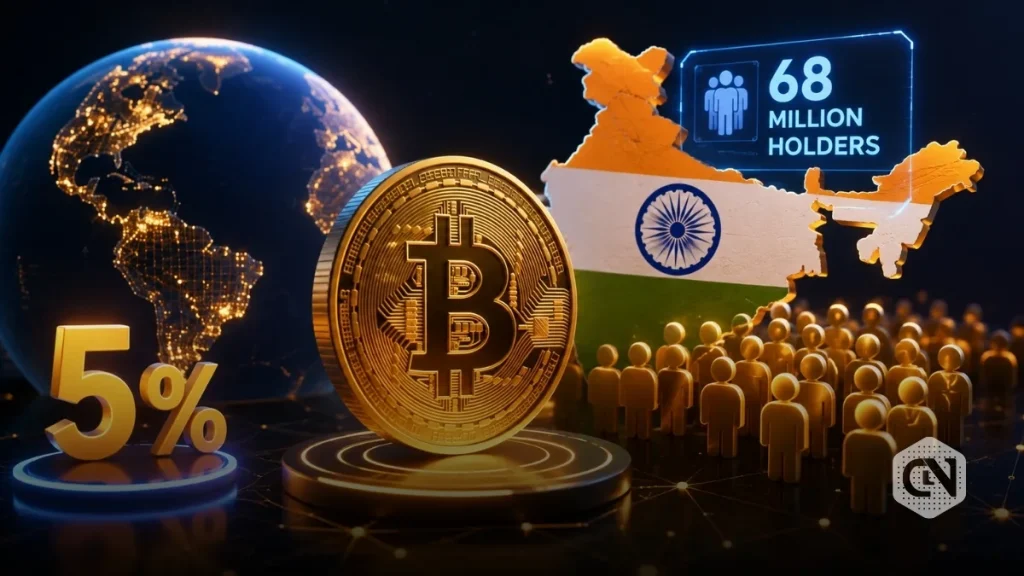
Bitcoin’s estimated global ownership has reached roughly 5% of the world’s population, according to figures shared by on-chain analyst Willy Woo on social media platform X today, September 1, 2026. India accounts for an estimated 68 million of these holders, giving it the largest number of Bitcoin owners in Woo’s country-level table despite an ownership rate of 4.6%.
The figures place Bitcoin’s estimated population penetration in a similar range to Woo’s estimates for gold and S&P 500 ownership. However, the comparisons are based on different datasets and definitions of ownership, so they do not provide a direct measure of how the assets compare as investments. The estimates have emerged at a time when India is reviewing its approach toward virtual digital assets, with a parliamentary hearing on the subject recently cancelled without a replacement date announced.
Bitcoin Adoption Estimates Show A Wide Gap Between Countries
Woo’s latest country-level figures put global Bitcoin (BTC) adoption at approximately 4.5% to 6%, with an estimated 370 million to 500 million holders. Woo’s BTC ownership post on X presents the figures by country, showing how population size can produce a large difference between ownership rates and the estimated number of holders. WooCharts’ Bitcoin Total Users page provides the historical data and methodology Woo has referenced for tracking adoption over time.
India is estimated to have a 4.6% BTC ownership rate, translating to about 68 million holders. This number puts it ahead of the United States, which is shown with roughly 50 million holders, while China is estimated at 33 million. Vietnam has a much higher ownership rate of 17%, but its smaller population results in an estimated 17 million holders. The Crypto Times’ analysis of Woo’s table notes that India ranks first by estimated number of holders but much lower when countries are ranked by ownership percentage.
The figures should be treated as estimates rather than a direct count of individual Bitcoin owners. Woo’s historical chart draws on different studies and datasets across periods, while more recent figures involve projections. This makes the overall adoption curve useful for assessing the scale and direction of ownership, but it also means the numbers are not directly comparable with every measure of cryptocurrency ownership.
Woo has also compared Bitcoin’s estimated 5% global penetration with roughly 4% for S&P 500 ownership and 4.5% for gold. His post on X uses those figures to ask where BTC adoption could eventually level off. He argues that Bitcoin’s role could remain primarily financial if ownership stays around current levels, while much broader adoption could give it a more significant monetary role.
Another distinction is the reason people hold Bitcoin. Woo argues that BTC can be used not only as an investment but also to address monetary problems in countries facing capital controls, inflation, or other financial constraints. His post on Bitcoin’s monetary use makes that distinction when comparing Bitcoin adoption with traditional investment assets.
India’s Bitcoin Ownership Estimates Come As Crypto Policy Remains Unsettled
The large estimated number of Bitcoin holders in India comes as policymakers continue to discuss the country’s approach to virtual digital assets. On Aug 27, the hearing on “Virtual Digital Assets and Way Forward” was cancelled, and no new date or explanation had been announced.
Moreover, this cancelled hearing was the seventh crypto-related hearing since late 2025, with the RBI, CBDT, Binance, WazirX and CoinDCX among the institutions and companies that had appeared before the committee. This move characterizes the repeated cancellations as another delay in India’s efforts to determine its approach to crypto regulation.
The development is relevant to Woo’s estimates because India represents a large share of the estimated BTC user base despite the country’s broader regulatory position remaining under discussion.
The cancellation should not be taken as a new ban or a change to India’s existing treatment of virtual digital assets. It is more limited to a scheduled policy discussion that did not take place, and a replacement date has not been announced. This distinction is important when assessing what the development means for India’s crypto market.
The contrast leaves India with two developments taking place at the same time. Bitcoin ownership estimates suggest a sizable potential user base, while policymakers are still discussing the longer-term regulatory framework for virtual digital assets. How these two trends develop will depend on future regulation, economic conditions, adoption, and the methodology used to estimate cryptocurrency ownership.

 GoogleNews