





Key Highlights
- The next big upgrade on the Ethereum network, Glamsterdam, will bundle over 22 EIPs across both execution and consensus layers
- There is a speculation in the crypto market about whether the next upgrade will spark a rally or not
- According to experts, Ethereum is preparing to be the leading RWA settlement layer
While the crypto market is already following a consolidation phase after a sharp fall in its price, Ethereum is not an exception in the current bear market conditions. At the time of writing, ETH is trading at around $2,027 with a small spike in the last 7 days. However, it is still down more than 34% year-to-date after a rough start to the year in its history.
Negative MVRV ratios are showing that many holders are selling at a loss, while on-chain data shows the depleting interest of retail investors. Amid this downward trend in the crypto market, Ethereum’s core developers are preparing for the next big upgrade on the network, Glamsterdam.
Glamsterdam is expected to take place in the first half of 2026. While this upgrade is unlikely to spark a near-term price rally, it is expected to establish Ethereum as the “undisputed” settlement layer for real-world assets amid the intense institutional adoption of tokenization.
What is Glamsterdam Upgrade
Glamsterdam is the combination of two terms, including “Gloas” and “Amsterdam.” Gloas is a consensus-layer star name, while Amsterdam refers to the prior Devconnect host city. This upgrade is the coordinated hard fork after the successful Fusaka upgrade in December 2025.
According to the Ethereum Foundation’s official Protocol Priorities Update for 2026, the upgrade bundles up to 22 Ethereum Improvement Proposals (EIPs) across both execution and consensus layers. It is the first major upgrade in a restructured development organized into three clear tracks, including Scale, Improve UX, and Harden the L1.
The Ethereum Foundation’s “three-track” framework is preparing the network for the next evolution. The Scale track combines L1 execution and data availability to boost throughout higher. The Improve UX track is focusing on easy smart wallets and trust-minimized cross-L2 interoperability. The Harden the L1 track ensures security while lowering censorship risks as the network grows.
This upgrade is not just an ordinary upgrade or a feature upgrade. It is developing infrastructure to prepare it specifically for trillion-dollar financial flows.
Why Glamsterdam Will Not Spark a Rally in Ethereum
There is proof in the history of Ethereum that upgrades never sparked an instant price rally when the market was most likely to expect. Dencun in 2024 cut L2 fees, but still, ETH was trading sideways for months in the later months after macroeconomic factors took charge.
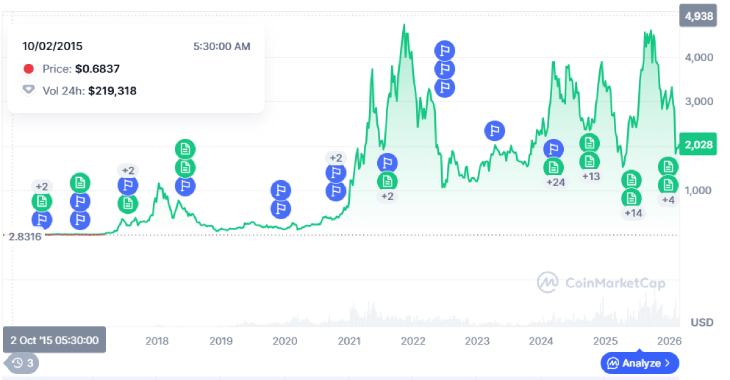
(Source: CoinMarketCap)
The same pattern is likely to repeat in the next upgrade. Glamsterdam’s upgrade is not likely to influence spot demand for ETH.
In the current market condition, technical improvements are being outperformed by macroeconomic factors. Constant selling pressure from holders, competition from other chains in retail, and a risk-off mood have created pressure on ETH to stay down.
According to experts, upgrades like this are “priced in” well in the early stage. There are many factors for 2026 that will influence the price, including ETF inflows, stablecoin regulatory clarity under frameworks like the GENIUS Act, and growing adoption of tokenized assets. Glamsterdam is a 12 to 18-month boost for utility, not a Q2 catalyst for a rally in the price of ETH.
Glamsterdam Upgrade to Make Ethereum the Undisputed RWA Settlement Layer
Many experts believe that RWA is going to be a new trend. As of February 26, 2026, data from rwa.xyz shows Ethereum already controls $14.9 billion in distributed asset value in tokenized real-world asset value. That is 58% of the entire on-chain RWA market, which is currently standing at around $25.3 billion in distributed asset value. This dominance has grown despite competition from Solana, which has rapid retail growth, and other dedicated chains.
But the question is, why do institutions choose Ethereum? BlackRock’s BUIDL, Circle’s USYC, Ondo’s OUSG, and dozens of tokenized treasuries and private-credit products are using Ethereum or its L2 ecosystem.
Ethereum is capable of providing unique features as it has huge liquidity. It has the most mature DeFi composability through platforms like Aave and Uniswap. It has robust security with over $100 billion in staked ETH securing the network. And it has institutional-grade standards like ERC-3643 for compliant tokenization. At present, there is no other layer-1 that can provide these features.
Apart from this, Glamsterdam will provide parallel execution and a 100 million-plus gas limit. This upgrade will allow the base layer to handle complex settlement logic that RWAs demand.
This includes multi-party compliance checks, Oracle integrations, cross-order transfers, and programmable cash flows. This will also be done freely without congestion. Apart from this, new upgrades in PBS and FOCIL will provide the neutrality and censorship resistance that regulated institutions require.
L2s will also play a role in the high-frequency activity. However, the final execution will take place on Ethereum.
Conclusion
Glamsterdam will not spark a 2026 price rally in the way retail traders think. It is not designed to do that. Instead, it will prepare Ethereum to support a tokenized economy. Instead, ETH will focus on other macroeconomic factors and institutional inflows.
For long-term holders, this upgrade is confirmation that Ethereum is executing exactly what is needed for the next generation of tokenized economy. It is building the settlement later that Wall Street will actually use.
Also Read: Is the Prediction Market New Indicator for Altcoin Rallies?
See less

