

Coinbase Review 2026
A neutral, experience-driven analysis of the world’s most compliant exchange. From simple buys to advanced institutional staking.


Coinbase is one of the most well-known cryptocurrency exchanges in the world and the leading platform for crypto investors in the United States. With over 120 million verified users, it operates across more than 100 countries under strict regulatory oversight, which has helped it earn a reputation for trust and reliability.
The platform lets users trade and stake cryptocurrencies, from major assets like Bitcoin and Ethereum to a range of altcoins. However, recent security incidents and concerns around fees make it essential to evaluate whether the platform still suits your specific trading needs.
This Coinbase review takes an unbiased, experience-based look at the exchange’s features, pricing, security, and everyday usability. We have designed this review to help both new and existing investors decide whether the platform fits their goals.
Key Takeaways
Coinbase's beginner-friendly interface and simple onboarding process make it ideal for first-time crypto buyers
It offers a variety of products for both individual and institutional investors
The standard Coinbase app charges spreads of up to 2% trading fees
Coinbase operates under SEC oversight, offering institutional-grade regulatory compliance and transparency
Coinbase Advanced provides charting tools and technical indicators suitable for experienced traders
Table of Contents
Coinbase at a Glance
| Founded | June 2012 |
| Listed Cryptos | 270+ supported |
| Trading Pairs | 460+ spot trading pairs |
| Supported Countries | 100+ countries |
| Deposit Fees | Free-3.99% |
| Transaction Fees | 0%-0.60% |
| Withdrawal Fees | Depends on the network |
| Mobile Application | iOS & Android |
| Customer Support | 24/7 phone, live chat & email |
| Regulation | BitLicense, FinCEN MSB, FCA, CBI e-money license, ASIC |
Our Take on Coinbase
Coinbase is simultaneously the most user-friendly entry point for retail investors and one of the most expensive platforms for active traders. As the largest U.S. crypto exchange and the world’s biggest Bitcoin holders, it benefits from regulatory clarity and institutional confidence.
Accessibility for beginners, regulatory compliance, and massive institutional trust are Coinbase’s strong points. Accounts can be opened in minutes with standard identity verification, and funding is also straightforward through multiple payment methods.
When it comes to Coinbase’s weaknesses, what really stands out is the fees. The basic Coinbase app’s fee structure includes spreads up to 2% plus transaction fees. That’s far above what most platforms charge.
Compared to exchanges like Kraken, Coinbase wins in user experience and regulatory clarity but loses out on fees and asset selection.
Who Coinbase is Best For & Who Should Consider Alternatives
Best For:
- Beginners and first-time crypto buyers: Coinbase is still one of the best options if you’re opening your first crypto account.
- Long-term buy-and-hold investors: If your goal is to hold crypto long-term or earn staking rewards, Coinbase is a great option.
- U.S and regulated-market residents: Users in the U.S or other regulated markets have the advantage of clear regulatory oversight and SEC compliance.
- Institutional investors: Coinbase Prime provides institutional-grade custody, OTC trading, and liquidity pools.
Consider Alternatives:
- High-frequency traders sensitive to fees: High-frequency traders should avoid Coinbase or switch to Coinbase Advanced due to higher maker/taker rates.
- Users seeking deep altcoin exposure: Coinbase has strict listing standards focused on regulatory compliance and liquidity. That means new or experimental tokens are often unavailable.
- Traders wanting full self-custody by default: Coinbase custody holds your assets on Coinbase’s servers.
Pros and Cons
- The beginner-friendly interface and intuitive design minimize onboarding friction
- Publicly listed, SEC-regulated, BitLicensed
- Strong cold storage security
- You can earn up to 4% APY staking on major assets
- Coinbase Advanced offers trading tools, including TradingView charts and 50+ indicators
- Fast deposit options with instant debit/PayPal and next-day ACH for large amounts
- High fees on the standard tier
- Banned in 40+ jurisdictions. Features are limited by region
- Customer support delays
- Above-average 25-35% staking commission reduces yield
- Limited altcoin access: Stricter listing standards mean fewer tokens
- Perpetual futures are unavailable for U.S. retail
What Is Coinbase? Background & Oversight
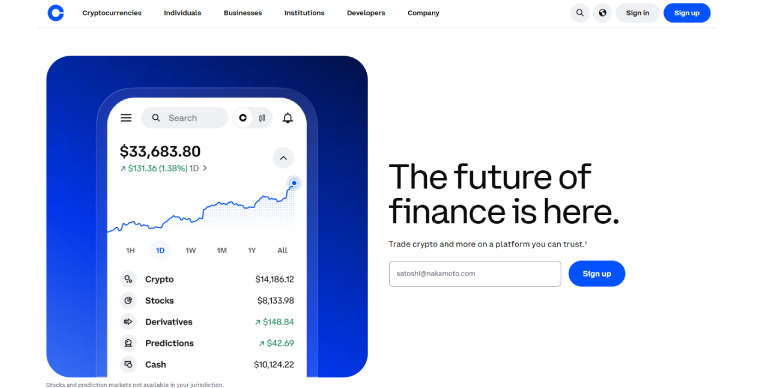
The history of Coinbase goes back to June 2012, when Brian Armstrong, a former Airbnb software engineer, and Fred Ehrsam, a former Goldman Sachs trader, founded Coinbase.
Coinbase started with basic Bitcoin trading via bank transfer, raising early venture capital, and then grew to 1 million users by 2014. Eventually, expansion into altcoins, custody services, and enterprise products followed.
By April 2021, Coinbase was listed on NASDAQ (ticker: COIN), becoming one of the first major crypto platforms to achieve public company status. As of early 2026, the company holds $500+ billion in customer assets and ~4.4% (~884k BTC) of the total Bitcoin supply.
Coinbase’s business model centers on transaction fees, which are its primary revenue drivers along with subscription services, staking commissions, and other products like the Coinbase Card.
Coinbase maintains compliance with financial regulators as it holds multiple licenses and registrations in:
- United States: BitLicense from the New York Department of Financial Services. Money Services Business registration with FinCEN. SEC registration as a securities exchange.
- European Union: E-money license from the Central Bank of Ireland. Markets in Crypto-Assets (MiCA) compliance across EU member states as of 2024.
- United Kingdom: FCA (Financial Conduct Authority) regulated, subject to UK consumer protections and AML/KYC requirements.
- Other jurisdictions: AUSTRAC license in Australia, MSB registration in Canada, and variable licensing in 100+ additional countries.
Account Types, Signup & Onboarding Process
Coinbase offers distinct account tiers tailored to different user profiles, each with corresponding features and access levels.
- Coinbase (Standard Account)
- Coinbase Advanced
- Coinbase Prime
- Coinbase Wallet
Step-by-step signup flow:
- Visit the Coinbase Website: Go to the Coinbase website and click on the “Sign up” button.
- Enter Your Personal Information: Fill in your personal information, including your full name, email address, and password.
- Verify Your Email: Check your email and click on the verification link sent by Coinbase.
- Complete Your Profile: Enter additional information, such as your country of residence and phone number, to complete your profile.
- Verify Your Identity: Provide a valid government-issued ID and proof of address to verify your identity.
- Add Payment Method: Choose a payment method, such as a bank account or debit/credit card.
- Buy Cryptocurrency: Once your account is set up, you can buy and sell various cryptocurrencies on the platform.
- Secure Your Account: Enable two-factor authentication and take other security measures to protect your account and assets.
Verification timelines
Verification is generally fast. Basic identity verification (KYC) takes between 5 and 30 minutes, and most accounts are immediately tradeable with standard deposit limits. Increasing account limits requires additional documentation and could take 1-3 business days.
Geographic differences
U.S.-based users have access to the full suite of products, while users in the UK and EU have access to most features but may face restrictions.
Supported Cryptos & Trading Pairs
Coinbase supports over 270 cryptocurrencies across its ecosystem, though the number available to individual users varies by product tier and jurisdiction. The standard Coinbase Exchange lists 150+ cryptocurrencies and 460+ trading pairs.
Major supported coins include:
- Bitcoin (BTC)
- Ethereum (ETH)
- Solana (SOL)
- Cardano (ADA), Polkadot (DOT), Avalanche (AVAX)
- Stablecoins: USDC, USDT
- Layer 2 tokens: Arbitrum (ARB), Optimism (OP)
- DeFi tokens: Aave (AAVE), Uniswap (UNI)
- Payment tokens: Ripple (XRP), Dogecoin (DOGE)
Coinbase considers quality over quantity regarding its listing standards. The company conducts technical and compliance reviews before listing any asset. This approach protects retail users from scams and low-liquidity tokens but frustrates traders who want to invest in newer altcoins.
Coinbase Trading & Investing Products
Coinbase Spot Trading
Standard trading on the basic Coinbase app is intentionally simplified for beginners. Users can place basic market orders and set recurring purchases. The interface hides order book complexity and technical analysis tools, making it accessible to beginners.
The platform does not use stop-loss or limit orders on the standard interface, which is a limitation for risk management.
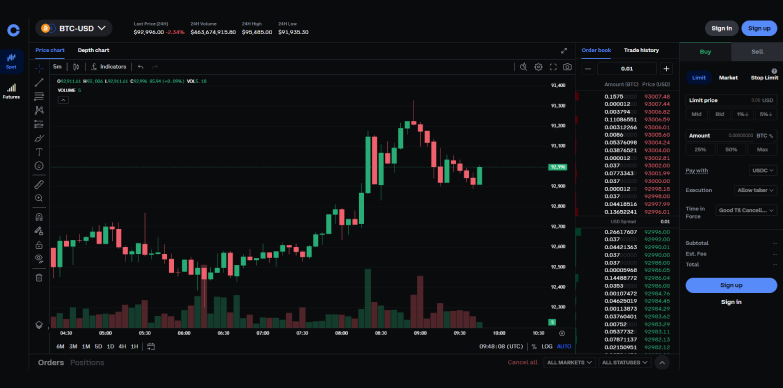
Coinbase Advanced Trading
Advanced Trade is where Coinbase’s institutional DNA becomes visible. It provides:
- TradingView-powered charting with 50+ technical indicators
- Flexible order types: market orders, limit orders, stop orders, and advanced orders.
- Real-time order book visibility
- Margin trading up to 5x leverage on eligible assets.
Fee structure on Advanced uses a maker/taker model with tiered discounts based on 30-day trading volume. Maker fees can range from 0.00%-0.40%, while taker fees fall within 0.05%-0.60%. Active traders quickly qualify for lower fees, making Advanced cheaper than the basic tier for frequent trading.
Coinbase One
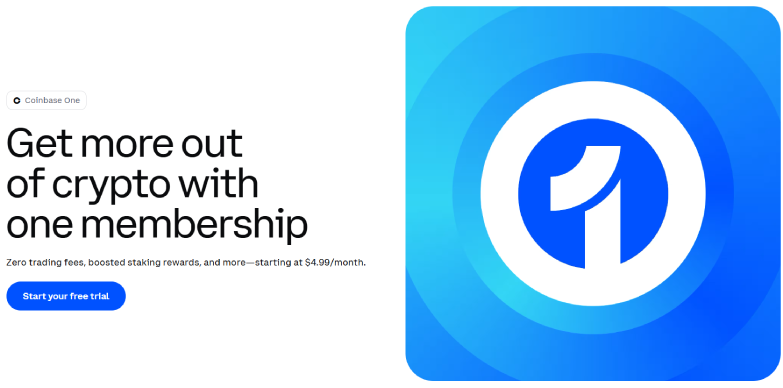
Coinbase One subscription model starts at $4.99/month. It offers:
- Zero trading fees on trades up to $10,000 per month
- Boosted staking rewards
- $1 million account insurance covering unauthorized account access
- 24/7 priority customer support
Coinbase One makes financial sense for traders placing $10,000+ in monthly transaction volume. A trader exceeding $10,000 monthly volume automatically receives fee waivers.
Earn & Staking
Coinbase allows users to stake crypto and earn rewards. It currently holds more than $20 billion in 125+ available staking assets. Some of the supported assets include:
- Ethereum
- Solana
- Cosmos
- Sui
- Polygon
How it works: Staking is a method of verifying and securing transactions on proof-of-stake blockchains. Coinbase forwards blockchain rewards to stakers after taking out a transparent commission.
Derivatives
Perpetual futures (leveraged, perpetual contracts) are not available to U.S. retail users due to regulatory constraints imposed by the CFTC and SEC. International users and institutions may have limited access depending on jurisdiction. This is a big limitation for leverage-seeking traders.
Coinbase Prime (Institutional)
This is the institutional option for hedge funds, asset managers, and exchanges. Features include dedicated asset custody with insurance, OTC trading, API access, advanced trading execution tools and liquidity pools, and governance access.
Prime is not designed for retail users and requires institutional accreditation and an application.
Coinbase Wallet
Coinbase Wallet has a non-custodial design feature, different from the main Coinbase exchange. When you create a Coinbase Wallet, the system generates a recovery phrase to access the assets in your wallet.
Supported assets and networks include:
- Bitcoin and all major Ethereum-based tokens (ERC-20)
- Stablecoins (USDC, USDT) across multiple blockchains
- Solana and SPL tokens
- Avalanche C-Chain tokens
In the standard Coinbase exchange, Coinbase holds your private keys and is responsible for security. Coinbase Wallet offers the opposite by giving users maximum security autonomy at the cost of personal key management responsibility.
Coinbase Card
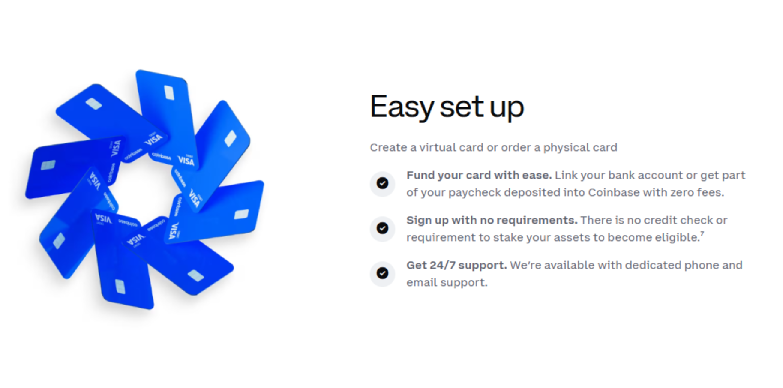
The Coinbase Card is a Visa debit card linked to your Coinbase account. You load cryptocurrency or fiat into the card, and transactions automatically convert crypto to the local currency. The card can be used anywhere Visa is accepted.
The unlimited rewards make regular spending attractive. A user spending $3,000/month at 4% rewards could earn up to $120 in crypto monthly.
It is currently available only in the United States. EU and UK users have faced restrictions, though the situation may change.
Fees and limitations:
- No transaction fees on the card itself
- No annual fee
- The daily spending limit is $2,500 per day
- You can transfer crypto or fiat to the card instantly
- Crypto conversion cost
Coinbase Fees & Pricing Breakdown
Simple Trading Fees
| Purchase Amount | Transaction Fee | Additional Spread |
|---|---|---|
| Up to $10 | $0.99 | Up to 2% |
| $10.01-$25 | $1.49 | Up to 2% |
| $25.01-$50 | $1.99 | Up to 2% |
| $50.01-$200 | $2.99 | Up to 2% |
| Above $200 | 1.49% | Up to 2% |
Advanced Trading Fees (Maker/Taker Model)
| 30-Day Volume | Maker Fee | Taker Fee |
|---|---|---|
| <$10,000 | 0.40% | 0.60% |
| $10,000-$50,000 | 0.35% | 0.55% |
| $50,000-$500,000 | 0.30% | 0.50% |
| $500,000-$1M | 0.25% | 0.40% |
| $1M-$10M | 0.20% | 0.35% |
| $10M-$50M | 0.15% | 0.30% |
| $50M+ | 0.10% | 0.25% |
| $400M+ | 0.00% | 0.05% |
Spread Explanation
On Standard Coinbase, spreads can reach 1-2%. On Advanced Coinbase, spreads are typically 0.05-0.2%, indicating tighter institutional liquidity.
Coinbase Payment Methods
Supported fiat methods vary by region and verification level.
United States
- ACH Bank Transfer
- Wire Transfer
- Debit/Credit Card
- PayPal
- Google Pay / Apple Pay
European Union / United Kingdom
- SEPA Bank Transfer
- Faster Payments
- Card Payments
Australia / Canada
- PayID
- Interac e-Transfer
- Bank Transfer
The fastest methods are card and PayPal for instant processing. The cheapest are ACH and bank transfers but they can take 2-5 days. Debit card deposits are immediately tradeable, while ACH transfers typically allow trading after 2-3 business days.
Features are different depending on the jurisdiction. For example, U.S. users have the most extensive payment method options. Users in the EU have SEPA but not PayPal.
Security & Regulation
Cold Storage and Asset Protection
Coinbase stores 98% of its crypto holdings in offline cold storage. These assets are not accessible via internet-connected systems and are protected by physical security, multi-signature requirements, and insurance policies.
The remaining 2% is held in hot wallets to enable liquidity for customer withdrawals and platform operations.
By holding assets on Coinbase, users accept counterparty risk. If Coinbase is hacked or becomes insolvent, assets could be lost. This is the tradeoff for convenient trading and account recovery.
Regulatory Coverage
Key regulators and licensing:
- United States (SEC): Coinbase is registered as a broker-dealer and exchange, subject to SEC oversight, Regulation SHO (short selling rules), and AML/KYC requirements
- United States (New York): BitLicense holder
- United States (FinCEN): Registered Money Services Business
- European Union: Central Bank of Ireland e-money license and MiCA (Markets in Crypto-Assets) compliance
- United Kingdom: FCA-regulated
- Australia: AUSTRAC license for digital currency exchange
Coinbase focuses on multi-jurisdiction licensing. This approach increases compliance costs but provides users with legal recourse and regulatory oversight.
Past Incidents (2025 Hack)
In May 2025, Coinbase discovered that unauthorized external contractors at overseas customer support centers had compromised nearly 70,000 customer records through bribes. Attackers extracted sensitive personal information and used it for social engineering attacks, tricking some users into transferring crypto to attacker-controlled wallets.
On May 11, 2025, the attackers contacted Coinbase, demanding $20 million in Bitcoin to prevent the public release of data. CEO Brian Armstrong publicly refused, stating, “We will not fund criminal activity,” and offered a $20 million reward for information leading to arrests instead.
- Terminated contracts of compromised staff and reported the incident to the FBI and SEC.
- Pledged to reimburse customers who were affected.
- Covered over $180 million in remediation costs, including customer reimbursements and legal/regulatory expenses.
The breach highlighted contractor management vulnerabilities but showed its strong security since no funds were stolen directly.
Mobile App & User Experience
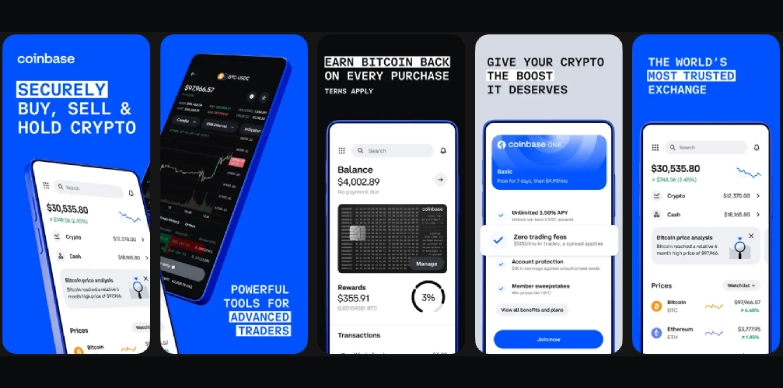
Coinbase’s mobile app is one of the most downloaded and best-rated apps in the crypto space. It has over 10 million downloads and a 4.4+ star rating across both iOS and Android app stores. The app is designed for simplicity and features a clean, intuitive home screen showing portfolio value, assets, One-tap buying/selling, price alerts, and transaction history.
Feature Parity with Desktop
The mobile app mirrors the core trading experience of the web platform for standard users. Coinbase Advanced features on mobile are limited compared to the desktop version.
Features missing on mobile Advanced:
- TradingView charting with technical indicators
- Real-time order book depth
- Advanced order types
Performance During Volatility
The Coinbase app has proven to be very reliable during high-volatility sessions and market crashes. Unlike some competitors that experience issues during flash crashes or traffic spikes, Coinbase’s infrastructure has stayed stable through the most intense crypto market events.
Suitable User Types
The mobile app excels for:
- Beginners making first purchases (low friction)
- Long-term investors checking portfolio performance
- Users wanting to buy and hold without active trading
- Users prioritizing mobility over advanced charting
Customer Support
Available Channels
Coinbase provides multiple support channels, though quality and response times vary:
- Phone support
- Live chat
- Email support
- Help Center
Response Times
- There are reports of 3-hour waits for live chat and phone lines, especially during market volatility.
- Initial contact often routes through automated phone trees or chatbots, delaying human interaction.
- Email responses can take 3-7 business days or longer.
Strengths
- 24/7 availability.
- Responsive social media (Twitter/X complaints sometimes get faster attention)
- Assistance for Password resets and account access issues is usually resolved quickly.
- The Help Center has comprehensive guides for common issues.
Known complaints
- Difficulty reaching support regarding fund freezes or account restrictions.
- Inconsistent policy enforcement when appealing account actions.
- Limited support for institutional-grade issues.
Coinbase has acknowledged that customer support is a weak point and has announced plans to expand capacity and improve response times.
Educational & Research Tools
Coinbase Learn / Earn
Coinbase Learn is a free educational hub offering articles, videos, and interactive lessons on crypto fundamentals. Topics include blockchain basics, Bitcoin and Ethereum explanations, DeFi, and regulatory topics. The content is beginner-focused and complemented by Coinbase Earn, a gamified learning platform where users complete short educational videos and answer quizzes to earn small amounts of crypto.
Market Insights and Research
Coinbase publishes the Coinbase Institutional Research, a quarterly report on crypto market trends, blockchain adoption, and regulatory developments. This content is primarily aimed at institutional clients and active traders but is publicly available.
Suitability:
- Beginners: The educational content is fine for beginners
- Advanced users: Institutional research provides valuable market context but is not a replacement for specialized crypto research platforms
Coinbase vs Other Top Crypto Exchanges
| Aspect | Coinbase | Kraken | Gemini | OKX |
|---|---|---|---|---|
| Best for | Beginners, U.S traders, Institutions | Cost-conscious traders | Security-focused traders | Advanced traders |
| Trading fees (advanced) | 0.40%-0.60% | 0.16%-0.26% | 0.20%-0.40% | 0.08%-0.15% |
| Asset selection | 270+ | 500+ | 80+ | 300+ |
| Regulatory status | Public company, BitLicense, FCA, CBI | Fully licensed globally | NY Trust Company | Not regulated in the US/UK/EU |
| Perpetual futures | Restricted (US retail) | Available | Available (select jurisdictions) | Widely available |
| Security incidents | 2025 data breach | No major breaches | No major breaches | Standard exchange risks |
The right choice depends on your priorities. For regulatory protection and simplicity, Coinbase comes on top. Kraken is a great option for low fees and a broad selection of assets. Gemini is suited for maximum custody security. For unrestricted trading with minimal fees, choose OKX.
For a comprehensive side-by-side comparison of these and other crypto exchanges, check out our detailed list of top crypto exchanges.
Global Availability & Restrictions
Supported Regions
Coinbase operates in over 100 countries, including all major developed markets:
- Fully supported: United States, Canada, United Kingdom, EU member states, Australia, Japan etc.
Notable Country Restrictions
Coinbase is blocked in jurisdictions subject to OFAC (Office of Foreign Assets Control) sanctions and a few additional countries:
Completely restricted:
- Russia
- Iran
- North Korea
- Syria
- Cuba
- Venezuela
- Sudan
- Yemen
- Somalia
- Libya
- Myanmar (Burma)
- Central African Republic
- Zimbabwe
Compliance-Driven Limitations
Even in supported countries, some features are unavailable due to local regulations:
- EU: Perpetual futures restricted under MiCA
- US: Perpetual futures unavailable for retail users
- UK: Certain staking products restricted
- Australia: Different AML/KYC requirements
- Japan: Restricted to FCA-approved assets
You can check availability by entering your country on Coinbase’s website or by trying to sign up, which will clearly indicate if your jurisdiction is blocked.
Final Verdict & Alternatives
Coinbase is a legitimately safe, regulated cryptocurrency platform. It is not the cheapest platform for active traders and has some security vulnerabilities as seen in the 2025 breach, but it balances regulatory compliance and institutional credibility in a way few competitors match.
It is a suitable option for first-time crypto buyers who prioritize simplicity, long-term holders staking for passive income, U.S. traders benefiting from SEC oversight and strong legal protections and users willing to pay a convenience premium for beginner-friendly tools.
A few alternatives to consider include:
Kraken:
Kraken offers lower trading fees, broader asset selection, and a strong security record without major breaches. The platform is fully licensed internationally and highly regarded by professional traders.
Our Methodology: How We Reviewed Coinbase
We conducted this Coinbase review using a comprehensive, hands-on approach designed to give you the most accurate and practical insights into Coinbase’s real-world performance.
Platform testing: We created actual Coinbase accounts and worked through the signup and verification process. We executed test trades on both Simple and Advanced interfaces, and linked various payment methods to understand the complete user experience.
Fee comparison: We analyzed transaction fees, spreads, and total trading costs across all Coinbase tiers at various volume levels, comparing actual costs to platforms like Kraken and OKX.
Security assessment: We reviewed publicly available security documentation, regulatory filings, incident reports, and cold storage practices. We paid particular attention to the May 2025 data breach, studying attack vectors, Coinbase’s response, and security improvements implemented afterward.
User experience evaluation: We tested the mobile app on iOS and Android, navigated the desktop interface, and contacted customer support through multiple channels to gauge response times and service quality for both beginners and advanced traders.
For more details, visit CryptoNewsZ Review Methodology.
Frequently Asked Questions
Is Coinbase legit and safe?
Yes. Coinbase is a regulated, publicly traded crypto exchange with strong custody and cold storage security.
What are the downsides of Coinbase?
Coinbase’s main downsides include high fees on the basic app, slow customer support, limited emerging altcoin listings, and relatively high staking commissions compared to decentralized alternatives.
Is your money protected on Coinbase?
Partially. Coinbase stores most assets in cold storage, but protection depends on Coinbase’s solvency and policy limits. Personal data exposure and custodial risk still exist.
Is Coinbase good for beginners?
Yes. Coinbase is one of the easiest crypto platforms for beginners, with simple onboarding and a clear design
Can Coinbase freeze your funds?
Yes. Coinbase can temporarily restrict withdrawals due to security alerts, AML or KYC reviews, legal requests, or suspicious activity.
How can I lower my fees on Coinbase?
Switch to Coinbase Advanced for lower trading fees, use bank transfers instead of cards, increase trading volume to unlock lower tiers, or consider Coinbase One if your monthly trading volume justifies the subscription cost.
Does Coinbase offer staking, and is it safe?
Yes. Coinbase supports staking for several major cryptocurrencies. Security risk is low, but protocol-specific risks like slashing or unbonding delays can still apply.
What are the tax implications of using Coinbase?
Most Coinbase transactions are taxable. Selling crypto, swapping assets, spending via Coinbase Card, and receiving staking rewards can trigger tax obligations. Coinbase provides reports, but users should verify accuracy and consult tax professionals.
What are the best features of Coinbase?
Coinbase stands out for its beginner-friendly interface, regulatory clarity, strong cold storage security, advanced trading tools, integrated staking, and the option to move funds into a non-custodial wallet.
What is the difference between Coinbase Simple, Advanced, and Prime?
Coinbase Simple targets beginners with high fees and simplicity. Advanced offers lower fees and professional trading tools. Coinbase Prime is designed for institutions, providing OTC trading and custody services.
Can you use a credit card on Coinbase?
Yes, but it’s expensive. Credit and debit card purchases carry fees up to 3.99%.
Can Coinbase refund money if you get scammed?
Generally no. Coinbase may reimburse users in rare cases involving platform-related breaches, but phishing scams or user-initiated transfers to attackers are typically unrecoverable.
Can you use Coinbase without KYC?
No. Coinbase requires full identity verification to trade or withdraw. Coinbase Wallet is non-custodial and does not require KYC.
How do you withdraw money from Coinbase?
You can withdraw crypto to an external wallet or sell crypto for fiat and send it to your bank. Bank withdrawals take 2-3 business days, while wire transfers are faster but take up additional fees.
Does Coinbase report to the IRS?
Yes. Coinbase reports certain transactions and income to the IRS and complies with subpoenas.
See less
