
Gemini Exchange Review 2026
Gemini is a regulation-first cryptocurrency exchange designed for beginners and compliance-focused traders who value security, transparency, and institutional-grade custody over high-risk trading features.


Renowned for its compliance standards and security features, Gemini Exchange is considered a safe and trusted exchange, and many Gemini Exchange reviews score it highly. This exchange has security certifications such as ISO 27001 and SOC 1/2, and offers users insurance for its hot wallets, and is aimed at users who prioritize compliance and crypto security.
Additionally, Gemini Exchange is suitable for beginners because of its simple UI, which makes navigation easy. ActiveTrader provides advanced spot trading tools, but Gemini does not offer high-leverage derivatives like many offshore exchanges.
Key Takeaways
Gemini Exchange prioritizes safety and regulation, ranking high among the most compliance-focused crypto exchanges in 2026.
While the Gemini crypto app and website might be quite expensive, its ActiveTrader platform offers competitive, low fees to frequent and high-volume traders.
Due to its simple interface, robust high-tech trading tools, and compliance standards, Gemini Exchange fits the use case for beginners, advanced traders, and institutions.
Main drawbacks include high fees for non-ActiveTrader users, subscription costs for advanced trading features, and limited third-party integrations.
Table of Contents
- Gemini Exchange Overview & Key Takeaways
- What Is Gemini Exchange? Regulation & History
- Supported Assets, Markets & Trading Products
- Pros and Cons
- Derivatives, Tokenized Assets & Advanced Market Access
- Gemini Fees Explained: Instant Buy vs ActiveTrader
- Gemini for Beginners, Pro Traders & Institutions
- Security, Wallets, Staking & Proof of Trust
- Gemini App, User Experience, Comparisons & Final Verdict
Gemini Exchange at a Glance
| Founded | 2014 |
| Native Token | Gemini Dollar (GUSD) |
| Listed Cryptos | ~70-80+ including BTC, ETH, SOL, etc. |
| Trading Pairs | Over 100+ |
| Supported Countries | 60+ Countries |
| Deposit Fees | Free (ACH, Crypto) • Card & PayPal fees apply |
| Transaction Fees | Instant: up to 3.49%; ActiveTrader limits: 0-0.40% |
| Withdrawal Fees | Free (ACH & Bank Transfer) • Wire fees apply |
| Mobile Application | iOS, Android, and Web |
| Customer Support | 24/7 |
| Regulation | NYDFS, MiCA, AML-Compliant |
Our Take on Gemini Crypto Exchange
While our Gemini review stamps it as one of the most trusted exchanges in 2026, a critical overview shows that the Gemini exchange also comes with high fees and constrained crypto flexibility.
The exchange’s strong regulatory compliance, wallet protections, and insurance give users the confidence that their assets are safer on Gemini, yet higher fees, limited derivatives, and crypto yield options often undermine its usability when compared to exchanges like Binance and Coinbase.
Unlike Gemini, which charges expensive fees for premium trading tools and options, these other exchanges offer deeper markets and lower costs, which makes day-to-day users prefer them. Gemini’s simple interface is appealing to every user, and its advanced tools are a fit for large volume traders, but traders seeking wider asset options at cheaper fees may find other exchanges suitable.
Gemini Exchange: Pros and Cons
- Strong regulatory oversight (NYDFS, MiCA)
- ISO 27001 & SOC 1/2 security certifications
- Beginner-friendly UI with ActiveTrader upgrade
- Institutional-grade custody and insurance
- Reliable fiat on/off ramps
- Higher fees outside ActiveTrader
- Limited altcoin and derivatives selection
- Slower token listings
- Advanced tools weaker than Binance/Bybit
What Is Gemini Exchange?
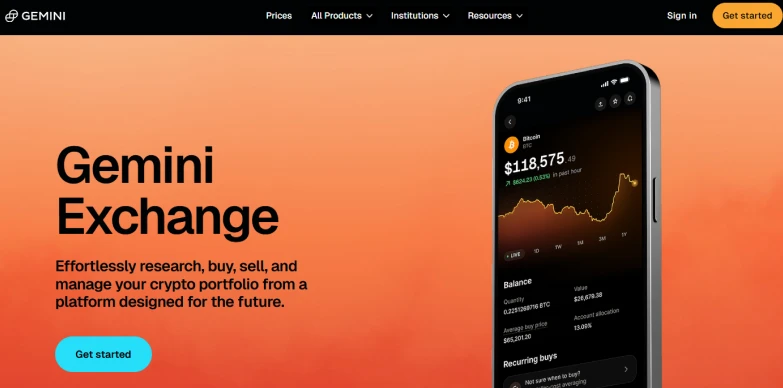
Gemini Exchange is a U.S.-based cryptocurrency exchange and wallet founded in 2014 by the Winklevoss twins (Tyler and Cameron Winklevoss). Due to their earlier expertise in fintech and crypto ventures, the platform carries major credibility from its founders’ repute.
Gemini Exchange is a compliance-first platform, and it is financially regulated while operating under the New York State Department of Financial Services (NYDFS). This platform is also compliant in the European Union as it holds a MiCA certification, amongst several licenses in other jurisdictions, broadening its global service.
Since Gemini’s mission is to improve transparent and regulated crypto trading, it is ISO 27001:2022-certified, insures user wallets, and operates a robust KYC/AML process, making it ideal for users who prioritize trust and compliance. Gemini supports spot trading for ~70-80 cryptocurrencies, offers fiat on/off ramps, and powers a custom ActiveTrader product. However, strict U.S regulatory laws have listed its derivative offerings in recent times compared to giant competitors like Binance and Coinbase.
When compared to these giants, Gemini has fewer asset options and higher fees, but with a more compliant ecosystem. Whereas these other giants have wider asset options and lower fees, but with risks of regulatory breaches.
Though a competitor like Coinbase is regulatory-focused too, it has deeper markets and broader fiat support. Kraken also competes with Gemini on security levels and even offers wider derivatives, but its user interface is sometimes considered too complex for beginners.
Though less expensive than its competitors, Gemini is best suited to security-minded users and institutions who prioritize regulatory compliance and pedigree.
Gemini Key Highlights & Platform Strengths
Being a compliance-oriented leader in the U.S. crypto market, Gemini holds a BitLicense certification from the New York Department of Financial Services (NYDFS) and is expanding under global frameworks like MiCA and other licenses in major jurisdictions. This structure is attracting major institutions that prioritize compliance and financial transparency globally.
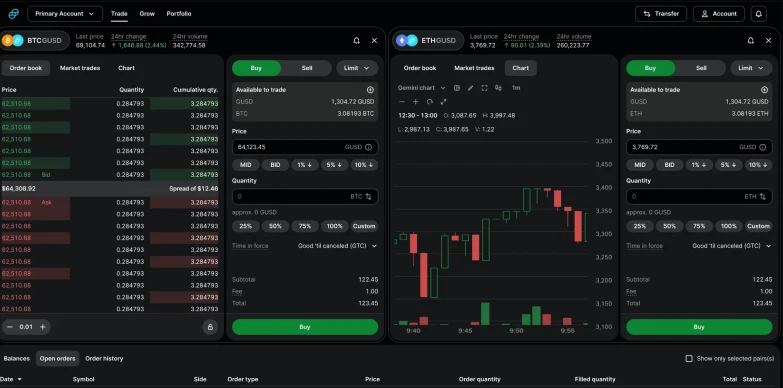
Standing out among Gemini’s features is its dual interface, which features a beginner-friendly interface with simple buy and sell options, and an ActiveTrader interface, which features deeper charting, order types, tiered fee pricing, and advanced trading tools for higher-volume traders, serving both newbies and technical users. More so, not forgetting that this platform is well certified with SOC-2 and ISO 27001:2022 certs for value proposition and security appeal.
Gemini Exchange supports both custodial and web3 wallets, while offering staking for selected tokens and a crypto rewards credit card. With its custody and OTC desk offerings, this exchange is enterprise-ready, though its derivative options are still quite limited in some regions due to compliance and regulatory issues. Overall, major Gemini exchange reviews highlight its strong governance and robust platform design as its selling points.
Supported Assets, Markets & Trading Products
Cryptocurrencies Supported
The Gemini cryptocurrency exchange supports ~70-80 cryptocurrencies, as it is an exchange that selects tokens based on popularity and regulatory compliance. So, when compared to competitors like Binance (350+) and Coinbase (200+), Gemini trades off regulatory compliance and asset quality over asset quantity.
Gemini Exchange has a strong coverage of layer-1 blockchains, as it supports the major protocols in the market. Gemini supports Bitcoin (BTC), Ethereum (ETH), Solana (SOL), Cardano (ADA), Polkadot (DOT), Avalanche (AVAX), Algorand (ALGO), and Cosmos (ATOM). However, many Gemini exchange reviews suggest that it may lag behind competitors in listing newer or more experimental layer-1s.
When it comes to DeFi tokens, Gemini Exchange is conservative, as it selects only the premium tokens compared to other exchanges that list all, including new and higher-risk protocols. Gemini supports Uniswap (UNI), SushiSwap (SUSHI), Maker (MKT), Compound (COMP), Chainlink (LINK), and Aave (AAVE).
Gemini offers strong support for stablecoins while prioritizing regulatory-compliant Stablecoins, giving birth to its custom Gemini Dollar (GUSD). Gemini supports USDC (USD Coin), USDT (Tether), DAI, and PAX (Paxos).
When it comes to memecoins, Gemini is quite rigid, generally not supporting memecoins except Dogecoin (DOGE) and Shiba Inu (SHIB). A critical Gemini review suggests that if it were to list another memecoin, it must have shown significant market capitalization with deep liquidity.
With a strong focus on regulatory compliance, every asset on Gemini has passed rigorous legal and compliance review. It also prioritizes tokens that are suitable for institutional investment, while avoiding high-risk tokens. Through these security measures, scam tokens are cancelled out during security tests.
On the flip side, due to the conservative nature and strict security mechanisms, Gemini often takes longer to list tokens. It also has a limited altcoin selection, as traders have complained that early-mover opportunities are not available on Gemini. There are also fewer innovative DeFi protocols and very minimal meme coin access, as the Gemini ecosystem is not as expansive.
Spot Trading Markets
Fiat pairs vs crypto-to-crypto pairs
Gemini offers robust fiat-to-crypto trading, mainly supporting USD (US Dollar) and other additional fiats like GBP, EUR, CAD, SGD, HKD, and AUD as select currencies. ~70-80 crypto tokens are paired with the USD, and a limited selection is paired with other fiat currencies. Hence, Gemini is a USD-centric exchange.
For its crypto-to-crypto pairs, it focuses on BTC pairing, while accommodating ETH pairs to a good extent. It has fewer crypto-to-crypto pairs than other major exchanges, while focusing on BTC and ETH trading pairs. Overall, Gemini focuses on fiat on-ramps, reflecting its institutional focus.
Liquidity depth & spreads (relative comparison)
Gemini’s major assets are BTC, ETH, and USD. It offers good liquidity for these assets with tight spreads in high-volume pairs (around 0.1-0.3%), making it suitable for both institutional and retail traders. Gemini then offers moderate liquidity to SOL, LINK, and ADA, with wider spreads than most exchanges (around 0.3-0.8%).
However, there is sometimes slippage on larger orders. For its smaller assets, Gemini offers lower liquidity with clear spread widening. There is also a higher slippage risk for bulk trades. Overall, Gemini is great for major tokens, acceptable for mid-range altcoins, but not good for smaller altcoins.
Best assets for spot investors
Optimal Liquidity & Spreads
- Bitcoin (BTC): Great depth, tight spreads, high volume
- Ethereum (ETH): Strong liquidity, institutional-grade execution
- USDC: easy fiat conversion and seamless stablecoin integration
- GUSD: zero trading fees and premium USD integration
Good for Spot Trading
- Solana: Acceptable liquidity for a top layer-1 chain
- Cardano: Adequate depth for moderate positions
- Polkadot: Moderate spreads
- Chainlink: Solid premium DeFi option
- Avalanche: Growing ecosystem support
Acceptable (But Spread Caution)
- Uniswap (UNI)
- Algorand (ALGO)
- Cosmos (ATOM)
- Aave (AAVE)
However, you want to be entirely cautious with assets like memecoins (higher spreads), newer or smaller-cap listings, and niche DeFi tokens. Overall, Gemini is best for traders who trade major cryptocurrencies (top 10) and use USD fiat pairs. If you need deep liquidity for altcoins beyond the top 20, you might want to consider other alternatives.
Derivatives and Futures Trading
Perpetual futures overview
Gemini has limited derivatives offerings when compared to major competitors, and perpetual futures are currently not available to most users. There is also no leverage trading in the main Gemini platform, as it focuses on regulatory-compliant spot markets. Though it previously offered derivatives through its ActiveTrader platform, Gemini does not actively compete in the perpetual futures and derivatives market like Binance, Bybit, and others.
Leverage Limits (Region-Wise)
Currently, leverage trading is restricted in the United States due to regulatory compliance, as Gemini has withdrawn from most leveraged asset offerings globally due to regulatory checks and strategic focus on compliant spot trading. While other exchanges offer varying leverages, Gemini practically offers 0x.
Margin & Liquidation mechanics (risk transparency)
Since Gemini does not offer active perpetual futures or significant margin trading, there are no forced liquidation risks for users, no liquidation engine to access, and no margin requirements to assess.
Funding Rates & Settlement Asset (GUSD)
Since there are no active perpetual futures, funding rates cannot be calculated at this moment. Gemini’s settlement asset is the Gemini Dollar (GUSD), as it is used for spot trading settlements, while offering zero trading fees when paired with other assets on the platforms.
Who are Gemini derivatives suitable for?
Gemini derivatives are limited and region-restricted, making the platform unsuitable for most derivatives traders. Even for non-US users, ActiveTrader primarily serves advanced spot traders rather than high-leverage derivatives users.
Tokenized Stocks (Non-US Users)
Tokenized stocks are digital assets that represent real-world assets like Gold, company shares, and others on the blockchain. These tokens are backed 1:1 by the underlying stock and can be bought fractionally, enabling 24/7 trading without the time differences of traditional markets. This is a major appeal for non-US users, especially users in the EU, where tokenized stocks are actively offered on the exchange.
However, there are risks and limitations worth noting. Unlike buying shares through a traditional broker, tokenized stocks do not always give direct legal ownership, voting rights, and guaranteed dividends, as it depends on the specific structure of the token and the jurisdiction.
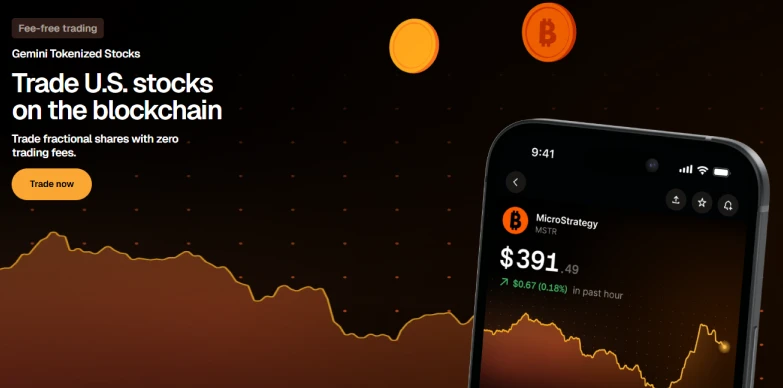
Also, liquidity can be less reliable than on regulated stock exchanges, potentially widening bid-ask spreads or making it hard to trade large positions effectively. With tokenized stocks, regulatory conditions and terms are still developing; hence, legal protection and tax terms can vary widely.
When compared with traditional brokers, Gemini has explored regulated tokenized asset offerings in select jurisdictions through partnerships, but availability is limited and subject to regulatory approval. For investors seeking full shareholder rights and established regulatory safeguards, traditional brokers remain a better choice.
Gemini Exchange Fees Explained
| Fee Type | Gemini | Coinbase | Kraken |
|---|---|---|---|
| Instant Buy Fees | 0.50 – 3.49% | 0.50 – 3.99% | Not offered |
| Spot trading (Maker) | 0 – 0.40% | 0 – 0.40% | 0 – 0.16% |
| Spot trading (Taker) | 0 – 0.40% | 0.05% – 0.60% | 0.10% – 0.26% |
| Futures Trading | A few futures options (Not offered in the US) | Not offered (US) | 0.02% – 0.05% |
| Staking Fees | 0% commission | 25% commission | 0 – 15% |
| Crypto Deposits | Free | Free | Free |
| Crypto Withdrawals | Network fees only | Network fees only | Network fees only |
| Fiat Deposits (ACH) | Free | Free | Free |
| Fiat Withdrawals | Free (ACH) | Free (ACH) | Free (ACH) |
| Wire Deposits | Free | $10 | Free |
| Wire Withdrawals | $25 | $25 | $5 (domestic) |
Instant Buy vs ActiveTrader: Cost Comparison
For small trades, Gemini charges 0.5 – 3.49% depending on the trade size and payment method, while its ActiveTrader uses a maker-taker model with 0.40% for takers and 0.20% for makers. For large trades, the difference is more pronounced as a $10,000 purchase on instant buy could incur as much as $50 to $350, and around $20 to $40 on ActiveTrader.
Instant buy is advisable when you choose speed and simplicity for smaller, occasional purchases, or if you are a newbie and need a simple UI. ActiveTrader is better if you are making large trades where percentage-based fees significantly impact your bottom line. This way, you are trading frequently so that the fee savings add up. ActiveTrader also makes sense if you need advanced trading tools like limit orders, tight stop-losses, and so on.
How To Minimize Fees on Gemini
To minimize fees on Gemini, you could switch to ActiveTrader, which offers significantly lower trading fees than the instant buy interface. Use limit orders to be eligible for maker fees, which are cheaper than taker fees. Then avoid trading with the Gemini mobile app, as it incurs convenience fees. Use the desktop version instead to keep overall costs as low as possible.
Gemini for Beginners: Is It Beginner-Friendly?
Gemini Exchange is generally beginner-friendly, as the account setup and KYC process are straightforward and regulatory compliant, making it easy for newbies to onboard. Its buy/sell interface is as simple as it gets, and there are recurring purchases and DCA tools to automate your investment.
You can also monitor your portfolio with basic tracking tools while improving your crypto knowledge with its cryptopedia integration. However, like all platforms, there are pros and cons. Hence, beginners should weigh both before starting out.
Gemini for Pro Traders & Active Traders
For professional and active traders, Gemini crypto exchange reviews suggest that it can be a solid choice. However, Gemini is more niche to advanced algorithmic trading compared to competitors like Binance and Bybit. Its ActiveTrader tool provides traders with TradingView charting and advanced order types like IOC, FOK, and stop-limit.
This interface also supports API access for algorithmic trading with reliable execution and uptime for major crypto markets. However, trading fees on ActiveTrader are usually higher than on Binance and Kraken Pro, and the asset range is also more limited, with thin liquidity. This might impact execution quality and portfolio spreading strategies for big-time, swing traders.
Gemini Staking, Earn & Passive Income Options
Gemini’s staking program supports select proof-of-stake assets such as Ethereum and a limited number of other tokens, depending on region. The platform charges approx 15% after deducting on-chain costs (varies by region/product) of staking rewards as a service fee, an important factor when comparing yields. While many exchanges list a wider range of staking assets, Gemini focuses on a smaller set with clear access in supported regions.
Although Gemini once offered a high-yielding lending product called Gemini Earn, it got discontinued after its lending partner, Genesis, froze withdrawals and filed for bankruptcy. Though users have been fully compensated, this failure highlights the custodial staking and lending risks when third parties are involved.
Gemini Wallets & Custody
Gemini is generally a custodial wallet that houses the private keys to your crypto assets. This gives users more control. Gemini now offers a Web3 self-custody wallet that allows you to manage your own keys and interact directly with dApps across major networks like Arbitrum, Ethereum, Polygon, Base, and Optimism.
Note that this wallet does not currently integrate directly with hardware wallets. So, if you want to hold for the long term, you could just transfer your assets off-exchange to a third-party hardware wallet. Overall, self-custody wallets are best if you prioritize control and security in the long term, while storing assets on an exchange like Gemini is more convenient for active trading and quick access.
Gemini Security, Regulation & Proof of Trust
What strongly differentiates Gemini from other exchanges is its regulated, security-focused model. With New York trust licenses and asset segregation models that keep customer funds separate from company funds, Gemini is foremost in compliance. It has wallet insurance, cold storage certifications, and security certifications such as SOC1/2 and ISO 27001:2022.
Note, however, that these insurances are not FDIC-insured; they only cover USD held at partner banks up to statutory limits. However, Gemini has recorded high-profile failures such as the Gemini Earn product, which froze over $900M in customer funds and drew SEC and NYDFS actions for unsafe practices and unregistered securities, resulting in a $1.1B settlement in compensation and fines. Gemini has since doubled down on its regulatory compliance to be at the forefront of crypto compliance.
Gemini Mobile App & User Experience

The Gemini mobile app offers a smooth, beginner-friendly interface for buying, selling, and holding crypto on both Android and iOS versions. If you want advanced information like live price data, limit orders, and advanced chart details, you can switch to the ActiveTrader interface. The app comes with useful tools like price alerts, basic market insights, and portfolio tracking for all users.
Though advanced technical tools and customization are more limited on mobile and can lag during network congestion, the performance is generally smooth and secure. Overall, the mobile app is great for on-the-go trading and monitoring, while the desktop version is better for deeper analysis and high-volume trades.
Gemini’s Credit Card & Real-World Utility
Gemini’s crypto credit card offers Bitcoin rewards of up to 3% in select spending categories. This card is best for users who enjoy cashback, as a percentage of their purchases is deposited back into their crypto wallet. However, they are not usually of large value since they are not in fiat. Overall, crypto debit cards may provide more substantial rewards with varying features, and in fiat.
Gemini’s Institutional & High-Net-Worth Solutions
Gemini provides secure custody services for housing large crypto holdings, OTC trading for private, low-slippage large orders, and institutional APIs for seamless integration into treasury bases and trading algorithms. These services best suit fund managers, enterprises, and high-volume traders needing compliance and liquidity. Day-to-day investors likely do not need them.
Customer Support, Reputation & User Reviews
Gemini’s support channels include emails, live chat, and help centre support to power its reliable 24/7 access. However, during peak trading hours and network congestion, verification delays may sometimes surface. Gemini’s strength is its security and regulated ecosystem. While your funds are secure, you should realistically expect to be patient with occasional lags and ID check delays.
Gemini vs Top Crypto Exchanges
| Exchange Feature | Gemini | Coinbase | Kraken | Binance |
|---|---|---|---|---|
| Fees | Higher on Instant buy, Lower on ActiveTrader | Higher retail fees, lower bulk fees | Mid-range but lower than Gemini | Lowest Fees |
| Security | Strongest regulatory base | Secure | Very secure | Security risks |
| Tokens Supported | ~70-80 | 150+ | 200+ | 350+ |
| Advanced Tools | ActiveTrader for Pros | Advanced Spot trading | Strong Pro features on OTC trading | Advanced derivative tools |
| User Interface | Easy-to-use UI | Simple UI | Not As Simple, but clear UI | Mid-Range Complexity for beginners |
Gemini is best for security-oriented users and beginners who need an easily navigable interface. Coinbase exchange is best for newbies who need a wide range of fiat pairs. Binance is best for those who prioritize extremely low fees and a wide range of assets to trade. Kraken is good if you don’t mind moderate fees, with professional trading tools available.
Who Should Use Gemini Exchange in 2026?
Overall, Gemini Exchange is best for beginner traders who are US-based due to its focus on US fiat for its pairings and its simple UI. More so, if you are a compliance-first trader with plans to hold your assets for the long term, Gemini is the place for you in 2026.
However, if you are a fee-sensitive scalpers who prefer to trade in short timeframes at low costs, Gemini exchange is not ideal for you. Also, if you are an altcoin trader who focuses on high leverage, you might want to explore other major crypto exchanges in 2026.
Final Verdict: Is Gemini Worth It in 2026?
Gemini Exchange is still a solid choice in 2026, especially if you value security, compliance, and ease of use. Its mobile app and desktop versions are very navigable with advanced trading features. However, if you are looking for the cheapest transaction fees and a wide range of asset options, you might want to explore other options. Still, Gemini trumps for zero-hassle trading and simplicity.
It’s worth noting, however, that this is not financial advice. Crypto investments are risky and highly volatile. Hence, you should do your own research and consult experienced professionals before investing.
Our Methodology: How We Reviewed Gemini Exchange
We reviewed Gemini using a hands-on, research-driven approach to evaluate its real-world performance, costs, security standards, and overall usability for different types of crypto users.
Platform testing
We created verified Gemini accounts and completed the KYC process to assess onboarding speed and usability. We tested both the basic buy/sell interface and ActiveTrader, executing spot trades across multiple pairs to evaluate order types, liquidity, and trade execution.
Spread Explanation
On Standard Coinbase, spreads can reach 1-2%. On Advanced Coinbase, spreads are typically 0.05-0.2%, indicating tighter institutional liquidity.
Fee and cost analysis
We analyzed Gemini’s trading fees, spreads, and withdrawal costs across different order types and volume tiers, comparing standard Gemini pricing with ActiveTrader fees and benchmarking them against exchanges like Coinbase and Kraken.
Security and user experience review
We reviewed Gemini’s regulatory framework, custody practices, and security certifications, including NYDFS oversight and SOC 2 compliance. We also tested the mobile apps and desktop platform and evaluated customer support accessibility and responsiveness.
For more details, visit CryptoNewsZ Review Methodology.
Gemini Exchange FAQs
Is Gemini a safe exchange?
Is Gemini legal in the USA?
Does Gemini charge higher fees than Binance?
Is Gemini a good exchange for beginners?
Does Gemini exchange offer futures?
Is Gemini better than Coinbase?
See less