

Margex Review 2026
Margex is an offshore crypto derivatives exchange offering up to 100x leverage, best suited for experienced traders comfortable with counterparty and liquidation risks.


Margex Exchange is a crypto derivatives platform that focuses on leveraged trading rather than spot asset ownership. This platform allows its users to trade perpetual contracts in major cryptocurrencies with leverage of up to 100x, multiplying their earnings. However, this leverage model also means that losses will be amplified as well when trades go in the negative direction.
Being a derivatives-only exchange, Margex is most suited for active traders who understand margin requirements and liquidation risks. This Margex exchange review provides readers with an unbiased, in-depth analysis, evaluating its trading features, fees, security structure, and risk profile, helping them decide if it fits their use case.
Key Takeaways
Margex exchange is a derivatives-oriented platform that specializes in perpetual contracts.
Margex exchange does not support spot trading.
The exchange offers crypto perpetual futures trading with leverage of up to 100x.
Through its copy trading model, Margex users get to benefit from the technical analysis of expert traders.
Though the platform is globally accessible, its services are subject to regional restrictions and compliance requirements.
Table of Contents
- What Is Margex? Platform Overview & Key Features
- Margex at a Glance: Fees, Leverage, Markets & Availability
- Is Margex Legit & Safe?
- Trading Experience: Leverage, Liquidation & Funding Rates
- Fees Breakdown & Real Cost Simulation
- Supported Markets, Liquidity Depth & Comparison
- User Reviews, Final Verdict & FAQs
Margex at a Glance
| Founded | 2019 |
| Native Token | No Native Token |
| Listed Cryptos | Derivatives-Focused |
| Trading Pairs | ~60 |
| Supported Countries | Europe, Africa, Asia (not available in the U.S.) |
| Deposit Fees | Crypto – Free Bank/Card – Third-party charges |
| Transaction Fees |
Taker Fee – 0.060% Maker Fee – 0.019% Funding Rates – only when positions are held into new funding periods |
| Withdrawal Fees | Zero Fees; only network fees apply |
| Mobile & Desktop Apps | Available |
| Customer Support | 24/7 |
| Regulation | Offshore, unregulated |
What Is Margex?
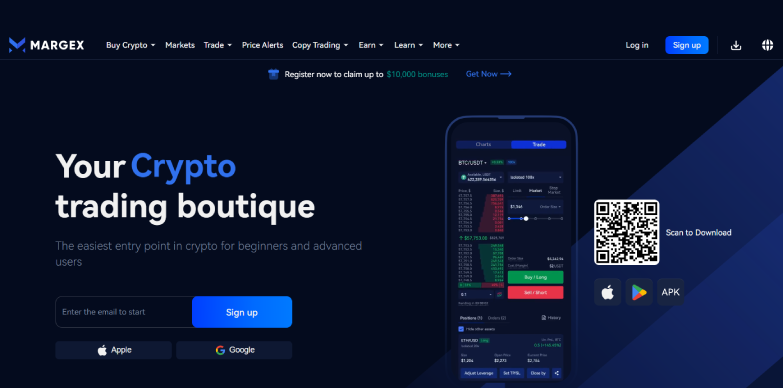
Launched in 2019 as a crypto derivatives trading platform, Margex exchange specializes in crypto perpetual futures contracts. This model allows users to predict the price movement of major digital assets without owning the underlying cryptocurrencies.
Margex does not offer spot trading, as users cannot directly buy, hold, or withdraw cryptocurrencies as personal assets. Depending on the trading pair, Margex exchange provides its derivatives traders with leverage up to 100x and a copy trading feature that lets individuals follow and replicate strategies from experienced traders.
Is Margex Legit?
Company Transparency
The exchange is operated by Margex Trading Solutions Ltd., a corporate entity registered under the International Business Companies Act (Reg no. 225155) in the Republic of Seychelles. Margex’s legal presence in Seychelles provides a registered jurisdiction, but it does not hold major regulatory licenses from Tier-1 financial regulators such as the U.S. SEC, U.K. FCA, and E.U. regulators. Hence, you will not find this platform in major regulatory registries.
The platform does not have publicly available disclosures. In fact, detailed leadership information and a fully transparent executive team are not prominently published. The formal audit reports are not publicly available either. Overall, while Margex has a verifiable registered legal entity, its regulatory oversight and public transparency are relatively limited compared with heavily regulated platforms.
Regulatory Status
Since the exchange operates an offshore model, it lacks a legal framework to operate as a digital asset provider in major financial markets. It does not have a model for enforcing investor protection and audited financial standards. In 2022, Spain’s Comisión Nacional del Mercado de Valores (CNMV) issued a public warning to notify the public that the Margex exchange was unregulated and not authorized to provide investment services in Spain, highlighting its unregulated status to retail investors.
“Unregulated” means that the activities of the platform are not under the oversight of major financial regulators. In essence, there is no investor compensation model to reimburse investors and users if the exchange becomes insolvent or user funds are lost. Users may also have to deal with limited dispute resolution options, as there are no formal regulatory bodies to hear complaints.
Overall, Margex’s derivatives offerings serve global users from jurisdictions with lighter regulatory oversight, which may reduce compliance costs, but also means users have limited legal recourse and protections compared with regulated exchanges.
More so, legal recourse can be more complex when the exchange is unregulated because cross-border legal action, which is costly and difficult to implement, may be required. This structure does not simply imply illegality; it just means that formal protection mechanisms are reduced compared to heavily regulated exchanges.
Is Margex Safe? (Security & Counterparty Risk Audit)
If one is looking to ascertain “Is Margex safe?” or “Is Margex legit?”, the key factor to consider is custody. The exchange is a custodial offshore derivatives platform, as users do not hold private keys and must trust Margex’s internal security controls to safeguard funds and process withdrawals. Hence, there is a counterparty risk because users depend on Margex’s operational controls and ecosystem solvency.
Although the platform states that it employs cold storage and internal risk management systems, the absence of full public financial audits limits transparency compared to heavily regulated platforms.
There is also no formal investor compensation mechanism because the platform operates outside the regulation of Tier-1 financial frameworks. Hence, it is best suited to experienced traders who are comfortable with the platform and leverage risks.
Security Infrastructure
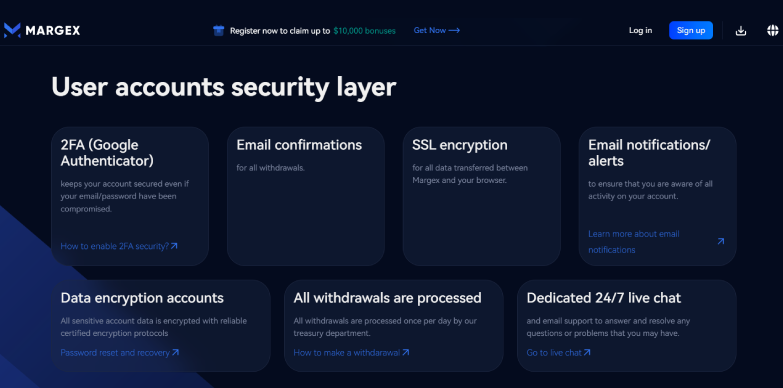
Margex states that it uses a multi-layered security infrastructure designed to protect user accounts and platform data. Most of the client funds are stored in a cold wallet, meaning these assets are stored offline and are safe from internet risk exposures. This cold storage model reduces hacking risks, compared to hot storage models, though users must still trust interns’ custody controls.
Margex uses account-level protection, which includes two-factor authentication (2FA), which adds a login verification layer beyond passwords. It also uses SSL encryption to secure data transmission between users and its servers, hence preventing interception of sensitive information.
Many Margex reviews have it that it implements a DDoS protection to defend against distributed denial-of-service attacks that could disrupt trading or withdrawal.
Margex also floats a custom MP Shield system, described as a price manipulation protection mechanism. This system is positioned to safeguard against unfair liquidations caused by abnormal price spikes. However, it remains a marketing-defined feature rather than an independently audited system. As with most offshore derivatives exchanges, security often depends on internal security controls and operational integrity rather than publicly verified audits.
Proof-of-Reserves Analysis
Proof-of-Reserves (PoR) is a publicly verifiable mechanism that shows a crypto exchange has sufficient assets to cover all user balances. This mechanism uses cryptographic proofs or third-party audits to ascertain solvency in real-time.
This mechanism matters because it enhances transparency and trust, as it shows users that funds are not mismanaged, over-leveraged, or at risk of insolvency. Exchanges with proof-of-reserves reduce counterparty risk, provide reassurance against system hacks and failures, and support regulatory credibility.
Margex exchange does not publish its PoR audits, meaning users must rely on the platform’s internal guarantees on fund security. Unlike Binance and Kraken, which periodically publish PoR data or engage third-party attestations, or Bybit, which also maintains some transparency reports for derivatives holdings, Margex lacks any form of external verification or audit transparency.
Without PoR publishing, Margex users face increased counterparty and operational risks, as there is no independent confirmation that it fully covers all user balances. This is even more relevant given Margex’s offshore derivatives model and high-leverage trading environment, where liquidity corrections or mismanagement could directly impact user capital.
Insurance Fund & Socialized Loss Risk
Insurance funds are designed to cover losses when highly leveraged positions cannot be fully closed at the liquidation price. Hence, if a trader’s position is liquidated but market movements leave a shortfall, the insurance fund absorbs the loss, preventing it from affecting other users’ accounts.
Margex states that it maintains such a fund to help stabilize the platform during extreme volatility, especially for high-leverage perpetual futures products. However, the exact size, structure, or transparency of the insurance fund is not publicly disclosed, unlike some major competitors like Binance and Bybit, who often report funding levels or rules.
The absence of detailed disclosure then means that users cannot independently verify whether the insurance fund is sufficient to handle large market swings. Consequently, while the fund provides a theoretically safe model, Margex users should still note that significant market swings, high leverage, and sudden volatility could still result in losses beyond account balances, and the platform’s internal risk management is largely unverified externally.
The platform does not use stop-loss or limit orders on the standard interface, which is a limitation for risk management.
Trading Experience & Platform Testing
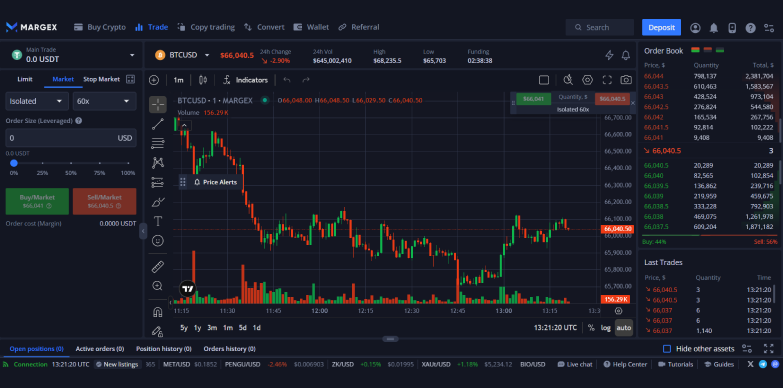
Margex is designed for low-latency execution and stable performance under high-order flows. This is why many derivatives traders choose Margex, as its mechanism reduces slippage and timeout errors during market volatility.
The ecosystem also uses a risk modeling algorithm to reduce manipulation and order pressure during fast-paced market sessions. Compared with many competitors, Margex’s approach to execution quality, chart responsiveness, and leveraged mechanics tends to feel tighter and more predictable in hands-on platform testing. This favors perpetual futures users rather than traditional spot investors.
Leverage & Liquidation Mechanics
Liquidation Probability Modelling
A 1% intraday ETH move can liquidate a fully leveraged 100x position. Margex uses ATR-based analysis in its internal risk systems to model price volatility and estimate liquidation probability. This model helps traders to assess the risk and see how susceptible their positions are to liquidation before entering high-leveraged trades.
Funding Rate Analysis
Margex charges 8-hour funding cycles on perpetual futures, meaning positions pay or earn funding three times a day based on the long-short imbalance. In the long run, these payments multiply, and traders holding positions for 30 days may experience significant charges.
Margex’s funding rate is usually 0.02% per cycle, the same as Bybit, though rates fluctuate with market conditions. However, on a general market basis, BitMEX usually charges 0.04%.
| Duration | Margex Funding (0.03% per 8hr) | Bybit Funding (0.02% per 8hr) | BitMex (0.04% per 8hr) |
|---|---|---|---|
| 7 days | About 0.63% | About 0.42% | About 0.84% |
| 30 days | About 2.70% | About 1.80% | About 3.60% |
Slippage & Liquidity Depth
Order book depth means the volume present at each price level in an exchange’s order book. When the books are very deep, large orders have very little impact on price, resulting in lower slippage, which is the difference between the expected and executed price. On the other hand, order books that are very thin (especially in low-volume altcoins) show wide gaps between buy and sell prices, making larger trades have a significant effect on the market.
On Margex, major pairs like BTC and ETH perpetual markets have moderate liquidity but are generally shallower than those on larger exchanges. This means that mid-range orders (e.g $1k) can generally execute with minimal slippage, but a large order (e.g $5k) can significantly move the price of the market because the depth is not very deep. On many altcoin perpetuals, the books are even thinner, increasing the price impact and execution cost for both small and mid-sized trades.
Compared with Binance and Bybit, which have strong depth for many markets, Margex has less overall depth, leading to higher potential slippage on large trades and thinner altcoin books.
| Exchange | BTC Perpetual Depth Estimate | ETH Perpetual Depth Estimate | Altcoin Liquidity |
|---|---|---|---|
| Margex | Moderate | Moderate | Thin |
| Binance | Very Deep | Very Deep | Deep |
| OKX | Deep | Deep | Moderate – Deep |
Margex Fees Breakdown (Real Cost Modelling)
Margex exchange charges a maker fee of 0.019% and a taker fee of 0.060%. A realistic comparison against Binance futures shows typically lower fees at base levels; Binance charges about 0.02% maker fee and between 0.04 – 0.05% taker fee with further discounts for large trades and BNB holders.
If we compare Margex’s trading fees with Bybit, Bybit offers competitive fees: 0.02% for maker and about 0.055% for taker, and gives out discounts for some VIP tiers.
Funding Costs Over Time
On Margex perpetual contracts, funding payments are charged every 8 hours based on the long-short imbalance. The longer a position is held, the more these costs accumulate.
Intraday traders accumulate lower funding costs because they open and close their trades within a day. Hence, they don’t get to accrue multiple 8-hour charges.
For swing traders who hold their positions for days, they incur moderate or mid-range funding costs because the 8-hour charges accrue from open positions left over from days. These charges then multiply within a 3 to 7 day period.
For 30-day holders, they have the highest funding rate, which has compounded over a period of weeks. Because they are holding positions for weeks, their charges multiply, as even a small charge can be enormous by the end of a 90-day window.
Real Monthly Cost Simulation
Let’s take our capital as $200, a 10x leverage, 30 trades per month, average funding of 0.02% per 8 hours, held 24 hours per trade, and a 0.060% taker fee since traders are more on the taker side in real life. With a position size of $2000 per trade, let’s simulate:
Trading fees:
Taker fee per side: 0.060% x $2,000= $1.20
Entry + Exit = $2.40
30 trades: $72 total fees
Funding Costs
0.02% per 8hrs x 3 cycles per day = 0.06% per day
0.06% x $2,000= $1.20 per trade (if held for 24hrs)
30 trades: about $36 funding fees
Liquidation Fee Risk
If one trade hits liquidation, an additional penalty coupled with margin loss may cost around $10 to $20 and above, minus full capital loss.
Estimated monthly costs
Trading Fees: $72
Funding: $36
Slippage: $30
Total: $138
With about $138 in structural costs on a $200 capital, the trader must generate almost 70% monthly return on equity just to break even, excluding liquidation events. Hence, high turnover plus leverage significantly raises the profitability threshold.
*Note: The above example is a hypothetical modeling scenario for illustrative purposes only and does not represent actual trading outcomes.
Supported Markets & Assets Selection
| Exchange | Number of Contracts | Major Altcoins | Order Book Depth (BTC/ETH) | Overall Liquidity |
|---|---|---|---|---|
| Margex | 20 – 30 perpetual contracts (BTC, ETH, and selected alts) | Limited – core high-cap coins available, but major altcoin coverage is weak | Moderate depth on BTC/ETH | Moderate, but thinner on smaller altcoins |
| Binance | 100+ perpetuals and futures market | Extensive altcoin futures | Very deep on BTC/ETH | Very deep across most pairs |
| Bybit | 50+ perpetuals and futures market | Strong altcoin base, but less than Binance | Deep on BTC/ETH | High overall but strong for major pairs |
| OKX | 80+ perpetuals and futures market | Broad altcoin futures and options | Deep on BTC/ETH | High across major and mid-range pairs |
Copy Trading & Staking — Are They Worth It?
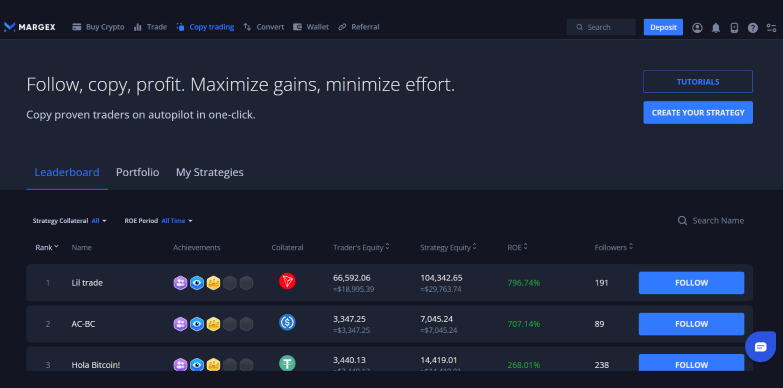
For copy trading, the risk appears in the fact that performance is not guaranteed, as the losses of the lead trader are replicated even during high volatility and leverage events.
Also, followers share a percentage of their profits with the strategy provider. So, they don’t have 100% profits no matter what.
Historical returns are platform-reported and may not show full risk exposure, changing market conditions, and general pushbacks.
There is counterparty dependency as users depend on both the lead trader’s expertise and Margex’s operational and ecosystem management.
Risk Disclaimer: Copy trading involves substantial risks, including potential loss of capital, and it is also noted that past performance does not guarantee future results.
User Reviews & Reputation Analysis (Margex Reviews)
User reviews are mixed across platforms, with both positive and negative experiences reported. Across Reddit and community forums, members report delayed withdrawals, forced KYC after deposits, account access issues, and account freezes — though these are just reports and not confirmed.
A pattern analysis shows that users complain about withdrawal issues and unresponsive support repeatedly, with the majority claiming that issues occurred after deposit.
Despite the above claims, the risk level of Margex could still be categorized as moderate because, as some users complain of poor services, others commend the platform for smooth access and reliability.
Margex vs. Top Competitors
| Metric | Margex | Binance | Bybit | OKX |
|---|---|---|---|---|
| Regulation | No regulation | Broad global compliance | Strong global compliance (excluding the US) | Licensed in Malta, Labuan (Tiered KYC) |
| Proof-of-Reserves | Not available | Yes, voluntary PoR reporting | Available | Transparent reserves |
| Insurance Funds | Not publicly disclosed | Over $1B in SAFU Funds | Available | Risk and insurance funds are reported |
| Liquidation Model | Standard derivatives liquidation | Advanced, portfolio margin | Standard with risk limits | Standard with risk controls |
| Funding Variability | Variable; periodic funding cycles | Variable across products | Variable but deep liquidity stabilizes | Variable with unified accounts |
| Market Depth | Moderate; thinner than major | Very deep global liquidity | Deep derivatives liquidity | Strong liquidity across assets |
| KYC Requirements | Not required, but may be required by the system for large, suspicious, and abnormal trades. | Tiered (required for full use) | Flexible tiers | Mandatory |
| Transparency Score | Low (no audits, no PoR) | High (audits + disclosure) | High (PoR + funds) | High (security & reserves) |
Compared to major exchanges, Margex has no regulatory or formal licensing, resulting in an increase in its counterparty risk. For a more detailed comparison, visit our best crypto exchanges hub page.
Who should use Margex?
The platform is best for small retail traders, high-volume scalpers, and users comfortable with offshore exchanges, that is, exchanges with no publicly disclosed regulations. On the other hand, U.S. residents, high-volume traders, long-term holders, and users who seek regulatory clarity should avoid the Margex exchange and look for alternatives that suit their interests and trading needs.
Our Methodology: How We Reviewed Margex
We reviewed Margex based on publicly available data, direct first-hand testing, and broader market context to help readers make an informed assessment of the platform.
First, we did hands-on testing to evaluate trading execution, deposits, order types, fee structure, UI/UX responsiveness, and withdrawal processes to verify the core functionality of the system.
Next, we did a comparison against other exchanges, looking at parameters such as spot liquidity, derivatives depth, fee competitiveness, and regulation to contextualise strengths and limitations.
We then did a security analysis, which revealed security upgrades such as cold storage and 2FA. To conclude, we carried out user feedback analysis to assess community sentiments from user reviews and forum sites. This gave us a clear understanding regarding feature gaps, risk exposures, and support responsiveness.
The result of our first-hand testing is this balanced and practical review that provides a comprehensive overview of the real-world experience using the Margex exchange.
Final Verdict
It is obvious from our Margex exchange review that the strengths of the platform are in its simple UI, competitive fees, and high leverage access. However, traders are skeptical about this exchange because of its lack of proof-of-reserves, its limited transparency, its offshore and unregulated model, and its full liquidation model.
Overall, the Margex exchange provides core features that may appeal to short-term speculative derivatives traders. The platform is functional and operational, but it does not currently meet institutional-grade standards in terms of regulatory oversight and transparency.
Frequently Asked Questions
Is Margex safe?
Margex implements internal security measures such as 2FA and cold storage, but it does not publish proof-of-reserves or operate under Tier-1 regulatory oversight. Users should assess their own risk tolerance.
Is Margex legit?
It operates under Margex Trading Solutions Ltd, which has a registered business number, but it is not regulated by financial institutions.
Is Margex available in the USA?
No, Margex is not available to users in the United States due to regulatory restrictions.
Does Margex require KYC?
No, Margex does not require mandatory KYC verification for basic trading access. However, users should check current compliance policies before registering.
What is the max leverage on Margex?
The maximum leverage offered on Margex is up to 100x, depending on the trading pair and risk parameters.
Does Margex have proof of reserves?
No. It does not. However, the platform may request detailed verification for large, abnormal, or suspicious transactions.
Has Margex been hacked?
There is no publicly available data that shows that the exchange has been hacked.
What happens if Margex goes bankrupt?
Most likely, users would lose their funds since there is no investor compensation model available.
See less