
Best Crypto Exchanges and Apps for 2026


In the last few years, the crypto sector has grown exponentially, driven by increased adoption by institutional investors and progress in regulatory frameworks. However, the risks of losing money are still there in the crypto market, especially if you choose the wrong crypto exchanges for your hard-earned money.
We assessed more than 100 cryptocurrency exchanges against major criteria, including fees, regulatory compliance, security, and the range of features each platform offers. Our analysis highlighted Coinbase as the top overall pick for most users in 2026, thanks to its strong regulatory compliance, beginner-friendly user interface, and solid security standards.
- Coinbase is still the best crypto app for beginners. It’s heavily regulated by FinCEN and the United States Securities and Exchange Commission (SEC); the interface is clean, and USD balances come with FDIC insurance. Everything feels familiar, which is why most first-time crypto buyers start here.
- Binance holds the tag of the biggest crypto exchange with 250 million users across more than 100 countries. It records around $10 billion in daily trading volume.
- Kraken remains the security king. Low maker fees starting at around 0.25%- 0.40%, strong oversight from FinCEN and the FCA, deep liquidity, and reliable staking rewards make it the cryptocurrency exchange professionals tend to trust most.
- OKX and Toobit dominate the advanced trading scene. Maker fees around 0.08%–0.10%, fast matching engines, access to 200x leverage, and huge derivative markets make them ideal for global traders who want speed and flexibility.
- MEXC is the altcoin hunter’s playground. With 2,000+ assets, zero maker fees, and constant new listings, it’s perfect for people who like exploring gems before they go mainstream.
- CryptoNewsZ personally tested more than 100 cryptocurrency exchanges. The team compared fees, security standards, staking yields, withdrawal speeds, liquidity depth, and customer support response times to give recommendations that actually reflect real user experiences today.
Our Review Methodology for Crypto Exchanges
- CryptoNewsZ reviewed 100+ crypto exchanges over three months with more than 20 rigorous metrics. We considered maker and taker fees, convenience fees, security, liquidity, regulation, coin selection, payment services, and genuine customer reviews.
- We analyzed proprietary data, such as $30B in BTC volume and MEXC’s 1.4M transactions per second. For instance, we added Kraken for lower fees and FinCEN registration, making it the best option for U.S. traders who care about fees.
- We do use affiliate links (always with full disclosure), but our views are straightforward and non-promotional.
Top Crypto Exchanges for 2026 - Detailed Reviews
1. OKX – Low Trading Fees
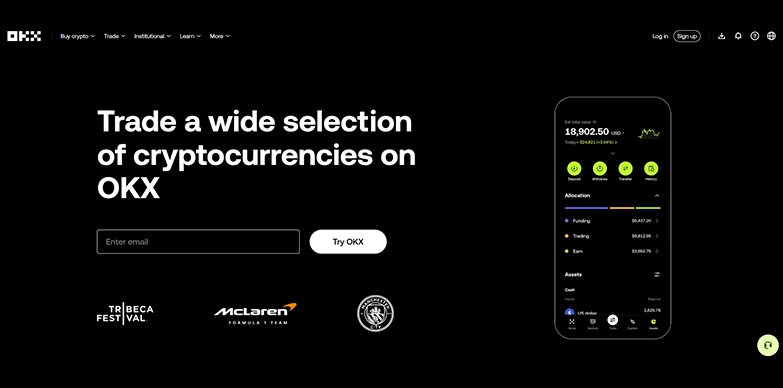
- Available Coins – More than 300
- Fees (Maker/Taker) – Maker 0.08%, Taker 0.10%
- Regulated – Dubai VARA Full VASP License, European Union MiCA, Singapore Major Payment Institution license, and Australia (AFSL)
- Derivatives/ max leverage – Perpetual futures, max leverage goes up to 125x
- Security Incidents – Data breach in 2024
Introduction
OKX ranks among the best crypto exchanges, known for massive trading derivatives liquidity, an advanced interface, and a powerful Web3 wallet. With billions in assets and thousands of pairs, it offers one of the most complete ecosystems for modern traders.
Why We Choose It
Its combination of social trading, automation tools, low fees, and deep crypto derivatives markets makes OKX ideal for experienced crypto traders who want everything in one platform.
Key Features
- 300+ tokens and 700+ trading pairs
- Spot, margin (up to 20x), futures, swaps & options
- Copy trading with transparent statistics
- Strategy bots (grid, DCA, arbitrage)
- OKX Web3 Wallet with DeFi access across 40+ blockchains
- Ultra-low fees (0.02%-0.2%)
Pros and Cons
| Pros | Cons |
| Excellent derivatives liquidity | Not available in the US |
| Powerful trading tools and bots | Advanced features may feel overwhelming |
| Integrated Web3 wallet with DeFi access | Smart contract risk for DeFi options |
2. CoinW – Global Altcoin Trading Hub with Competitive Futures
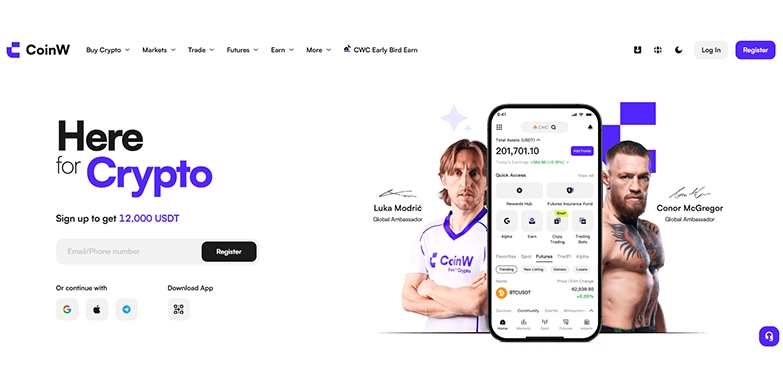
- Available coins – 300+
- Fees (Maker/Taker) – Maker 0.1%, Taker 0.6%
- Regulated – No Major Tier-1 (offshore, MSB registration in selected regions, AUSTRAC registration)
- Derivatives/ max leverage – Perpetual futures market, up to 200x leverage
- Security Incidents – None
Introduction
CoinW is a global cryptocurrency exchange launched in 2017, known for its large selection of altcoins. The platform offers a derivatives market and a user-friendly design. The platform suits both beginners and experienced traders, offering spot, futures, copy trading, and staking options.Why We Choose It
CoinW appeals to traders who want to trade large volumes and get early access to new tokens. The cryptocurrency exchange is also known for competitive fees. The cryptocurrency is popular among altcoin fans and futures traders who want high leverage, with up to 200x available on certain pairs.Key Features
- More than 350 cryptocurrencies and thousands of trading pairs.
- CoinW has advanced trading tools, including copy trading and trading bots.
- High-leverage futures and margin trading.
- Mobile application with P2P options.
- Staking and yield products with impressive APYs.
Pros and Cons
| Pros | Cons |
| More than 350 cryptocurrencies, along with new listings. | Limited major regulatory licenses in top-tier jurisdictions. |
| CoinW is known for competitive fees, especially on futures. | Not available to US Users. |
| User-friendly interface for all types of traders. | Low liquidity on tokens with small market capitalization. |
3. PrimeXBT – Multi-Asset Investment & Trading Platform
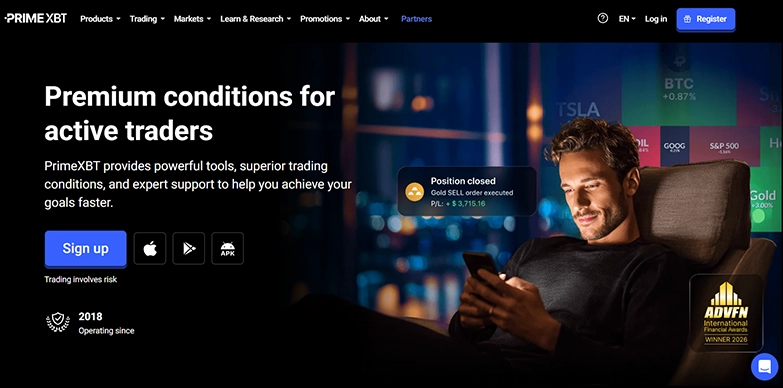
- Available coins – More than 100
- Fees (Maker/Taker) – Maker 0.01%, Taker 0.02%-0.045%
- Regulated – Digital Asset Services Provider (DASP) license in El Salvador, Securities Dealer by the Financial Services Authority (FSA) in Seychelles
- Derivatives/ max leverage – Offers Derivatives Trading, up to 500x leverage for Bitcoin
- Security Incidents – None
Introduction
PrimeXBT is a derivatives and multi-asset trading platform built for users who want high leverage and deep liquidity. It offers crypto, forex, commodities, and index CFDs in one dashboard. With $1.5 billion in daily volume, PrimeXBT has become a popular destination for more experienced traders who enjoy flexible markets and fast execution.Why We Choose It
The exchange offers a wide selection of markets, plus high-leverage options and a clean, TradingView-powered interface, making it ideal for active traders who want more than just crypto.Key Features
- Leverage up to 200x
- 100+ trading pairs across crypto, forex, commodities & indices
- TradingView charts and customizable workspace
- No mandatory KYC for basic accounts, though KYC is required in the regulated entity
Pros and Cons
| Pros | Cons |
| Multi-asset trading in one platform | No KYC means lost accounts are nearly impossible to recover |
| High leverage and low trading fees | Not ideal for beginners or low-risk traders |
| Simple order placement with strong charting tools |
4. Margex – An Efficient Crypto Trading Platform
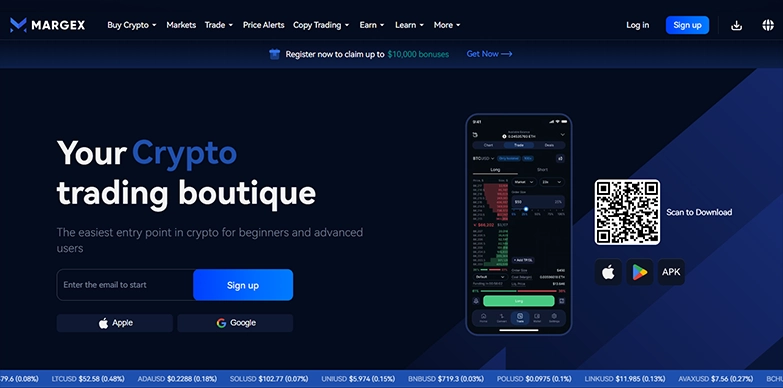
- Available coins – Over 60
- Fees (Maker/Taker) – Maker 0.019%, Taker 0.06%
- Regulated – Unregulated by major Tier-1 authorities.
- Derivatives/ max leverage – Perpetual Futures trading, max leverage goes up to 100x
- Security Incidents – None
Introduction
Margex focuses specifically on Bitcoin and Ethereum perpetual trading, offering up to 100x leverage. The platform executes orders quickly and is built for simplicity, attracting traders who prefer focused, high-leverage environments.Why We Choose It
Its MP Shield system, which protects users from unfair liquidations, and its clean, fast interface make Margex appealing for BTC/ETH derivatives traders.Key Features
- BTC & ETH perpetual contracts
- Up to 100x leverage
- MP Shield liquidation protection
- TradingView charts and fast execution
- Copy trading support
- Low maker/taker fees (0.019% / 0.06%)
Pros and Cons
| Pros | Cons |
| Excellent for high-leverage BTC/ETH traders | Very few trading pairs |
| Simple interface with fast execution | No staking, lending, or extra features |
| MP Shield adds extra liquidation protection | Not regulated |
5. Bitfinex – Best Multi-Asset Exchange
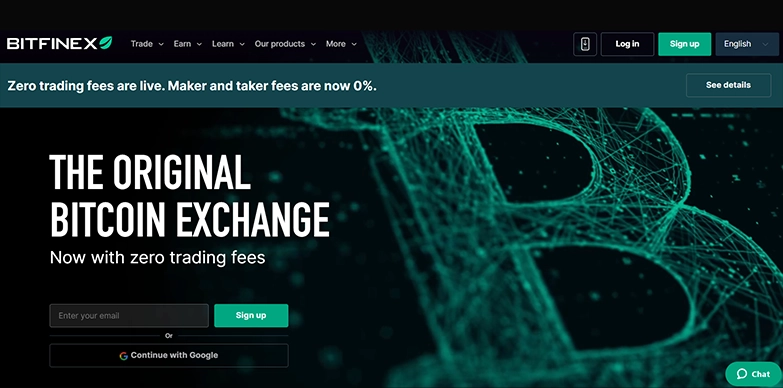
- Available coins – 270+
- Fees (Maker/Taker) – No Maker and Taker Fees on spot, margin, and derivatives trading
- Regulated – No Major Tier-1 regulatory licenses
- Derivatives/ max leverage – Derivative trading, leverage goes up to 100x
- Security Incidents – Major Security Incident in 2016
Introduction
Bitfinex is a long-standing exchange known for deep liquidity and advanced tools. Processing over $100 million daily, it offers spot, margin, derivatives, and a unique peer-to-peer funding market that appeals to sophisticated traders.Why We Choose It
Its liquidity, professional-grade tools, and margin-funding system make it perfect for institutional traders and high-volume players.Key Features
- More than 170 coins and 400+ pairs
- Margin up to 10x – Derivatives and P2P margin funding
- 99.5% cold-storage protection
- Staking yields up to 6.5%
Pros and Cons
| Pros | Cons |
| Very deep liquidity | Past security incidents |
| The margin funding market is unique and versatile | Complex interface for beginners |
| A strong suite of professional tools | Tether regulatory concerns |
6. Gemini- Most Secure Exchange & Best for US Traders
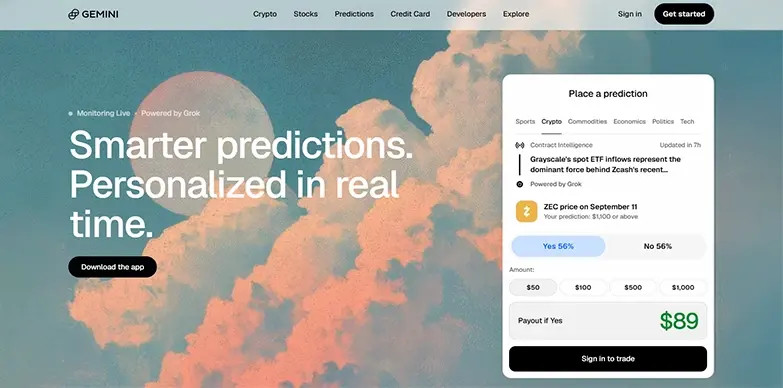
- Available coins – 90+
- Fees (Maker/Taker) – 0.6%/1.20%
- Regulated – NYDFS
- Derivatives/ max leverage – Crypto Derivatives, up to 100x Leverage
- Security Incidents – None
Introduction
Gemini operates under one of the strictest regulatory frameworks globally, licensed across all 50 US states. It holds $200 million in insurance for crypto in hot storage and maintains high compliance standards. Also, Gemini offers a clean, beginner-friendly trading experience.Why We Choose It
Its strong security, regulated environment, and insured assets make it the safest exchange for US users who value trust and transparency.Key Features
- 90+ digital assets and 100+ trading pairs
- $200M hot-wallet insurance
- Beginner-friendly app with biometric login
- Staking for ETH and SOL
- Gemini Credit Card with crypto rewards
Pros and Cons
| Pros | Cons |
| Extremely high regulatory protection | High trading fees |
| Simple and secure user experience | Limited advanced tools |
| Insurance coverage on hot wallets |
7. Kraken- Exchange With High Security
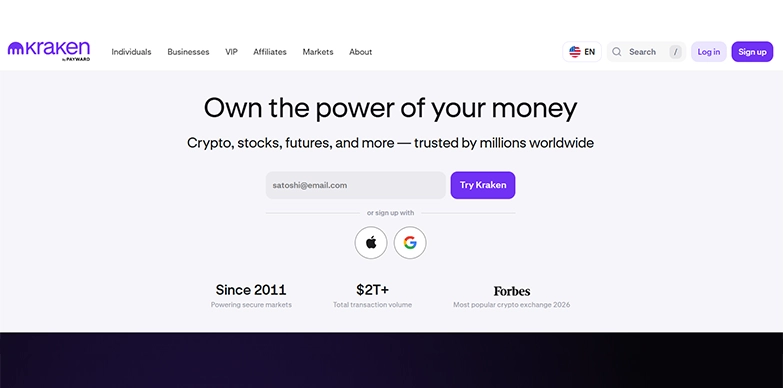
- Available coins – 570+
- Fees (Maker/Taker) – Maker 0.16%, Taker 0.26% (based on volume tiers)
- Regulated – Yes (FinCEN-registered, FCA, multiple state licenses)
- Derivatives/ max leverage – Crypto Futures and Perpetual Contracts, up to 100x Leverage
- Security Incidents – Insider Data Access and Extortion (2025-2026)
Introduction
Kraken is one of the oldest and top-rated crypto exchanges, operating since 2011 without a major security breach. Kraken offers 570+ tokens, 1,000 pairs, and both beginner and advanced trading interfaces with strong liquidity.Why We Choose It
Its long-standing security record, diverse markets, and fair fees make Kraken a trusted option for intermediate and advanced traders.Key Features
- Spot, margin, and futures markets
- 0%–0.26% trading fees
- Kraken Pro with 70+ technical indicators
- Licensed by FinCEN, FCA, AUSTRAC
- Staking with up to 21% rewards
Pros and Cons
| Pros | Cons |
| 13+ years of unmatched security | The interface can be complex for new users |
| Deep liquidity on major pairs | Some altcoins have thin liquidity |
| Strong staking rewards | App design feels slightly outdated |
8. Poloniex- Best for Cross Margin Trading
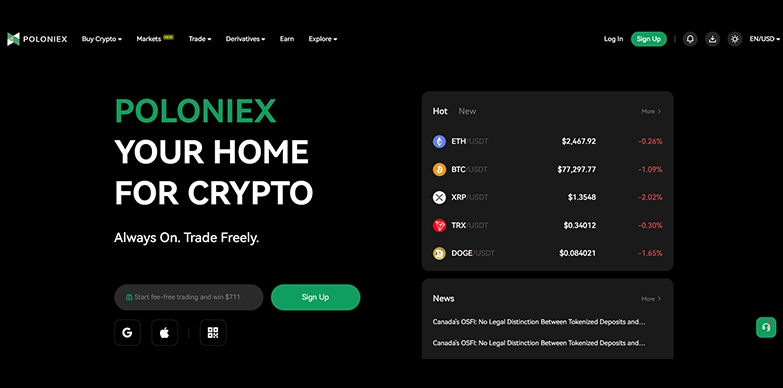
- Available coins – 350+
- Fees (Maker/Taker) – Maker 0.07%-0.145%, Taker 0.12%-0.19%
- Regulated – No (Not FinCEN/SEC-registered, Seychelles-based)
- Derivatives/ max leverage – Crypto Derivatives, up to 100x Leverage
- Security Incidents – Hot Wallet Breach in 2023
Introduction
Poloniex is known for its broad altcoin selection, providing over 500 pairs, including niche DeFi and low-cap tokens. With around $1B in daily volume, it attracts traders looking for variety and flexible margin tools.Why We Choose It
Its low fees, broad altcoin access, and cross-margin features make it ideal for active traders who explore new markets frequently.Key Features
- 350+ trading pairs
- Up to 100x leverage
- Lower fees with TRX staking
- Spot, margin, and futures trading
- ATOM staking with up to 25% APY
Pros and Cons
| Pros | Cons |
| Huge variety of altcoins | Previous hacks and reliability concerns |
| Competitive fees | Slow withdrawals during market spikes |
| Good for cross-margin traders | Liquidity varies widely across tokens |
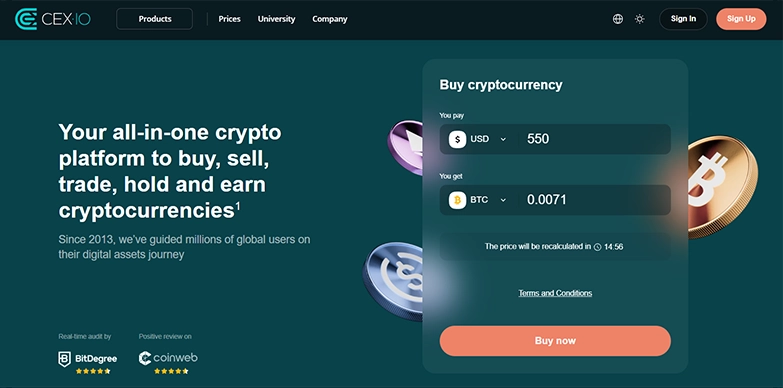
9. CEX.io- Customer-Centric Crypto Trading Platform
- Available coins – 100+
- Fees (Maker/Taker) – Maker 0.1%-0.15%, Taker 0.2%-0.25%
- Regulated – Yes (FinCEN-registered, UK FCA-authorized)
- Derivatives/ max leverage – Margin Trading, up to 20x Leverage
- Security Incidents – None
Introduction
CEX.io offers strong fiat integration and is regulated in the US, UK, and EU. It supports a wide range of fiat currencies alongside 300+ cryptos, making onboarding extremely simple for global users.Why We Choose It
Its beginner-friendly interface, strong regulatory compliance, and wide fiat support make CEX.io ideal for new users and international traders.Key Features
- 100+ tokens and 300+ trading pairs
- Supports USD, EUR, GBP, RUB & more
- Tiered trading fees (0.1% maker / 0.25% taker)
- Fast card deposits and purchases
- Staking up to 30% APY
- Broker service for instant crypto purchases
Pros and Cons
| Pros | Cons |
| Excellent fiat on-ramps and global support | Card deposits can be expensive |
| Regulated across major regions | No futures or leverage trading |
| Easy for beginners with a clean interface | Lower liquidity than top-tier exchanges |
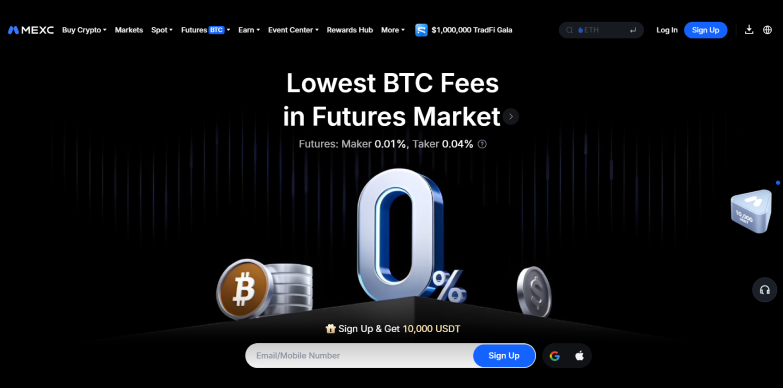
10. MEXC - Lowest Fees and Widest Altcoin Selection
- Available Coins – 2,500+
- Fees (Maker/Taker) – 0%/0.05%
- Regulated – It operates services in most countries through its offshore entity
- Derivatives/ max leverage – Perpetual Futures, Offers leverage up to 500x
- Security Incidents – None
Introduction
MEXC is popular among crypto traders for its wide range of cryptocurrencies, offering spot trading for more than 2,500 cryptocurrencies, including BTC, ETH, SOL, etc. The crypto exchange is known for competitive, low fees, fast new token listings, and a full suite of products, including spot, perpetual futures, margin trading, copy trading, and staking. It regularly records impressive volume in futures and spot activity.Why We Choose It
It offers a wide range of tradable assets, including popular altcoins and newly listed tokens. It offers some of the lowest spot trading fees. It also offers high-leverage derivatives and tools designed for active, speculative traders. This makes it a strong fit for users who want deep market access and cost efficiency beyond major blue-chip cryptocurrencies.Key Features
- Competitive fees, including a 0% maker standard on spot and futures.
- Monthly Proof of Reserves in order to ensure the backing of users’ funds.
- It also offers staking products, copy trading, margin, and tokenized assets.
- It comes with high liquidity on major and many popular cryptocurrencies, like BTC/USDT.
- Beginner-friendly mobile application and advanced trading tools.
Pros and Cons
| Pros | Cons |
| A wide range of cryptocurrencies and trading pairs, with quick listings of newly launched tokens. | It does not hold major Tier-1 regulatory licenses. |
| Strong derivatives offering with high-leverage options. | Beginners often find the app interface complex due to the large number of features. |
| Regular, transparent Proof of Reserves and protective funds. | Occasionally, some users report account freezing. |
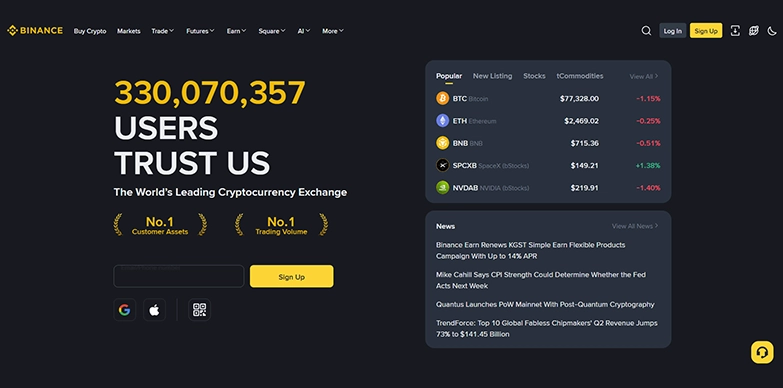
11. Binance - Global Volume and Derivatives
- Available Coins – 500+
- Fees (Maker/Taker) – 0.1%/0.1% (base)
- Regulated – Registered in more than 20 countries, including India, Abu Dhabi Global Market (ADGM), Dubai, and Australia
- Derivatives/ max leverage – Offers derivative trading, leverage up to 125x
- Security Incidents – Binance’s hot wallet was compromised in 2019
Introduction
Binance is the world’s largest cryptocurrency exchange by trading volume and user base, with millions of registered users. The platform offers a comprehensive ecosystem, including spot trading, margin, futures, and perpetuals with leverage up to 125x on selected pairs, plus options, earn, and staking products. Binance comes with impressive depth on major trading pairs while also supporting a solid range of mid-cap and lower-cap assets. Its liquidity depth makes the platform suitable for both retail and professional traders worldwide.Why We Choose It
The platform provides great liquidity depth on popular trading pairs. It offers a professional-grade product suite among major exchanges, along with competitive trading fees with volume-based discounts. Its strong security measures and transparency make Binance the go-to global platform for high-volume trading and diversifying crypto investments.Key Features
- It supports spot trading service for more than 1,400 trading pairs along with deep perpetual futures, options, and TradFi-linked products.
- It offers a strong security framework by keeping most assets in cold storage. It has also integrated multi-signature controls and zk-SNARK Proof of Reserves.
- It offers the SAFU insurance fund to compensate users in case of a security breach.
- Tiered fee structure with BNB discounts and VIP benefits for active traders.
Pros and Cons
| Pros | Cons |
| Deepest liquidity and lowest slippage for large trades among centralized exchanges. | It has a complex user interface, and numerous features on a single dashboard can overwhelm beginners. |
| Transparent Proof of Reserves and an important user protection fund (SAFU). | Product limitations in some regions and KYC requirements. |
| It comes with competitive fees that improve significantly with volume or BNB use. | Binance has faced regulatory scrutiny in many countries in the past. |
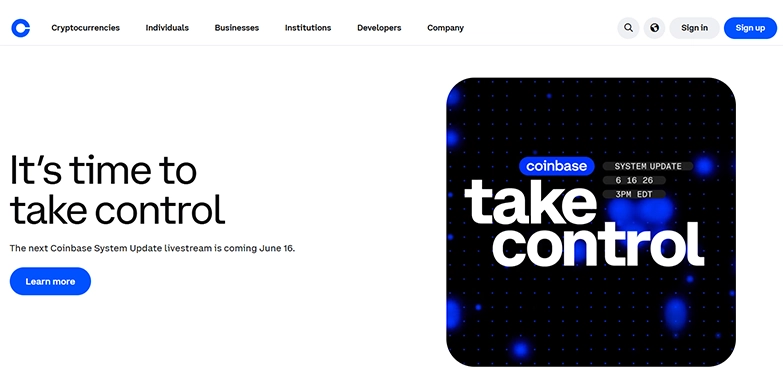
12. Coinbase - Most Compliant-friendly Crypto Exchange
- Available Coins – 400+
- Fees (Maker/Taker) – 0.4%/0.6% (base)
- Regulated – Holds licenses in more than 80 countries, including Europe’s MiCA, India’s FIU-IND registration, New York BitLicense, and others.
- Derivatives/ max leverage – Futures and perpetual contracts, up to 50x
- Security Incidents – Data breach reported in 2025
Introduction
Coinbase is one of the most established and trusted cryptocurrency exchanges, widely popular in the United States and other regulated markets. It holds a large share of US spot volume while expanding its footprint globally. The platform focuses on compliance, ease of use, and institutional-level custody. It offers a smooth retail interface alongside Coinbase Advanced Trade for advanced traders. Beyond spot trading, it offers staking products, USDC rewards, a self-custody wallet option, and more.Why We Choose It
Coinbase is known for its strong compliance and transparent public-company structure. It offers strong security and custody of users’ funds. Its easy-to-use interface makes Coinbase a strong choice for beginners.Key Features
- It offers a simple interface for newcomers, plus Advanced Trade with order books, advanced order types, and charting tools.
- It offers a careful selection of popular and mid-cap cryptocurrencies.
- It also offers institutional services via Coinbase Prime and Custody via a qualified custodian structure.
- It supports a wide range of fiat on-ramps.
- It has integrated self-custody via Coinbase Wallet to engage with the Base ecosystem.
Pros and Cons
| Pros | Cons |
| It comes with industry-leading regulatory compliance and public-company transparency. | Higher fees on regular spot trading in comparison to its competitors. |
| Coinbase has convenient fiat integrations. | Staking rewards include a major platform commission. |
| It has an impressive security track record for customer funds with a beginner-friendly user interface. | Its advanced products and derivatives are restricted in some regions. |
13. Crypto.com - Best for Rewards and Crypto Card Ecosystem
- Available Coins – 400+
- Fees (Maker/Taker) – 0.250% /0.500% (Without CRO Balance)
- Regulated – Follows Compliance in more than 100 countries; holds a Major Payment Institution license in Singapore, VARA operational approval in Dubai, full CFTC derivatives licenses in the U.S., and an FCA Electronic Money Institution license in the UK
- Derivatives/ max leverage – crypto derivatives and leverage trading, leverage up to 50x
- Security Incidents – Major security breach in 2022
Introduction
Launched in 2016, Crypto.com has grown into a major global cryptocurrency exchange with millions of registered users worldwide. The platform offers a comprehensive suite of products and services designed to serve a wide range of user needs. These include a retail-focused mobile app for easy crypto access, a full-featured exchange for spot and derivatives trading, and more. It offers a widely popular Visa card program that rewards users with CRO tokens. Crypto.com also integrates DeFi wallet features for self-custody and a vast ecosystem built around the Cronos network.Why We Choose It
Crypto.com is an all-in-one platform for crypto enthusiasts, which offers far more than just a trading platform. The native CRO token gives users fee discounts and other perks, making the platform more cost-effective for active users. It also supports spot and derivatives trading for more than 400 cryptocurrencies and over 500 trading pairs.Key Features
- Complete ecosystem for crypto traders with spot, margin, perpetual futures, derivatives, and others.
- Crypto.com Visa card with tiered CRO cashback and other perks.
- It has integrated a DeFi wallet into the main user interface with integration of the Cronos ecosystem.
- It offers a mobile-first experience with fiat on-ramps in many regions.
Pros and Cons
| Pros | Cons |
| User-friendly mobile interface and global security standards. | Additional benefits are only linked to CRO token holding or staking. |
| It has highly competitive spot trading fees and discounts via CRO staking. | It has high withdrawal fees along with high minimum threshold requirements compared to other exchanges. |
| It follows regulatory compliance in many regions, including Europe’s MiCA. |
14. KuCoin - Best for Altcoin Variety and Intermediate Traders
- Available Coins – 400+
- Fees (Maker/Taker) – 0.1%/0.1% for base (Varies based on tiers)
- Regulated – India’s FIU-IND, Europe’s MiCA, Australia’s AUSTRAC
- Derivatives/ max leverage – Full suite of crypto derivatives, max leverage goes up to 125x
- Security Incidents – Hot wallet breach in 2020
Introduction
KuCoin launched in 2017 and has since become a well-known global cryptocurrency exchange, mainly known for its wide selection of altcoins and early-stage tokens. KuCoin offers spot trading for a wide range of cryptocurrencies, including ETH, SOL, POL, and others. It also offers margin trading, and futures and perpetuals with leverage up to 125x on selected pairs. Beyond its competitive fee structure, the platform rewards active users through its native token, KCS, alongside additional benefits and discounts.Why We Choose It
KuCoin is popular among traders who want to focus on emerging tokens, diversify their portfolios, and use flexible trading strategies. Its vast altcoin catalog is one of the platform’s main advantages, which allows traders access to a wide range of digital assets that may not be available on more regulated exchanges. The platform also offers competitive base fees, which can be reduced further through KCS token discounts. The platform also offers a solid derivatives suite and a variety of earning tools, allowing users to grow their holdings through staking and other products.Key Features
- Large selection of cryptocurrencies and trading pairs, including mid- and lower-cap assets.
- It offers spot, margin, perpetual futures, options in some cases, and P2P trading.
- It provides earn products including staking, flexible savings, and structured options.
- It provides advanced trading tools, such as trading bots, copy trading, and early-access launches.
Pros and Cons
| Pros | Cons |
| It offers one of the lowest spot trading fees with KCS discounts. | It has a complex fee structure across pair classes and VIP levels. |
| It offers a feature-rich platform, including advanced trading bots and copy trading. | Thin liquidity on newly launched or speculative tokens. |
| Strong security standards and regular Proof of Reserves. | |
| It is accessible in many regions, with relatively flexible onboarding in non-restricted markets. |
15. Bitget - Best for Copy Trading and Social Futures
- Available Coins – 400+
- Fees (Maker/Taker) – 0.1%/0.1% for standard trading fees, lower with Bitget’s native BGB token
- Regulated – Holds VASP registration in Europe, FCA approval in the UK, and AUSTRAC registration in Australia
- Derivatives/ max leverage – Offers crypto and stock derivatives, leverage up to 125x
- Security Incidents – Not directly
Introduction
Bitget launched in 2018 and promotes itself as a Universal Exchange, meaning users can trade a wide range of financial products in one place, including cryptocurrencies, futures contracts, and tokenized assets. Bitget holds a strong international user base. It is especially popular among traders for its copy trading tools, which let users automatically replicate the trades of experienced traders. Apart from these social trading features, the platform offers competitive fees, strong derivatives products, and many other services. It appeals to both retail and experienced traders.Why We Choose It
Bitget offers solid liquidity on popular trading pairs, ensuring orders execute smoothly with minimal slippage. Its copy trading features are among the best in the industry, making it a strong choice for users who want to benefit from successful traders’ strategies without managing every trade themselves. The fee structure is competitive, and users can enjoy additional discounts by using the native BGB token. Bitget is also expanding its multi-asset offerings.Key Features
- It offers spot trading services for more than 400 cryptocurrencies, along with popular trading pairs BTC/USDT, ETH/USDT, SOL/USDT, etc.
- One of the best copy trading platforms with various proven strategies to follow.
- BGB native token for fee discounts and other benefits.
- It also offers derivatives trading, including perpetual futures and margin trading.
- Users can diversify into other assets, such as tokenized stocks, ETFs, and other TradFi-linked products.
- Traders can generate passive income by staking on the platform.
Pros and Cons
| Pros | Cons |
| The platform offers great liquidity depth for popular crypto trading pairs. | Fewer high-level regulatory licenses than some competitors, such as Coinbase. |
| Competitive base fees with attractive BGB discounts. | The futures taker fee is slightly higher than the lowest of the competitors. |
| Its strong copy trading experience allows traders to apply strategies used by advanced traders. | |
| User-friendly interface for both beginner and professional traders. | |
| Regular Proof of Reserves and a dedicated Protection Fund. |
16. Toobit - Best Emerging Exchange with AI Tools
- Available Coins – 500+
- Fees (Maker/Taker) – Promotional: 0%/0%, Standard base fees: 0.075%/ 0.100%
- Regulated – Poland VASP License, Australia AUSTRAC Registration, United States FinCEN MSB Registration
- Derivatives/ max leverage – crypto derivatives and perpetual futures, maximum leverage goes up to 500x
- Security Incidents – Not directly
Introduction
Toobit is a relatively new cryptocurrency exchange that was launched in 2022. Despite its recent entry into the crypto market, the platform has grown quickly and now offers crypto trading services in more than 100 countries worldwide. The exchange provides various crypto-related services, including derivatives trading, copy trading, and many more. It also offers advanced tools, such as AI-based features, designed to help users make more informed trading decisions.Why We Choose It
As a newly launched platform, Toobit has some advanced features, such as AI-powered tools. Toobit is currently running promotions with zero or low spot fees, which makes it an attractive option for cost-conscious traders. Toobit attracts traders who are looking for high-leverage perpetual futures, which allow them to amplify their positions with small capital.Key Features
- It offers spot trading and a wide range of USDT and USDC-margined perpetual futures.
- It has some advanced trading tools and an open-source AI Agent Trade Kit.
- Toobit is expanding multi-asset support in TradFi pairs, including stocks, forex, metals, and indices.
- Cold storage and a Shield Fund for additional protection of users’ funds.
Pros and Cons
| Pros | Cons |
| Competitive spot trading fees, along with zero spot fees during promotions. | Small operational history in comparison to other established global cryptocurrency exchanges, Coinbase, Binance, and others. |
| Advanced trading tools, including AI-based features and copy trading. | Some users have reported withdrawal issues on the platform. |
| It regularly shares third-party Proof of Reserves reports. |
Comparing the Best Crypto Trading Platforms
Cryptocurrency Exchanges Comparison
| Crypto Exchange | Minimum Deposit | Regulatory Authority | Customer Support |
|---|---|---|---|
| OKX | $10 | Offshore, VASP Compliant | 24/7 Chat |
| CoinW | $10 | Offshore, AUSTRAC | 24/7 Chat, Email |
| PrimeXBT | $10 (varies between $5-$30 based on deposit methods) | South Africa’s FSCA, Salvador’s CNAD/BCR | 24/7 via live chat and email |
| Margex | $10 | Operates as an offshore | |
| Bitfinex | $0 | Holds DASP in El Salvador | Ticket-based support, Chat |
| Gemini | $0 | NYDFS Trust Charter, FinCEN MSB Registration, State-Level Money Transmitter Licenses (MTLs) | Ticket, Email, Phone Call |
| Kraken | $10 | FinCEN, FCA | 24/7 Live Chat, Email |
| Poloniex | No Fixed Deposit | Offshore Entity | Live Chat, Email |
| CEX.io | $20 | FinCEN, FCA, and others | Email, Live Chat |
| MEXC | $0 | Offshore | 24/7 Live Chat |
| Binance | $10 | VARA in Dubai, AMF in France, MTLs in the US | 24/7 Chart |
| Coinbase | $10 | FinCEN, SEC, NYDFS | 24/7 Chat, Email |
| Crypto.com | $1 | MAS (Singapore), FCA | 24/7 Chat |
| KuCoin | No Minimum Deposit Requirement | MiCA Registration, AUSTRAC, FIU-IND | Live Chat, Ticket |
| Bitget | Ranges $5 to $15 | DASP, BSP license in El Salvador, AUSTRAC in Australia, and Others | Ticket, Email |
| Toobit | Varies based on deposit methods | Poland VASP registration, AUSTRAC in Australia, US MSB | Live Chat, Ticket System |
Disclaimer: The fee structure may vary based on trading volume. Rates are subject to change and may fluctuate with market conditions.
How To Register on a Top Crypto Exchange
Here’s a step-by-step guide you can easily follow to register on the top cryptocurrency exchanges.
- Go to the official website for the exchange you want to use and trust, or download the verified app from Apple’s App Store or Google Play.
- Tap “Sign Up” to create an account, enter your email or phone number, create a strong password, and confirm your account with a verification link.
- Get full KYC done by submitting a government-approved ID proof. This typically gets you higher limits and enables fiat deposits.
- Enable 2FA (Two-factor authentication) using an authentication app like Google Authenticator to protect your account.
- After setup, don’t start trading immediately. Verify your account by completing a small test deposit.
- Make a deposit with a bank transfer, card, or crypto, and you’re ready to go trading.
Pro Tip:
Always start with $10-$50. Make a test trade; try a withdrawal first. This lets you test how fast the exchange processes transactions and how responsive customer support is before you invest a large amount.
The Importance of a Mobile App for Crypto Exchanges
The Crypto market moves 24/7, and in a market where Bitcoin breaking past $100,000 can easily trigger huge volatility, having a reliable mobile app is basically non-negotiable. The best crypto exchanges typically build apps that function like full trading terminals rather than simplified wallets.
Most leading platforms now offer:
- Biometric logins: Face ID, fingerprint
- Customizable alerts for price movements, funding rates, and liquidations
- Advanced real-time charts with RSI, MACD, EMAs, and depth analysis capabilities.
- Fast execution of orders without freezing during volatility.
Currently, Coinbase’s app has a 4.3 rating on the Google Play Store, while Kraken sits at 4.6 for its pro tools, Binance has 4.8, and OKX maintains 4.2, all thanks to smooth Web3 integration and lightning-fast UI.
From reviews, MEXC’s mobile app makes it easy to jump into new altcoins with just one tap. Kraken packs desktop-level analytics into a mobile layout without lag or loss of clarity.
Good mobile apps make sure you can manage your positions and track your portfolio anytime without missing opportunities, especially in fast markets.
Safety Tips for Secure Crypto Trading
Protecting your cryptocurrency investments requires vigilant security practices beyond simply choosing a regulated exchange. With almost $4 billion stolen in 2026 alone, following these essential safety measures is non-negotiable:
- Enable two-factor authentication (2FA): Use authenticator apps like Google Authenticator or Authy instead of SMS to avoid SIM-swapping attacks, which caused over $24 million in losses in 2024. Source: SIM Swap Scam Statistics
- Use biometric logins: Fingerprint or facial recognition features on mobile apps reduce susceptibility to phishing and unauthorized access.
- Store most of your crypto in hardware (cold) wallets. These types of wallets keep your assets safe offline, away from hacks and exchange breaches. Only leave actively traded funds on exchanges.
- Only trade crypto on exchanges registered with recognized authorities such as FinCEN (US), FCA (UK), or CBB (Bermuda). According to CoinLedger’s cybercrime report, U.S. crypto scam losses between 2017 and 2024 totaled $20.8 billion, with most scams concentrated on unregulated exchanges.
- Recognize and avoid phishing attacks: Scammers typically create fake websites by changing or adding characters to the real website’s URL. For example, they could write coinbasse.com instead of coinbase.com. Never click on unknown links in unsolicited emails claiming to be customer support.
- Test with small amounts: Start with small deposits to get familiar with the exchange’s interfaces and fee structures.
CEX vs DEX
Cryptocurrency trading is built upon two different types of exchange architecture: Centralized Exchanges and Decentralized Exchanges. Both models operate on different principles and offer distinct advantages and trade-offs. When choosing between them, users must weigh the convenience and deep liquidity of centralized platforms against the self-custody and personal autonomy offered by decentralized alternatives. The decision ultimately depends on individual priorities, risk tolerance, and each trader’s specific needs.
Centralized Exchanges (CEXs)
A centralized exchange is operated by a company that manages the entire trading process. Users must create accounts and, in most cases, complete identity verification as part of the Know Your Customer process. Once verified, they deposit funds into wallets that are fully controlled by the exchange. The platform then matches buy and sell orders using its own internal order book. Some of the most well-known examples of centralized exchanges include Binance, Coinbase, and Kraken.
On these platforms, trades are settled quickly, liquidity on major trading pairs is typically deep, and the overall interface feels familiar to anyone who has used a traditional brokerage service. Beyond basic trading, these exchanges often offer fiat on-ramps, customer support, staking options, and futures trading.
Decentralized Exchanges (DEXs)
A decentralized exchange runs on blockchain smart contracts rather than being owned by a single company. Users can connect self-custody wallets, such as MetaMask or Phantom, and trade directly from their wallets without handing over control of their funds. No central entity holds user assets during the trading process.
Liquidity on these platforms comes from pools supplied by other users or, on newer platforms, from on-chain order books. Popular examples include Uniswap, PancakeSwap, and Hyperliquid. In most cases, no KYC is required, and anyone can list a token without going through a formal approval process.
Key Trade-offs
The main difference between these two models is clear and significant. On a centralized exchange, you give up custody of your assets while they remain on the platform. This creates counterparty risk, meaning that if the exchange is hacked, freezes withdrawals, or fails, your funds can be affected. In return, you gain convenience, deeper liquidity on blue-chip trading pairs, faster execution speeds, and easier access to fiat deposits and withdrawals.
On a decentralized exchange, you retain full control of your private keys at all times, which means you always control your own assets. The downside is that you become completely responsible for your own security. This means that if you lose your seed phrase, it can not be recovered and your funds will be permanently lost. Liquidity can also be thinner on smaller tokens. Users must also pay network gas fees for every transaction. Price impact and slippage are also often higher for larger trades on decentralized platforms.
Exchange Fees Explained
Copy exchange fees are rarely represented by a single number. Understanding the full cost structure is important if you want to avoid surprises and make informed trading decisions.
Maker vs Taker Fees
Most platforms use a maker-taker model for their order-book trading screens. Under this model, a maker places a limit order that adds liquidity to the order book. Generally, makers pay lower fees and, in some cases, receive a rebate.
On the other hand, a taker places a market order that removes liquidity from the book and therefore pays a higher fee. Typical base rates on major global exchanges range from 0.08% to 0.10% for makers and 0.10% for takers on platforms like Binance. On Coinbase Advanced, however, low-volume users may pay rates of 0.40% to 0.60%. On many cryptocurrency exchanges, these fees decrease with higher 30-day trading volumes or if the user pays fees using the exchange’s native token.
The Hidden Spread on Instant-Buy Screens
The simple Buy or Convert button that many mobile apps display first rarely shows the true cost of a trade. These user-friendly interfaces embed a spread into the quoted price. This spread is entirely separate from any stated transaction fee. It shows how the platform makes money on trades executed through convenience features. Users should know that these simplified interfaces can significantly increase the overall cost of a trade.
Other Costs to Consider
Beyond trading fees and spreads, users should consider other costs. Withdrawal fees apply when you move cryptocurrency off the exchange, and they vary by network.
For example, TRC-20 USDT withdrawals are usually the cheapest option. Deposit method costs also matter, as bank transfers are often free or low-cost, while debit and credit card deposits can add an extra 1.5% to 3.99% in fees. When interacting with decentralized exchanges or withdrawing to certain blockchain networks, users must also pay network gas fees, which can change based on network congestion.
Worked Example: $200 Purchase
To explain how costs add up in crypto trading, let’s consider a user who wants to buy $200 worth of Bitcoin.
On Coinbase Simple Trade, which uses an instant-buy interface with a bank transfer, the user would face an embedded spread of about 1% plus an additional fee of about 1.49%. This brings the total cost to approximately $5.00, or roughly 2.5% of the purchase amount. As a result, the user would receive Bitcoin worth only about $195.
On Binance Spot, using the advanced trading interface with a market order, the taker fee is 0.10%, or $0.20. The spread on the BTC/USDT pair is typically under 0.01%, making the effective cost around $0.20 to $0.30. In this case, the user receives nearly the full $200 worth of Bitcoin, although network withdrawal fees would apply later if they choose to move the Bitcoin off the exchange.
The difference on a single $200 trade is relatively small in absolute dollar terms. However, this difference compounds quickly for regular buyers who make frequent purchases. Switching from the instant-buy screen to the proper order book is usually the single biggest fee-reduction strategy available to retail users.
Users should check the live fee schedule and the exact quoted price before confirming any trade, as rates and spreads are subject to change.
Crypto Exchanges by Country and Region
The availability of cryptocurrency exchanges, the fiat payment methods they support, and their regulatory status vary dramatically from one country to another.
In the European Union, the Markets in Crypto-Assets regulation (MiCA) has created a clear regulatory framework for cryptocurrency businesses operating in the region. Under this regulatory framework, only authorized Crypto-Asset Service Providers are legally allowed to serve US residents for most crypto-related activities. Platforms without the appropriate license have been forced to restrict access or exit certain countries altogether. For users in the EU, compliant exchanges offer local fiat on-ramps such as SEPA and local bank transfers.
In the United States, the regulatory landscape differs significantly from the EU. Federal rules apply alongside state-level money-transmitter licenses, and some states impose even stricter requirements, such as New York’s BitLicense. As a result, many global platforms either restrict US users completely or offer only limited products and services. Coinbase and Kraken are two widely used regulated cryptocurrency exchanges in America.
The Asia-Pacific region is highly diverse in its regulatory approach. Japan and Singapore maintain relatively clear licensing requirements for crypto exchanges. However, other Asian countries, like India, have implemented heavy restrictions or complete bans on certain types of crypto activities.
In Latin America, Africa, and some parts of the Middle East, peer-to-peer platforms and local crypto enterprises play a major role because traditional banking integration can be difficult. For example, in Nigeria, traders widely choose peer-to-peer (P2P) and mobile-focused crypto exchanges because local banking restrictions limit direct crypto transfers. Regulatory requirements also vary by jurisdiction. In the UAE, cryptocurrency is governed by a dual framework that operates at both the federal and individual emirate levels.
Conclusion: Your Path to Crypto Trading Success
Choosing from the best crypto exchanges in 2026 ultimately depends on balancing security, maker and taker fees, regulatory protection, and features aligned with your trading goals and experience. Exchanges like Coinbase and Gemini have regulatory compliance, insurance protection, and easy-to-navigate platforms, making them great options for beginners. Experienced traders who want exposure to multiple altcoin markets should consider MEXC, while OKX gives traders exposure to several derivatives and DeFi markets.
Security is non-negotiable, regardless of fee differences. Make sure the exchanges you choose comply with regulatory requirements. Keep your assets in cold wallets and test platforms before making big investments. Your security practices determine whether your portfolio grows or becomes another statistic in the billions lost annually.
This guide provides information for responsible trading decisions. Always have a trading strategy to avoid significant risks in the crypto market. Stay informed about regulatory changes, updates, and security threats through official exchange channels and cryptocurrency news sources.
FAQ
What is the best crypto exchange in 2026?
There is no single “best” cryptocurrency exchange in 2026 as it depends on your location, experience, and trading goals. For example, Binance leads in global trading volume and liquidity for users outside restricted regions. On the other hand, Kraken and Coinbase are popular for security and regulatory compliance in U.S. and European markets.
Which crypto exchange has the lowest fees?
MEXC generally offers the lowest standard fees, at around 0% maker / 0.05% taker on spot trading. Other exchanges with competitive trading fees include Binance, OKX, Bitget, and others. Coinbase Advanced and Kraken Pro also become more competitive at higher trading volumes.
What is the safest crypto exchange?
Kraken is widely regarded as one of the safest due to its long clean record, regular Proof of Reserves audits, and strong regulatory compliance. Coinbase benefits from being a publicly listed company with high regulatory oversight. Gemini also offers regulated custody and insurance coverage.
Which crypto exchange has the most coins?
MEXC has the largest catalog of cryptocurrencies, with trading support for more than 2,500 coins. KuCoin also offers a wide range of cryptocurrencies, usually over 1,000 coins.
What is the best crypto exchange for beginners?
Coinbase is the best cryptocurrency exchange for beginners, thanks to its user-friendly and simple interface, simple buy/sell process, and regulatory compliance. Kraken is also another beginner-friendly option.
Are crypto exchanges safe?
Many established, reputable crypto exchanges follow strict security measures, such as cold storage, 2FA, regular Proof of Reserves audits, and more. These exchanges also provide insurance funds to compensate users in various scenarios, such as cyberattacks. However, you should research before investing in any exchange.
What is the difference between a centralized and decentralized exchange?
Centralized exchanges are run by a company, where you deposit funds into the exchange’s wallets. Decentralized exchanges, by contrast, run through smart contracts on the blockchain, so you trade directly from your own wallet.
Do I need KYC to use a crypto exchange?
Yes, almost all major centralized exchanges, such as Binance, Coinbase, and OKX, require users to complete KYC to access their platforms. Without KYC, users cannot deposit or withdraw fiat currency from centralized exchanges. However, decentralized exchanges do not require KYC, as they operate without a central authority.
Can I use more than one crypto exchange?
Yes, many experienced crypto traders use more than one crypto exchange for various reasons, such as accessing different cryptocurrencies, better liquidity, or lower fees on specific platforms.
What happens to my crypto if an exchange collapses?
If any crypto exchange becomes bankrupt or insolvent, customers’ funds locked on the platform may be delayed or partially recovered. In the worst case, users might lose all their funds. Some cryptocurrency exchanges, such as Coinbase and Binance, provide insurance coverage, though the outcome depends on the jurisdiction.
Which crypto exchange is best for day trading?
Day traders mostly use platforms with deep liquidity, tight spreads, low fees, and advanced order types, such as Binance, Coinbase, OKX, Bitget, and others.
How much does it cost to withdraw crypto from an exchange?
Withdrawal fees vary by exchange, cryptocurrency, withdrawal method, and blockchain network. For example, stablecoins on low-cost networks like TRC-20 range between $0.50 and $2.00. Always check the withdrawal fee shown on the platform before making the actual withdrawal.
