
Cardano Price Prediction


Predicting the future value of digital assets involves inherent volatility, making any specific price target subject to significant market shifts and unforeseen variables. The Cardano price prediction highlights ADA’s future through three main factors: execution, adoption, and competitive positioning in the market.
Cardano operates as a research-focused Layer 1 platform, with a substantial staking network that keeps over 60% of its ADA tokens staked at all times. Its DeFi presence continues to expand but remains smaller than Ethereum and Solana.
The ADA price could trend higher under favorable conditions throughout 2026 as the ecosystem continues to develop, global liquidity conditions influence market performance, and on-chain transactions sustain ongoing customer engagement. Our forecast uses multiple scenarios to determine realistic outcomes through range predictions, even as long-term cryptocurrency outcomes remain uncertain.
Key takeaways
- Cardano’s outlook depends more on delivery and usage growth than narratives
- The $1 mark is plausible under steady adoption and stable markets
- Levels above $5 imply broad crypto expansion and strong ecosystem traction
- Cardano is not dead, but competition among Layer 1 networks is intense
Cardano (ADA) Statistics
$ 0.263367
The Cardano network now supports 4.8 million unique wallets and over 17,000 Plutus smart contracts. This steady growth across DeFi, NFTs, and identity systems reflects a shift toward long-term utility rather than speculative bursts.
Staking remains a cornerstone of the network’s security. Approximately 24 billion ADA (65-70% of supply) is currently staked via the Ouroboros model, providing a stable 3–4% annual yield for long-term holders.
According to DefiLlama, the total value locked in DeFi has recovered to a level exceeding $400 million, driven by decentralized exchanges and liquid staking. While Cardano’s methodical “slow and steady” approach ensures stability, it continues to face stiff competition from faster-moving Layer-1 peers.
The transition into the Voltaire phase is shifting focus toward decentralized governance. Community involvement in treasury proposals and voting could shape Cardano’s 2026 narrative as scaling solutions like Hydra and Leios come online.
Our Prediction Methodology
To ensure transparency, we utilize a market-cap-based approach to determine potential price ranges. This method assesses Cardano’s current supply and historical valuation periods, alongside patterns from other Layer 1 blockchains, to establish achievable targets.
By applying scenario-based modeling, our Cardano price prediction generates weighted outcomes, base, bullish, and downside, derived from adoption data, on-chain activity, and macro liquidity. This structured method ensures that each ADA coin price forecast remains balanced, as probability is a core element rather than absolute certainty.
While technical indicators and stakeholder participation help gauge market trends, our approach prioritizes essential capital-flow regulations and ecosystem development. This consistent analytical framework allows us to provide a balanced assessment of Cardano’s value through 2026, moving beyond simple historical data to capture real market factors.
CryptoNewsZ price predictions rely on a transparent, data-driven methodology, not speculative hype. We detail how technical, fundamental, and macroeconomic factors are evaluated.
Cardano (ADA) Overview: What Still Matters in 2026
Cardano operates as a research-based main blockchain network that develops its fundamental aspects of scalability, security, and governance through scientific research rather than through practical testing.
The network established itself as a systematic alternative to fast smart contract systems in 2026, thanks to its formal verification methods and peer-reviewed research and development.
The network enables smart contract execution, decentralized application support, and native asset management, while operating one of the largest cryptocurrency staking communities, with more than 60% of circulating ADA remaining delegated, indicating long-term holder dedication rather than short-term trading behavior.
Institutional users and software developers prefer Cardano’s gradual upgrade process because it provides them with a more reliable network that better meets their needs than rapid development.
Cardano uses the Ouroboros proof-of-stake consensus mechanism to provide security at the protocol level, as academic research shows this delivers both energy efficiency and security.
ADA serves as the core element of the ecosystem, serving as the payment method for transaction fees, the reward system for staking, and the on-chain voting process that Cardano uses to develop its treasury and voting system.
The value proposition of ADA in 2026 centers on actual network usage, governance participation, and ecosystem execution, which has a strong impact on all Cardano price predictions and the overall Cardano market outlook.
Cardano Price Predictions 2026–2030
| Year | Bear Range | Base Range | Bull Range |
|---|---|---|---|
| 2026 | $0.22 – $0.40 | $0.40 – $0.65 | $0.65 – $1.20 |
| 2027 | $0.30 – $0.50 | $0.50 – $0.90 | $0.90 – $1.80 |
| 2028 | $0.35 – $0.60 | $0.60 – $1.10 | $1.10 – $2.50 |
| 2029 | $0.40 – $0.75 | $0.75 – $1.50 | $1.50 – $3.50 |
| 2030 | $0.50 – $0.90 | $0.90 – $2.00 | $2.00 – $5.00 |
These Cardano price ranges are not linear forecasts and assume materially different market and execution conditions each year. Visit our crypto forecast hub for a quick overview of how the other coins are performing in the market.
Cardano Price Prediction 2026
The Cardano price prediction for 2026 depends on various scenarios that require actual implementation to assess their impact. Cardano, one of the largest Layer-1 networks by market capitalization, shows that more than 60% of ADA tokens remain staked, reducing the available supply.
The bull case projects ADA prices between $0.65 and $1.20, based on three factors: successful Hydra head implementation, Leios roadmap advancements, and DeFi TVL recovery reaching the $1 to $2 billion range.
The base case assumes moderate ecosystem growth, stable staking participation, and ADA broadly tracking the wider crypto cycle, resulting in an ADA base price range of $0.40 to $0.65. The bear case projects ADA between $0.22 and $0.40 based on slower developer adoption, delayed scaling milestones, and extended periods of risk due to macroeconomic conditions.
Cardano Price Prediction 2027
The 2027 Cardano price prediction depends on the success of the Voltaire governance phase to create measurable ecosystem growth through its decentralized infrastructure. If the network is fully operational by the scheduled time, the ADA value may increase, as developers and actual projects use the platform.
The estimated ADA price for Cardano will range from $0.90 to $1.80 during a bull market when governance systems increase DeFi usage and total value locked (TVL) shows steady improvement. The base case reflects moderate adoption, placing the ADA coin price prediction around $0.50 to $0.90. The bear case predicts a Cardano price range of $0.30 to $0.50, driven by strong competition from Layer-1 networks.
Cardano Price Prediction 2028
The 2028 Cardano price forecast depends on the upcoming Bitcoin halving cycle, the current global liquidity situation, and ADA’s ability to sustain on-chain development through its extensive staking network.
The post-halving period has historically seen increased willingness to take cryptocurrency risk, which could benefit ADA price predictions if Cardano manages to attract both new retail investors and institutional customers.
The bull scenario predicts that ADA might reach between $1.10 and $2.50 because of increasing stake participation, rising DeFi usage, and governance development. The base case predicts that Cardano will gain market advantages because of favorable conditions, but will fall behind faster Layer 1 networks, which will result in a price range between $0.60 and $1.10.
The bear case shows that prices will move between $0.35 and $0.60 due to limited liquidity growth and developer losses, leading to the conclusion that this Cardano price forecast is a temporary evaluation rather than a definite prediction.
Cardano Price Prediction 2029
The accuracy of Cardano price predictions for 2029 depends on two factors that determine whether ADA will maintain its value after market peaks. Cardano needs to achieve successful utility-based demand. This will happen during a bull market, when DeFi protocols have matured, the network generates regular transaction-fee revenue, and users continue staking. The increased use of ADA by people will lead to a higher market value of the cryptocurrency.
The base case for this Cardano prediction assumes ecosystem stability but slower growth, with ADA prices consolidating as capital flows favor fewer Layer‑1 leaders. The bear market causes liquidity to shift from Layer‑1 platforms to emerging technologies that use modular chains and app‑specific rollups. The ADA price prediction for 2029 ranges from $0.40 – $0.75 in bearish outcomes to $1.50 – $3.50 in stronger utility‑led scenarios. The base case, however, is expected to remain between a range of $0.75 – $1.50.
Cardano Price Prediction 2030
The Cardano price prediction for 2030 centers on whether ADA can justify a materially higher valuation through real utility rather than speculation. The bull scenario describes a future in which Cardano establishes a permanent market position that operates through regulated DeFi and digital identity solutions, real-world assets, and its Ouroboros proof-of-stake model and on-chain governance, while its ~35-37 billion circulating supply maintains operational stability.
The ADA price movements will create a trading range between $2.00 and $5.00, resulting in a market capitalization that equals the market value of major Layer 1 networks during peak usage. The base case predicts that Cardano will maintain its current market position, with users continuing to stake their coins and generate moderate revenue, resulting in a price range of $0.90 to $2.00.
A bear case reflects stagnating developer activity, declining total value locked, or displacement by faster chains, with ADA stabilizing between $0.50 and $0.90. The ranges show possible outcomes that depend on fundamental factors and do not guarantee future value increases.
Cardano Price Prediction Beyond 2030: Long-term Outlook
The Cardano price prediction after 2030 focuses on long-term market dynamics tied to its multi-chain architecture. ADA’s outlook depends on Cardano’s ability to sustain real-world utility through governance, scalability, and economic durability beyond market narratives.
Cardano’s research-driven development model, combined with on-chain governance via Voltaire and predictable upgrade cycles, supports long-term flexibility. However, the network faces strong competition from Layer 1 platforms with faster execution and more developed commercial ecosystems.
To remain viable beyond 2030, Cardano must demonstrate sustained usage across regulated DeFi, identity, and tokenized asset applications. Ongoing developer participation, consistent user activity, and fee generation are critical, as incremental product progress alone delivers limited long-term value.
Why ADA Isn’t Rising Yet — And What Needs to Change
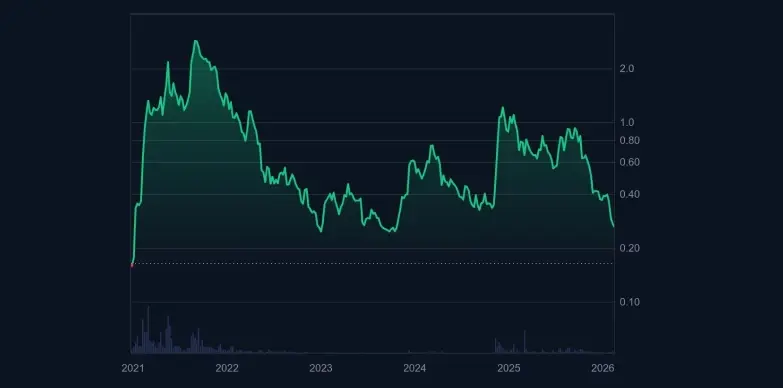
The current market for Cardano price predictions sets its 2026 forecast by highlighting permanent market conditions that persist beyond short-term price fluctuations. The ADA cryptocurrency maintains its current value, which remains below previous peak levels because post-2021 valuation corrections affected all Layer-1 cryptocurrencies with extended development periods.
Cardano has implemented regular improvements through its scaling solutions and governance instruments, though it missed multiple promotional periods that helped drive faster growth in ecosystems such as Solana.
The Cardano network operates through two different paths. On-chain metrics show that Cardano DeFi usage remains below its market value, which limits price growth. The retail market now invests in meme cryptocurrencies and blockchain networks that process transactions at high speeds, which reduces demand for speculative ADA trading.
The Cardano price prediction indicates that investors prefer to wait for results rather than follow price trends, as the current valuation depends more on project execution than on public relations efforts.
Key Drivers That Will Shape Cardano Price Outlook
Network Upgrades & Roadmap Execution
Any Cardano price prediction from 2026 to 2030 must be grounded in measurable network performance, real-world usage metrics, and evolving market dynamics. The primary force of development progress is ongoing network improvements, together with the execution of the planned development path.
Cardano’s Hydra introduces off-chain scalability through parallel heads, significantly increasing transaction throughput for supported use cases, rather than replacing base-layer capacity.
The Leios evolution of the Ouroboros consensus seeks to improve base-layer efficiency by increasing transaction-processing capacity, achieving hundreds or thousands of transactions per second while maintaining decentralization, addressing performance issues opponents raise with its existing capabilities.
The Voltaire era, together with CIP‑1694 governance upgrades, has established decision-making processes that operate on the blockchain, through which hundreds of thousands of registered wallets have participated across governance rounds, while Project Catalyst has distributed over 180 million ADA to support actual ecosystem development projects.
The price prediction for ADA coins depends on these upgrades, as their execution speed and decentralization capabilities determine how developers will use it and how institutions will assess its trustworthiness.
Ecosystem & DeFi Growth
Two main elements, which include ecosystem growth together with DeFi expansion, determine the sustainable worth of ADA over time. Cardano’s Total Value Locked in DeFi protocols has reached hundreds of millions, according to a quarterly report showing more than $400 million and a DeFi presence that exceeds previous cyclical periods.
The Cardano network demonstrates distinct growth patterns that arise from a development process that produces growing foundational elements while actual progress remains inactive. Users have developed more than 10,000 Plutus scripts that execute smart contract functions.
The real-world applications of identity systems, together with enterprise pilot programs and tokenization initiatives, create broader use cases for ADAs, leading to multiple ADA crypto price prediction outcomes that depend on actual usage patterns rather than market sentiment.
Institutional & ETF Narrative
Institutional and ETF narratives, which create their own market trends, establish the market expectations between these two factors. ADA is supported by institutional custodians and included in select crypto index products, though direct institutional exposure remains limited compared to Bitcoin and Ethereum. However, the dedicated spot ADA ETF still awaits regulatory approval, as existing index ETFs already provide ADA market access.
The probability of approval may increase, but it is essential to understand that regulatory changes and ETF progress will not cause prices to rise; instead, these factors will affect demand by creating trust and security for large investors. The Cardano price forecast links optimistic price predictions with the actual limits of user adoption.
Whale Behavior & On‑Chain Signals
Whale behavior and on‑chain signals provide indicators of accumulation trends that frequently occur before medium‑term market recoveries. The major ADA holders have increased their holdings during periods when retail investors showed decreased confidence, demonstrating institutional confidence in the currency. The above 60% staking rate of the circulating supply, together with liquid pressure reduction, enhances network security and contributes to future Cardano predictions.
Macro & Crypto Market Cycles
The macroeconomic environment and the overall cryptocurrency market cycle continue to be primary drivers of market movements. The combination of Bitcoin dominance, current liquidity levels, and altcoin rotation patterns determines whether ADA will join market uptrends or remain in consolidation. The macroeconomic variables interact with fundamental market drivers to yield specific price predictions for ADA between 2026 and 2030.
How High Can Cardano Go – Realistic vs Extreme Scenario
The best way to assess Cardano’s future value is to analyze market capitalization rather than rely on speculative price projections. The current ADA circulating supply of approx 35-37 billion tokens supports a $10 price, implying a valuation of approximately $350 billion, which matches Ethereum’s previous market peak, although achieving this level requires ongoing ecosystem development, actual user adoption, and institutional backing.
The $50 ADA price requires a market capitalization exceeding $1.7 trillion and would surpass the total historical market capitalization of all altcoins, making this price achievement extremely unlikely without structural changes to global financial markets.
Most reliable Cardano price prediction models indicate that the cryptocurrency will reach a maximum value, driven by execution capabilities, governance development, and practical uses, rather than market speculation.
Is Cardano Dead? A Clear, Evidence‑Based Verdict
Cardano is not dead, but its long-term success depends on execution and real usage rather than narratives. The active Cardano blockchain network continues to develop through ongoing work by developers creating new protocol functions, updating governance systems, on-chain voting systems, and community treasury management systems for the Voltaire phase.
Holders of staking rights continue to engage with the system, maintaining high participation rates despite the current circulating supply of governance proposals in the CIP‑1694 system.
The network demonstrates ongoing strength because its price remains low for extended periods, creating competition among different market trends, Cardano’s slower operational speed, faster Layer‑1 blockchains, and overall market conditions. Cardano’s operational behavior indicates basic strength, as the network has continued operating reliably despite prolonged market downturns.
Cardano vs Ethereum vs Solana (Quick Comparison)
This comparison shows Cardano prioritizing stability and low fees over raw throughput, while Ethereum balances decentralization with broad developer adoption. Solana emphasizes speed and cost efficiency but accepts higher operational risk. Each network’s tradeoffs reflect different design priorities rather than a clear technical winner.
| Metric | Cardano | Ethereum | Solana |
|---|---|---|---|
| TPS | Low (L1) | Medium | High |
| Fees | Low | Medium | Very Low |
| Dev Speed | Slow | Medium | Fast |
| Stability | High | High | Medium |
Risks That Could Break the Bull Thesis
Execution Delays
Delays in delivering roadmap milestones remain a key forecasting risk. Scaling initiatives such as Hydra and Leios, along with full Voltaire governance rollout, must show measurable performance gains and cost efficiency in live conditions. Prolonged timelines could weaken confidence in Cardano’s execution outlook.
Developer Migration
Cardano’s long-term value depends on retaining active developers. Competing Layer 1 networks with faster performance, mature tooling, and larger user bases continue to attract builders. Research-driven design alone may not translate into sustained dApp growth without clear market adoption.
Regulatory Surprises
Regulatory uncertainty introduces potential variability in market outcomes. Changes affecting staking, governance frameworks, or asset classification could influence exchange support and institutional participation. Unfavorable policy developments may slow adoption and affect medium-term projections.
Prolonged Crypto winter
Extended weak market conditions remain a structural risk. High interest rates, constrained liquidity, and reduced retail participation can suppress valuations across the sector. In this environment, ADA may trade within a narrow range despite ongoing network development.
Final Verdict on Cardano Outlook
The Cardano network projection for 2026 to 2030 shows that it operates continuously without interruption through all testing conditions. Cardano maintains its operational capacity because it uses research-based methods to develop its platform, because most users maintain a staking rate above 60% of all ADA coins in circulation, and because its Voltaire phase introduces new methods for users to control the network.
Cardano’s execution speed remains its main problem, along with its lower DeFi TVL compared to other top Layer 1 networks and its slow onboarding process for new developers, which creates obstacles for upcoming Cardano price predictions.
The ADA cryptocurrency is most suitable for long-term investors who want to hold their investments because they value decentralization, governance participation, and sustainability over quick profits from price speculation.
Cardano Price Prediction: FAQs
Is Cardano a good long‑term investment?
Is Cardano a good long‑term investment?
Will ADA reach $1 again?
Will ADA reach $1 again?
Is staking ADA safe?
Is staking ADA safe?
Can Cardano hit $5 or $10?
Can Cardano hit $5 or $10?
What will ADA be worth in 2030?
What will ADA be worth in 2030?
Will the Cardano price rise again in 2026?
Will the Cardano price rise again in 2026?
See less

