




What to Know:
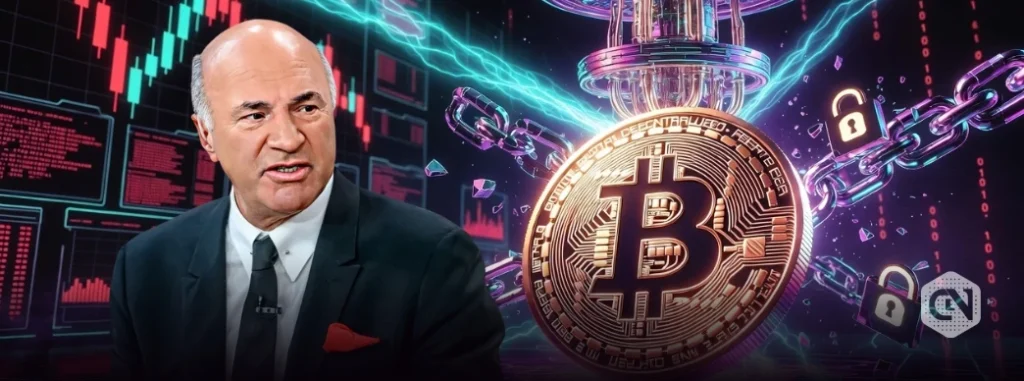
- Kevin O’Leary warns that quantum computing risks are making institutions cautious about increasing their Bitcoin exposure beyond roughly 3%.
- Institutions are concentrating allocations in Bitcoin and Ethereum after past market crashes wiped out many smaller cryptos.
- Developers have introduced BIP 360, proposing new wallet address formats to strengthen Bitcoin’s resistance to potential quantum attacks.
Investor and Shark Tank personality Kevin O’Leary has raised concerns about the long-term security of Bitcoin, as he linked institutional hesitation to the emerging threat of ‘quantum computing’.
Bitcoin has recently seen another sharp correction, as it fell nearly 50% from its recent highs. The pullback has revived familiar volatility trends in the crypto market. But O’Leary argues that a more structural shift is coming up under these price movements.
Kevin O’Leary On Bitcoin and Quantum Computing
O’Leary said that institutional investors have already reassessed their exposure to cryptos after the recent market downturns. During the October selloff, Bitcoin fell sharply while much of the broader market declined even further, with several cryptos losing between 80% and 90% of their value and failing to recover.
According to O’Leary, this divergence has reinforced a growing institutional preference for Bitcoin and Ethereum. He said large investors concluded that holding these two cryptos captures most of the upside and volatility available in the crypto sector. As a result, capital has been increasingly concentrated in these dominant networks, while smaller cryptos have struggled to attract sustained institutional demand.
Despite declaring his own ‘long position’ in Bitcoin, O’Leary pointed to quantum computing as a new factor influencing allocation decisions. He said the possibility that a sufficiently advanced quantum computer could one day compromise blockchain encryption has introduced a layer of uncertainty for institutional investors.
Kevin O’Leary added that this concern is placing a ceiling on institutional allocations. He stated that many firms are unlikely to allocate more than 3% of their portfolios to Bitcoin until the risks tied to quantum breakthroughs are better understood and mitigated. He described institutional investors as cautious and disciplined. He noted that they are waiting for technical clarity before increasing exposure.
Notably, Bitcoin’s security model is built on elliptic curve cryptography, specifically the ECDSA algorithm over the secp256k1 curve. In theory, a powerful quantum computer running Shor’s algorithm could derive private keys from exposed public keys and access funds linked to those addresses. The technology required to carry out such an attack does not yet exist, but its potential has become an active topic of discussion among developers and investors.
A related issue is the estimated 4 million BTC considered lost due to inaccessible private keys. If quantum developments made them recoverable, though, the coins may again enter circulation, and thereby increase the effective supply of Bitcoin, and may even alter price dynamics. Those in the Bitcoin ecosystem have begun thinking of defensive measures. Bitcoin Improvement Proposal 360, or BIP 360, was merged into the Bitcoin Core BIP repository this week.
In this regard, it is one of the proposals currently in development that might be looked at to upgrade the network in the future. The suggested approach uses a different wallet address type with a stronger barrier to quantum attacks. BIP 360 aims at addressing the vulnerabilities introduced in current address formats (i.e., Pay-to-Taproot and Pay-to-Public-Key), which expose public keys during transactions.
The new proposal replaces the previous Pay-to-Tapscript-Hash format with a new one called Pay-to-Merkle-Root to refine the naming and also maintain the technical approach. Bitcoin is trading near $68,030, which is 0.4% down over the past 24 hours at the time of writing.
Even as O’Leary spoke about risks, other pro-Bitcoin speakers seem confident that the crypto’s long-term path continues to be decent. Michael Saylor recently stated that markets and innovation have historically resolved major technical challenges. The author of ‘Rich Dad Poor Dad’, Robert Kiyosaki, has predicted a global financial market crash, saying he anticipates the downturn to benefit those already established in assets, including gold, silver, Ethereum, and Bitcoin.
