





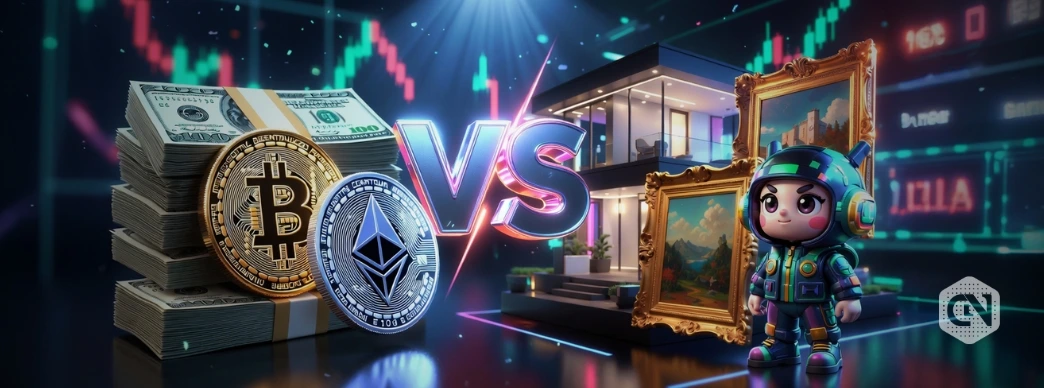
Key Highlights:
- Fungible and Non-Fungible Tokens (NFTs) rely on smart contracts.
- Fungible tokens are identical and interchangeable, however, NFTs are one-of-a-kind.
- Fungible tokens power payments, whereas, NFTs allow ownership of digital art, collectibles etc.
When Ethereum introduced token standards, it made digital assets follow clear, built-in-rules such as who owns them, how they move, and what can be done with them, without needing banks, platforms, or middlemen. This gave the internet a way to handle value natively, not just information.
Over time, this unlocked new kinds of online economies where money access, and ownership could be managed automatically by code. It’s why today’s blockchains support everything from global payments to creator-driven markets, all running transparently in the background.
Origin of Tokens
Blockchain tokens began with Bitcoin in 2009 where digital coins were created so that they could be easily exchanged between people, same as fiat money but online. This showed that value could move directly from one person to another without having the need of a bank or any other intermediary.
Things expanded after Ethereum launched in 2015. Its smart contracts let developers create something called standardized tokens. ERC-20 made it simple to issue interchangeable tokens used in payments and finance, while ERC-721 later enabled one-of-a-kind digital items, popularized by projects such as CryptoKitties.
Together these standards made digital ownership reliable and transparent, proving that scarcity and authenticity could exist online, paving the way for today’s DeFi platforms, NFT markets, and tokenized real-world assets.
Fungible Tokens explained
Fungible tokens are the digital tokens where every unit is exactly the same as the other one. For example one dollar note is equal to any other one dollar note.
These rules decide how these tokens are created and how small can they be divided into, and how they move from one wallet to the other. When someone sends a token like USDC from one wallet to the other, the blockchain simply updates the balances. Here it just subtracts from the sender and adds to the receiver, while the token itself remains unchanged in value or identity.
This consistency is something that makes fungible tokens easy to trade on exchanges, use for lending and borrowing in DeFi and spend for everyday digital payments.
Non-Fungible Tokens Explained
Non-Fungible Tokens or NFTs are nothing but digital items where each one of these items are unique and cannot be split or swapped one-for-one with another. It is as same as owning an original painting rather than a printed note. NFTs follow standards such as ERC-721 and ERC-1155, which is why these NFTs get their own IDs and set of details and makes them one-of-a-kind.
Those details usually point to extra information, such as images, traits, or descriptions, stored outside the blockchain on systems like IPFS (InterPlanetary File System). The track of the NFT owners and its entire history is maintained on the blockchain. When an NFT is created (minted to be more precise), a smart contract records it permanently.
When it is sold or transferred, ownership however moves to a new wallet. Many NFTs also include built-in royalties, so creators earn a fee each time the item is resold. Examples include CryptoPunks and Bored Ape Yacht Club (BAYC).
Difference Between the Two
Fungible tokens and NFTs differ mainly in how ownership and value work. Fungible tokens are interchangeable, which means that one unit is identical to the another one and hence they can be freely split or combined and as they are identical, they are suitable for payments, trading and financial uses across Ethereum-based systems. NFTs, on the other hand, are unique. They cannot be divided or fractionalized. Every token is so unique that it has its own identity and story behind it.
Fungible tokens are uniform in nature and provide liquidity. On the contrary, NFTs focuses more on individuality ownership of specific digital items, and this is why they are better suited for art, collectibles and other assets where uniqueness matters.
Applications
Fungible tokens are widely used wherever uniform value and easy exchange are important. Cryptocurrencies like Bitcoin and Ethereum function as digital money so that through them payments, remittance can be carried out. Stablecoins have been established so that transactions can be easily carried out in volatile market conditions. Whereas, DeFi relies on fungible tokens for lending, liquidity pools, governance, and crowdfunding through token sales.
These tokens are also used for reward points, which can be in-game currencies, tokenized real-world assets, charitable donations, and privacy-focused payments through coins like Monero and Zcash.
NFTs focuses on ownership and authenticity rather than exchangeability. They are commonly used in digital art, collectibles, gaming assets, virtual real estate, music and entertainment, as well as representing ownership of physical assets. Together, both token types underpin Web3’s shift toward programmable ownership and value.
Conclusion
Fungible tokens make money move, while NFTs make ownership clear. What started with Bitcoin and evolved on Ethereum has turned blockchains into places where you can spend, save, trade, collect, and truly own digital stuff. Together, they are the engine behind Web3’s permissionless economy.
Also Read: Here’s a Look at Famous Celebrities & The Most Expensive NFT They Own
See less

