





The world of cryptocurrencies had entered the scene almost two decades back with the introduction of the first cryptocurrency known as Bitcoin. Since then, the crypto market has grown manifold in terms if the total market capitalization of the market. On the contrary, a few years ago, there used to be a problem scaling up operations in the crypto industry due to regulatory ambiguity. But, thanks to the pro-crypto government in the United States, there is none popular DeFi exchange that has created quite an impact in the world of finance. The reason for the same is the fact that the world is witnessing war-like situations between America and Iran.
Hyperliquid is a leading decentralized exchange developed by using blockchain technology, which has lately become a popular place for perpetual futures. The reason behind the popularity of this platform is that it provides services for leveraged trading. While the platform was designed to focus on crypto perpetuals, it is now slowly making its way to integrate assets from the traditional financial world.
Apart from cryptocurrency, users can now access a wide range of investment products on Hyperliquid without the intervention of any middle party, including commodities, tokenized stocks, and others.
Grayscale Highlights Hyperliquid’s Growth in Recent Report
In the latest report, Grayscale highlighted Hyperliquid’s potential in the perpetual derivative market, saying that, “Hyperliquid is a DeFi platform specializing in perpetual futures that is increasingly competing with traditional exchanges. Regulatory clarity in the US can expand access to Hyperliquid to new users and, in our view, help drive value to the HYPE token.”
In 2025, Hyperliquid recorded approximately $2.9 trillion in perpetual futures volume, according to the Coinglass report. This large volume has helped it to generate around $800 million in revenue.
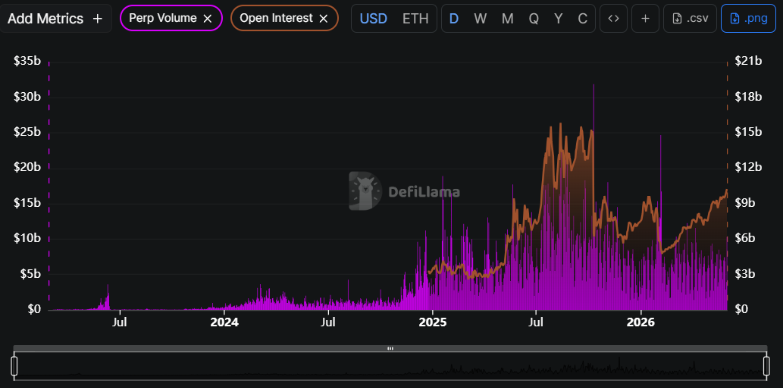
(Source: DeFiLlama)
According to DeFiLlama, in the last 30 days, Hyperliquid has recorded around $181.62 billion in perpetual volume with an open interest of $9.77 billion. The cumulative perp volume has surpassed the mark of $4.54 trillion. This makes it one of the biggest perpetual futures exchanges.
The growth of the decentralized exchange has also boosted the cryptocurrency HYPE’s price. At the time of writing this, HYPE is trading at around $72.93 with a jump of 76% in the last 30 days, according to CoinMarketCap. The token has a market cap of around $18.5 billion. Even though the entire crypto market is bleeding red, the performance of the HYPE token is showing its growing demand.
What are Perpetual Futures?
In simple words, perpetual futures are a type of derivative where users can trade on price movements without taking any kind of stress about expiration dates. These investment products use a system known as the funding rate to keep their prices linked to the actual spot market.
According to DeFiLIama, the daily trading volume for perpetuals has soared over hundreds of billions of dollars, and Hyperliquid is playing a major role in this.
Hyperliquid Skyrockets Amid War in the Middle East Between U.S.-Iran
While the platform was already witnessing peak activities, the major booster came this year after a major escalation in the Middle East. In February, the U.S. and Israel jointly launched a military operation against the Iranian regime. In response, Iran played its Trump card and seized control of the Strait of Hormuz. This is the biggest choke point for the global economy, as of 2025, nearly 34% of total crude oil trade passed through the Strait of Hormuz, according to an IEA report.
During this war, as major traditional trading markets such as the Chicago Mercantile Exchange (CME) were closed on weekends, the massive rush of traders was witnessed towards Hyperliquid to access perpetual contracts for oil, gold, and silver. During this war, traders have used these contracts to hedge their positions for traditional commodities by using on-chain products.
Due to the sudden spike in trading activities, the trading volumes for oil-related contracts have witnessed a sharp growth on the decentralized exchange. During the early phase of this war, the daily volume soared over $500 million. After that, it crossed the $1.5 billion mark during a time when price swings were happening in a harsher way.
During the war, the HIP 3 market, which is the platform for non-crypto assets, witnessed oil contracts as the most traded products on the platform. The open interest in commodities on Hyperliquid has soared to millions of dollars due to the growing activities on the platform.
The main advantage of Hyperliquid over traditional exchanges is that it has limitations on trading. On traditional exchanges, there are fixed hours for trading.
Hyperliquid has boosted its development as HIP 3 and HIP 4 proposals have allowed outside developers to launch these new markets in a rapid manner.
According to a recent report, the ratio of Open interest vs. perp equity has soared around 3.83 times. The total open interest on Hyperliquid is more than the perpetual equity. This is the user collateral or total value locked. This is the highest average in the entire system since August 25, 2025.
CFTC Approves First Perpetual Contracts and Futures
It is a very popular fact that Hyperliquid is not available in the United States due to strict regulatory frameworks for derivatives trading, perpetual futures, leverage products, and decentralized finance (DeFi). However, there are major developments coming from the U.S. regulatory agencies and government officials.
On May 29, the Commodity Futures Trading Commission (CFTC) officially announced the approval of the Kalshi Bitcoin perpetual futures contract, which is known as BTCPERP. This was the first time a regulated United States platform has offered an investment product.
At the same time, the CFTC has issued a no-action relief letter that will allow Coinbase to open a door for global crypto perpetuals through its affiliate.
“The policy statement makes clear that, given the unique characteristics of perpetual contracts, which tend to vary based on the underlying asset they reference, the Commission is of the view that the case-by-case review process detailed in Commission Regulation 40.3 is appropriate for the listing of perpetual contracts that reference asset classes that are not contemplated in the Order,” stated in the official press release.
These regulatory nodes from the CFTC are showing that regulators are opening doors for perpetual crypto futures trading in the United States under new regulatory clarity. The ongoing progress around the Digital Asset Market Clarity Act (CLARITY Act) has sparked a positive sentiment in the DeFi sector. The bill has recently received approval from the Senate Banking Committee.
Final Thoughts
In the last few months, Hyperliquid has become a leading decentralized platform that can compete with traditional exchanges. Amid the rise in geopolitical tension, it has managed to grab the attention of investors across the world, as the majority of traditional financial infrastructure has failed to retain traders.
In the last few months, Hyperliquid has created records in crypto perpetual trading amid the war in the Middle East. Apart from this, the majority of regulatory developments are helping DeFi platforms expand their operations beyond the crypto sector.

 GoogleNews