



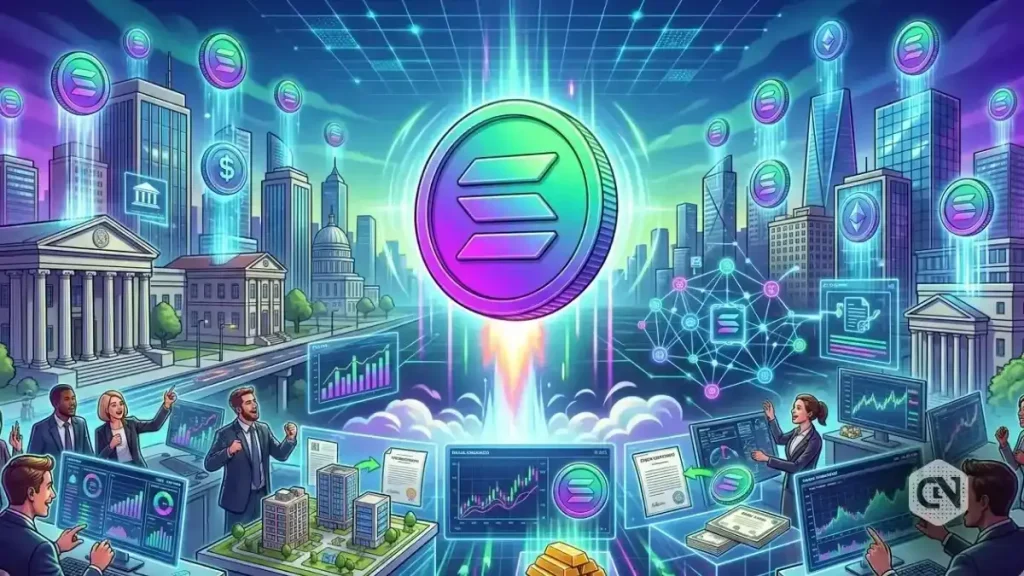
- Solana has moved from a retail-heavy chain to institutional settlement infrastructure, driven by the Alpenglow upgrade, Firedancer mainnet rollout, and reported Goldman Sachs exposure.
- The sub-150ms finality plus stronger client diversity make Solana more viable for high-frequency trading, payments, and large-scale financial rails than before.
- If the technical and capital-flow developments hold up, the market narrative around SOL shifts from “fast speculative chain” to “institutional-grade blockchain.”
Solana is gaining traction in the global financial markets as we enter the second quarter of 2026, and the conversation surrounding $SOL has shifted from “if” to “how fast.” While Bitcoin remains the undisputed store of value and Ethereum the foundational yield curve, Solana has officially emerged as the high-frequency settlement layer for the world’s largest financial institutions. In the second week of May, the broader crypto market experienced a complex macro environment of Fed leadership transitions and regulatory shifts. However, Solana has quietly executed the most significant technical overhaul in its history.
The convergence of two massive catalysts has solidified Solana’s position as the “institutional blockchain” of choice: the rollout of the Alpenglow upgrade and the disclosure of massive nine-figure positions from legacy giants like Goldman Sachs. With transaction finality now measured in milliseconds rather than seconds, the narrative of Solana as a “retail experiment” has been permanently replaced by its new role as institutional-grade infrastructure.
The 100ms Finality Breakthrough
For years, the Achilles’ heel of blockchain technology was the gap between “confirmation” and “settlement.” While Solana built its reputation on 400-millisecond block times, true deterministic finality (the point at which a transaction is mathematically irreversible) still took approximately 12.8 seconds. This lag made it impossible for the network to serve as a direct replacement for the ultra-low-latency systems of Wall Street. The Solana Alpenglow upgrade is the architectural answer to this challenge, fundamentally redesigning how the network reaches consensus to meet the millisecond requirements of global finance.
Alpenglow, formalized as SIMD-0326, represents a complete replacement of the network’s legacy TowerBFT and Proof-of-History consensus layers. By moving to a modernized system, Alpenglow has successfully reduced transaction finality from twelve seconds down to a staggering 100 to 150 milliseconds. This hundredfold improvement ensures that orders and cancellations land closer to real-time market prices, a critical requirement for high-frequency trading (HFT) and institutional liquidity providers. The impact is immediately visible in the perpetual market, where Delta Exchange reports that the reduction in latency has significantly lowered the incidence of “stale” prices during periods of extreme market volatility.
Votor and Rotor: The Duo Powering the Next-Gen Consensus
The Alpenglow era is powered by two distinct protocols that work in tandem to optimize the network’s speed and efficiency. The first of these is Votor, the new voting and finalization system that replaces TowerBFT. Votor utilizes a sophisticated “Fast Path” mechanism where validators attempt a single round of voting. If a supermajority of eighty percent of the network’s stake agrees, the block is finalized instantly. If the supermajority is not reached due to network turbulence, the system falls back to a two-round process that still completes in a fraction of the time required by the older architecture. This “one-round lock” is the secret behind Solana’s new sub-second finality.
The second half of this duo is Rotor, a new block propagation system that replaces the older Turbine protocol. Rotor is designed to handle data movement across the global validator set with unprecedented precision, utilizing stake-weighted relay paths to prioritize the most reliable and high-capacity validators as the primary conduits for information. This ensures that even if up to twenty percent of the network’s validators go offline, the remaining nodes can maintain full speed and data integrity. Perhaps most importantly for the long-term health of the network, Alpenglow effectively eliminates on-chain vote transactions, freeing up roughly seventy-five percent of the available block space for actual user transactions. This architectural shift ensures that Solana’s performance metrics now reflect real economic activity rather than internal network maintenance.
Building the Unbreakable Institutional Shield
While Alpenglow provides the speed, Firedancer provides the resilience. On May 5, 2026, the Solana ecosystem reached a pivotal milestone with the official mainnet rollout of Firedancer 1.0. Developed by the elite engineering team at Jump Crypto, Firedancer is a high-performance validator client built from scratch in C++. Its primary goal is to introduce “client diversity” to the network, ensuring that Solana no longer relies predominantly on a single validator implementation. This reduces the systemic risk that a single software bug or performance bottleneck could halt the entire network, a prospect that previously kept many conservative institutional risk committees on the sidelines.
The production deployment of Firedancer is the ultimate institutional endorsement. By allowing Solana to process over one million transactions per second in optimized environments, Firedancer provides the massive headroom necessary for global-scale payment networks. Institutions like Goldman Sachs and Worldpay can now operate with the confidence that the network they are building on is not only fast but is structurally immune to the single-point-of-failure outages that have plagued other, less diverse ecosystems. In the eyes of Wall Street, Firedancer has transformed Solana from a high-performance experimental chain into a battle-tested financial utility.
The Goldman Sachs Disclosure
The technical maturation of Solana is being met with a massive, quantifiable influx of institutional capital. According to recent 13F filings disclosed in late April, Wall Street titan Goldman Sachs has revealed a $108 million exposure to Solana via spot Solana ETF products. This position is part of a broader $2.36 billion crypto allocation by the bank, which also includes significant holdings in Bitcoin and Ethereum. For the world’s most influential investment bank, Solana is no longer a “side bet” but a core component of its digital asset strategy.
Data compiled by Bloomberg ETF analysts reveals that Goldman is part of a broader “flight to performance” among institutional investors. Wall Street poured over $540 million into U.S. spot Solana ETFs during the fourth quarter of 2025 alone, with total inflows now approaching the $1 billion milestone. What makes the Solana ETF market unique is the high participation rate of 13F-filing institutions, which hold approximately fifty percent of the total assets in these products. This points to a “serious” investor base that is less interested in retail-driven meme cycles and more focused on the fundamental case for Solana as a global settlement layer.
The Charles Schwab Influence
While Goldman Sachs represents the sophisticated “Smart Money,” the entry of Charles Schwab marks the dawn of mass-market institutional adoption. In April 2026, Schwab officially announced the launch of “Schwab Crypto,” a spot crypto trading platform that will provide its 35 million active retail accounts with direct access to digital assets. With over $11.9 trillion in client assets, Schwab’s entry into the space is a watershed moment that bridges the gap between the traditional brokerage world and the new digital economy.
Schwab’s integration is particularly significant because it allows investors to view and trade cryptocurrencies alongside their stocks and bonds on a unified dashboard. While the initial phased rollout focuses on Bitcoin and Ethereum, the firm has signaled that additional cryptocurrencies will be added over time, with Solana widely expected to be the next major addition due to massive client demand. With Schwab clients already controlling roughly twenty percent of the existing spot crypto ETP market, the move to native spot trading is a strategic play to keep retail capital within the Schwab ecosystem rather than letting it migrate to crypto-native exchanges.
A Trillion-Dollar Economic Engine: The 2026 Reality
The combined weight of the Alpenglow upgrade, the Firedancer rollout, and the Goldman/Schwab entries has created a network that is now processing record-breaking economic volume. In the first quarter of 2026, the Solana network processed an all-time high of 10.1 billion transactions, a fifty percent increase from the end of the previous year. The surge is largely driven by the explosion of the stablecoin settlement market, where Solana has solidified its lead as the primary chain for global B2B and retail payments.
By reducing deterministic finality to 100 milliseconds and slashing validator operational costs, Solana has effectively rendered legacy financial plumbing obsolete. From nationally chartered banks opening native Solana deposit accounts to sovereign nations issuing digital identity on-chain, the network is now the default choice for any entity requiring speed, scale, and institutional-grade security. The 2026 economic reality is clear: the global financial system is migrating toward the “Alpenglow” standard, where time is measured in milliseconds and settlement is both instant and verifiable.
The New Standard for Institutional Finance
As we move toward the second half of 2026, the message from the markets and the engineering labs is the same: the race for the dominant institutional blockchain is over, and Solana has secured its position. The Alpenglow upgrade was the final piece of the puzzle, transforming a fast but maturing network into a high-precision financial engine capable of outperforming centralized dark pools.
For the team at CryptoNewsZ, the “Solana Thesis” has moved past the era of speculation. With Goldman Sachs disclosing nine-figure positions and Charles Schwab opening the floodgates to thirty-five million retail investors, the network has transitioned into a structural pillar of the global macro machine. In the Alpenglow era, speed is not just a feature, it is the foundation of a new, decentralized world order where finality is the ultimate currency.

 GoogleNews