


This guide helps new users understand how crypto exchanges work, how to choose the right one, and how to trade safely on them. It’s built for beginners and for anyone who wants a clearer picture of how the crypto marketplace actually functions.
A Brief History of Crypto Exchanges
Cryptocurrency exchanges emerged alongside Bitcoin’s launch in 2009. Early adopters were skeptical of digital currency, but the space has since grown into a core part of the financial world, used for purchases, investment, and innovation alike.
For anyone entering this relatively young corner of finance, understanding how exchanges work is the natural starting point. If you haven’t yet, our Crypto Trading Beginner’s Guide covers the basics of wallets and your first trade.
What is a Crypto Exchange?
A crypto exchange is a platform for buying, selling, and trading cryptocurrencies, functioning much like a stock market but for assets such as Bitcoin and Ethereum.
Exchanges act as marketplaces where buyers and sellers meet: buyers list the price they’re willing to pay, sellers list the price they’re willing to accept, and the exchange facilitates the match.
These platforms let you swap one cryptocurrency for another (e.g., Bitcoin for Ethereum) or convert crypto into fiat currency like US dollars or Euros, a function that’s essential for anyone moving money between the crypto and traditional financial systems.
Why Do You Need a Crypto Exchange?
While it’s technically possible to acquire crypto directly from miners or other individuals, exchanges make the process easier and considerably more secure.
- Security and convenience: Exchanges provide a safer trading environment than dealing directly with strangers, with built-in security measures to help protect your funds and fairer, more transparent pricing.
- Portfolio management: Real-time price tracking, market trend analysis, and centralized visibility into your holdings make managing investments far simpler.
- Earning potential: Many exchanges offer staking, letting you earn rewards on certain holdings without actively trading.
How Does a Cryptocurrency Exchange Work?
Every cryptocurrency runs on blockchain technology, a distributed, tamper-resistant ledger that records every transaction transparently. That transparency is part of what makes exchanges reliable. Transactions can be independently verified rather than taken on faith.
Buying and selling crypto: You purchase tokens like Bitcoin or Ethereum and store them in a wallet. Selling works in reverse: you exchange your crypto for fiat or another digital asset, typically through the same exchange or a peer-to-peer market, then withdraw the proceeds to your bank account or wallet. This step, however, comes with various tax implications and underlying market risk.
Order placement and matching: Trading starts with buyers and sellers placing orders specifying price and quantity. The exchange matches compatible orders — if you place a buy order at a certain price, the exchange finds a seller willing to sell at that price and executes the trade.
Order books: An order book is the running record of all active buy and sell orders on an exchange, showing the highest price a buyer will pay and the lowest price a seller will accept. This is what sets the current market price and gives traders the transparency to make informed decisions.
Together, blockchain infrastructure, order placement, and order books form the backbone of how a modern crypto exchange operates.
How to Open an Account on a Crypto Exchange
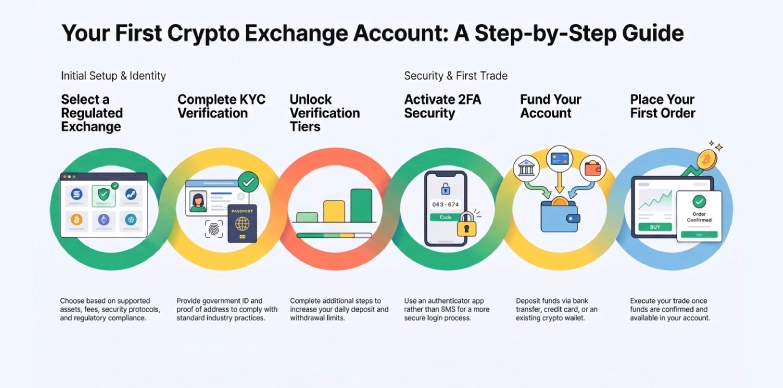
Getting started is more standardized than it might seem:
- Choose an exchange based on the factors covered later in this guide (supported assets, fees, security, regulation).
- Sign up and verify your identity (KYC): Most regulated exchanges require government ID and sometimes proof of address before you can deposit or trade — this is standard practice, not a red flag.
- Understand verification tiers: Many exchanges unlock higher deposit and withdrawal limits as you complete additional verification steps.
- Enable security features immediately: Two-factor authentication (2FA) at minimum, ideally via an authenticator app rather than SMS.
- Make your first deposit: You can do this via bank transfer, card, or an existing crypto wallet, depending on what the exchange supports.
- Place your first order once funds are available — see our Beginner’s Guide for a walkthrough of order types.
Types of Crypto Exchanges: CEX vs. DEX
| Centralized Exchanges (CEX) | Decentralized Exchanges (DEX) | |
|---|---|---|
| How It Works | A company operates the platform and holds custody of users’ funds. | Peer-to-peer trades are executed directly through smart contracts. |
| Custody | The exchange holds your funds and private keys. | You retain full control of your wallet and private keys. |
| Ease of Use | Beginner-friendly with a familiar interface. | Steeper learning curve and greater user responsibility. |
| Speed & Liquidity | Generally faster execution with deeper liquidity. | May be slower at times and have lower liquidity. |
| Security Model | Relies on the exchange’s security infrastructure. | Eliminates a central point of failure, but user mistakes carry greater risk. |
| Examples | Binance, Coinbase, Kraken | Uniswap, SushiSwap, PancakeSwap |
Both have a place: CEXs suit convenience and speed, while DEXs suit privacy and control. Many experienced traders use both, depending on what they’re doing. To understand the safety side of this choice in more depth, see our Building Trust in Crypto Trading guide.
Common Features of a Crypto Exchange
Basic features, found on nearly every regulated exchange:
- Trading pairs: The ability to exchange one asset for another, or for fiat
- Order types: Market orders, limit orders, stop orders, and similar tools
- User interface: Designed for easy navigation and trading
- Security measures: 2FA, encryption, and account-level protections
Additional features, common on more advanced platforms:
- Margin trading: Trading with borrowed funds to potentially amplify returns (and losses)
- Staking: Earning rewards for holding certain cryptocurrencies
- Wallet integration: Secure, built-in management of your digital assets
- Advanced trading tools: Charts, indicators, and deeper market-analysis features — see our Cryptocurrency Technical Analysis guide to learn how to use them.
Understanding Crypto Exchange Fees
- Trading fees: Typically a percentage of the transaction, often via a maker-taker model where takers (who remove liquidity) pay more than makers (who provide liquidity).
- Withdrawal and deposit fees: Withdrawals often carry a fee depending on the asset and method; deposits are frequently free, but not always.
- Variable structures: Fees differ by exchange and can drop for high-volume traders or specific coins. Always check the fee schedule before committing.
- Additional costs: Network/gas fees for blockchain transactions and margin fees for borrowed funds can add up quickly, so factor in the full cost, not just the headline trading fee.
Comparing fee structures across exchanges is one of the simplest ways to protect your returns over time.
Benefits and Risks of Using a Crypto Exchange
Benefits
| Benefits | What It Means |
|---|---|
| Accessibility | Buy, sell, and trade cryptocurrencies anytime, from anywhere. |
| Variety | Access to a wide range of cryptocurrencies and trading pairs. |
| Liquidity | High trading volume enables faster order execution, even for larger trades. |
| Tools and Resources | Built-in market research, portfolio tracking, and trading tools. |
| Earning Potential | Opportunities to earn rewards through staking and interest-bearing products. |
Risks
| Risk | What It Means |
|---|---|
| Price Volatility | Cryptocurrency prices can fluctuate significantly over short periods. |
| Security Threats | Exchanges can be hacked, putting users’ funds at risk. |
| Scams | The crypto market attracts fraudulent schemes and unreliable projects that can lead to financial losses. |
| Regulatory Changes | New laws or regulations may affect how an exchange operates in your region. |
| Platform Insolvency | If an exchange becomes insolvent, accessing or recovering your funds may become difficult or impossible. |
Weighing these benefits against the risks and choosing your platform carefully is central to trading crypto responsibly.
How To Choose the Right Crypto Exchange?
- Currency support: Confirm the exchange supports the coins and fiat currencies you actually plan to use, for both deposits and withdrawals.
- Fee structure: Compare trading fees (including maker/taker splits) and withdrawal and deposit costs.
- Deposits and withdrawals: Check the policies and fees for your preferred payment methods.
- Security: Look for 2FA, encryption, cold storage, proof of reserves, and insurance coverage where offered. Check whether the exchange has a history of breaches and how it responded.
- Licensing and regulation: Favor exchanges registered with recognized regulators in your region. This adds real legal accountability, not just a marketing claim.
With these factors in mind, you can choose a platform that fits how you actually trade, not just the one with the flashiest interface. For a deeper look at verifying platform trustworthiness, see Building Trust in Crypto Trading, or head back to the Crypto Trading Hub for the full picture.
FAQs

