



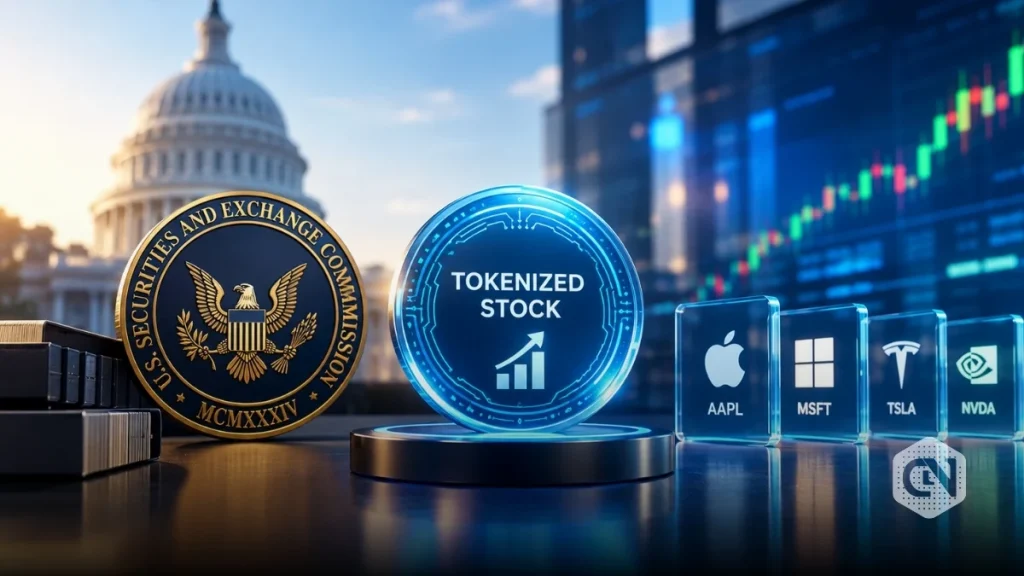
The U.S. Securities and Exchange Commission (SEC) has opened a regulated pathway for trading tokenized versions of American stocks on public blockchains, with the first venues expected to file their operating notices as early as the fourth quarter of 2026, according to a senior agency official.
The order, issued September 17 and dubbed the “Innovation Exemption,” grants what the Commission calls Tokenized Securities Venues (TSV) a five-year relief window from having to register as a formal stock exchange. It applies to platforms that let investors trade blockchain-based versions of shares already listed on U.S. exchanges, using liquidity pools and automated pricing mechanisms instead of a traditional order book.
In a joint interview with Commissioner Hester Peirce published Monday by Crypto In America, Taylor Lindman, chief counsel of the SEC’s Crypto Task Force, said that qualifying platforms could begin taking shape next quarter, with companies expected to file formal notices and unveil operational plans in the coming months. Her comments, delivered around CoinDesk’s Policy and Regulation summit in Washington, gave the industry its clearest signal yet on how quickly the new framework might translate into an actual trading product.
Why The SEC Issued Its Innovation Exemption After CLARITY Stalled
Just two days before the SEC’s move, the Digital Asset Market CLARITY Act failed a 49-50 procedural vote in the Senate, well short of the 60 needed to advance. That defeat hit the brakes on Capitol Hill’s broader push to write comprehensive crypto rules.
To address this roadblock, the Commission used its existing authority instead of waiting for lawmakers. Chairman Paul Atkins described the exemption as “a bridge toward durable rulemaking,” framing it as a deliberate, incremental step rather than an attempt to route around Congress.
What Tokenized Securities Venues Must Do Under The SEC Order
The SEC isn’t sidestepping securities law so much as applying its existing exemptive powers while a more permanent legislative framework remains unresolved. That approach comes with real guardrails.
Under the exemption, a TSV must operate as a U.S. entity and comply with sanctions rules enforced by the Treasury’s Office of Foreign Assets Control. Access to trading must be permissioned, even though the tokens sit on public blockchains, meaning platforms can’t simply open their doors to anyone with a crypto wallet. Crucially, the tokens themselves must represent genuine ownership. This means that the tokens must carry the same dividend rights and voting privileges as the underlying shares. Products that merely track a stock’s price without conferring those rights, sometimes called synthetic tokens, are explicitly excluded.
Additionally, a trading venue looking to tokenize a company’s stock must give that company thirty days’ notice before listing begins. If the issuer objects within that window, the token can’t go live. This gives publicly traded companies a direct say in whether their shares trade in this new format.
The exemption also addresses a technical wrinkle that had complicated earlier tokenization efforts. Liquidity providers supplying capital to these blockchain-based trading pools would ordinarily be classified as dealers under securities law, triggering a separate set of registration requirements. The order extends matching relief to those firms, removing a quiet but significant obstacle to getting these markets off the ground.
How Hester Peirce And Taylor Lindman See Tokenized Stock Trading
SEC Commissioner Hester Peirce, addressing skepticism about the framework’s commercial viability, said the current limits on how many stock symbols a venue can list and how much trading volume it can handle are adequate for near-term use. She also pushed back on comparisons to decentralized finance, arguing that these platforms sit closer to what she called “on-chain finance”. These systems have an identifiable operating entity accountable for compliance, rather than the anonymous, code-only governance associated with pure DeFi protocols.
Lindman echoed that framing, noting that TSVs will need a clearly defined responsible party even as trading itself happens through automated smart contracts. That requirement will likely shape which companies step forward. Lindman said the SEC has already received inquiries from several companies about using the exemption, though nothing in the order names specific platforms or guarantees any particular launch date.
For now, the order is open for public comment, and the Commission has said it will use the five-year window to inform whatever permanent rules eventually follow. Whether that becomes lasting legislation, a more comprehensive SEC rule, or simply an extended pilot program remains an open question. The answer, however, will likely depend as much on how Congress handles crypto policy going forward as on how smoothly the first TSVs launch.
