





- Polygon price extends its correction trend within two converging trendlines of the daily chart.
- Polygon Labs is exploring a capital raise of up to $100 million to accelerate its expansion into regulated stablecoin payments.
- The relative strength index (RSI) indicator at 40% indicate that the sellers remain dominant force in market
POL, the native utility token of the Polygon ecosystem, is down roughly 3% during Wednesday’s U.S. market hours to currently trade at $0.0902. The Polygon price is slightly underperforming to the broader crypto market as Bitcoin price holds above the $70,000 mark. Despite the price uncertainty, Polygon Labs is in early talks to raise up to $100 million for launching a stablecoin payments business. The move could bolster protocol’s real-world adoption and boost the underlying demand of POL.
Polygon Targets $100M to Scale Stablecoin Payments Push
Polygon Labs is in early discussions with investors to raise up to $100 million in fresh capital. This investment round should facilitate the company to hasten its growth and expansion into the regulated realm of stablecoin payments, which would codify its shift away as a general purpose Ethereum scaler and towards a specialized financial infrastructure provider.
The new capital is to scale a separate on-chain payments unit. This comes after Polygon previously acquired Coinme, a crypto payments company, and wallet provider, Sequence, in January 2026 to the tune of 250 million dollars. Polygon is developing a coherent “Open Money Stack” by combining Coinme 48 U.S. state licences and 50,000 retail locations with the one-click cross-chain technology of Sequence.
According to industry analysts, such investment places Polygon in the same position as traditional fintech giants such as Stripe. In contrast to conventional finance, Polygon aims to shift the flows of fiat and stablecoins to be purely on-chain, and potentially achieve a revenue of over $100 million in annual real payment flows not token grants.
The news comes as Polygon’s network upgrade, the Giugliano hardfork, becomes live and shortens the finality of the transaction by two seconds. Although the overall market is experiencing a wider market downturn, Polygon has already served a volume of more than 2.3 trillion on-chain as of early 2026, indicating a high degree of institutional trust in its stablecoin infrastructure.
The core goal is to increase stablecoin transaction volume on Polygon’s blockchain, which could generate more gas fees, more bridging, and more ecosystem activity,bolstering the native token, POL.
This Resistance Line Limits Recovery Attempt From Polygon Price
Over the past two weeks, the Polygon price witnessed heightened volatility around the $0.0915 level. A series of neutral candles with price rejection on either side indicated lack of conviction from buyers or sellers to drive a sustainable move.
Despite the market uncertainty, the coin price strictly follows the resistance pressure of a downsloping trendline in the daily chart. Since late January, a declining trend line and the 50-day exponential moving average has acted as dynamic resistance against the Polygon price. Even the price decline today, emerges from the resistance line indicating that the sellers are still defending this ceiling.
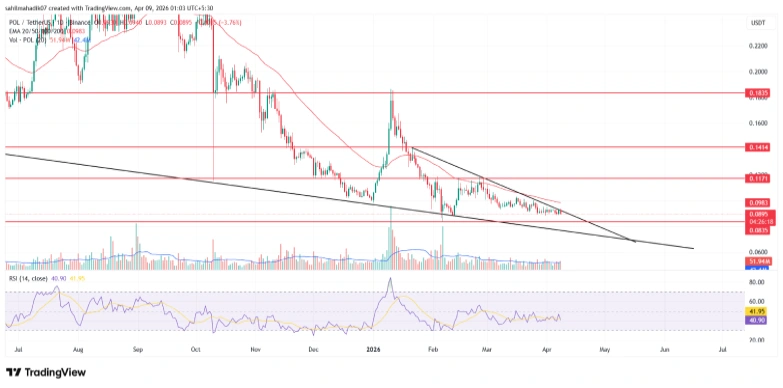
With sustained selling, the altcoin could plunge another 16% and retest a bottom support trendline at $0.075. This consolidation between two converging trendlines is leading Polygon price into a narrow range, creating a setup for decisive breakout.

