




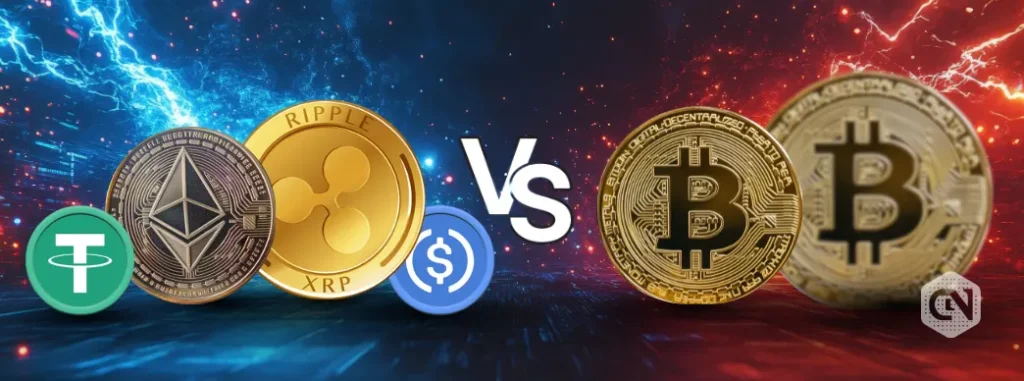
Digital currencies are changing the financial world, and at the heart of it all is Bitcoin, the first and most recognized cryptocurrency of them all. Times have changed, and Bitcoin is far from being the only one. A whole universe of other digital coins, known as altcoins (short for alternative coins), has emerged, and each of these coins brings something new to the table.
The main aim of these altcoins is to step up and solve Bitcoin’s limitations, bring in new technologies, or serve entirely different purposes. Since there is a whole universe of other digital currencies, diving into crypto can feel like entering a crowded marketplace. The most common confusion that a newcomer faces is figuring out whether they should invest in Bitcoin or explore the world of altcoins.
From this article, we will get to know the key differences between Bitcoin and altcoins, so that the audience can make informed decisions regarding their crypto journey.
A Beginner’s Guide to Bitcoin
In 2009, a person (or group) using the name Satoshi Nakamoto released Bitcoin (BTC) into the world. To this day, no one knows who Satoshi really is. The coin was launched as a peer-to-peer system that allows users to send digital money to one another without the need for a central authority.
Essential Characteristics of Bitcoin:
Apart from being the first cryptocurrency to be launched, it has a few other characteristics that give the coin its unique value, security, and global appeal. Let’s quickly have a look at these characteristics.
- Fixed Supply: Bitcoin has a fixed supply, and this makes it resistant to inflation. The number of coins has been capped at 21 million.
- Proof-of-Work: The network is dependent on a system known as Proof-of-Work. Here, miners have to solve complex problems to validate each and every transaction.
- Store of Value: The coin has earned the title of “digital gold” over the years, as it is seen as a store of value rather than just a payment method.
- First-Mover Advantage: Since the coin was the first cryptocurrency to be launched, it remains the most recognized and widely adopted cryptocurrency in the world.
From the above-listed characteristics, it can be said that Bitcoin is secure, decentralized, and has a limited supply, and this fact makes it preferable among long-term investors and institutional investors.
👉🏻Want to dive deeper into its history and technology? Learn more about Bitcoin here.
What Are Altcoins?
All cryptocurrencies besides Bitcoin are called altcoins. These are Ethereum (ETH), Solana (SOL), Cardano (ADA), and Ripple (XRP), plus thousands of others. Certain altcoins are Bitcoin forks, whereas others are constructed on completely new blockchains with special applications. These altcoins are innovation labs in motion.
Coins like Litecoin have been used to speed things up; others, like Ethereum, break new ground entirely. Think smart contracts; self-executing digital agreements that cut out the middleman and make decentralized apps possible. Then you have coins such as Solana and Avalanche that focus on scalability, and there are projects like Monero and Zcash that focus on privacy.
Key Differences Between Bitcoin and Altcoins
Purpose and Functionality:
Bitcoin is a decentralized digital currency and store of value, which is often referred to as “digital gold.” Altcoins can be used in a wider variety of applications. These applications include smart contracts, NFTs, privacy-focused transactions, decentralized finance (DeFi), and solutions for improving scalability.
Technology and Speed:
Bitcoin has been recognized as a secure network, but it is sometimes criticized for being too slow during the transaction process. It is also criticised for consuming a huge amount of energy due to its Proof-of-Work consensus.
Altcoins, on the other hand, have been testing out more scalable and quicker technologies. For example, Ethereum 2.0 relies on the reduction of energy consumption based on Proof-of-Stake. Solana has fast transaction times (with 65,000 TPS). Polygon helps decongest Ethereum by using Layer-2 scaling. Altcoins are attractive to developers and users who want scalable solutions using fast blockchains.
Market Cap and Liquidity:
Market cap is a metric through which you can gauge how big and established the coin is, and through liquidity, you can figure out how easily you can trade the coin without any drama. A decent market cap and good liquidity indicate a strong and safe coin to invest in.
Bitcoin has the highest market capitalization and is most frequently considered to be the most liquid cryptocurrency asset. Altcoins, on the other hand, are more unstable and numerous. They usually have cheaper valuations, but with the possibility of much higher returns.
Risk and Investment Strategy:
Bitcoin is a less risky crypto asset because of its age, safety, and institutionalization. Altcoins are a riskier option but give better possible returns, particularly in the case of young projects that pick up.
Advantages of Bitcoin:
- Lower risk
- Institutional support
- High liquidity
Advantages of Altcoins:
- Innovation-driven
- Greater upside chance
- Exposure to niche opportunities (e.g., DeFi, GameFi, AI)
Caution: Most altcoins are a pump and dump, or they could eventually go out of use.
Regulatory Outlook:
The regulatory acceptance of Bitcoin is increasing around the world. It is frequently classified as a commodity (e.g., with the U.S. SEC and CFTC). Because of this commodity status, financial products such as ETFs (Exchange-Traded Funds) and futures contracts that are based on Bitcoin have been approved. This move has gained the confidence of the investors and has provided a safe and easy access to it.
The altcoins, however, have a harder time, particularly in the U.S., where the SEC treats a substantial part of them as unregistered securities. There might come a time when certain altcoins may be banned, depending on how the laws change.
Regularity trend to follow: Governments may continue to support Bitcoin, but they can scrutinize altcoins aggressively.
Developer Activity and Ecosystem:
- Bitcoin options have a conservative stance towards security and decentralization of development.
- Most altcoins are innovation centers that drive Web3, gaming, finance, and other applications.
Should You Invest in Bitcoin or Altcoins?
Bitcoin and altcoins each show advantages over the other, reliant on whether you are goal-oriented, risk-adverse, or have a long-term investment strategy. Keep in mind the following points while investing in crypto:
In case you are new to the crypto industry:
- Begin with Bitcoin.
- It is more stable, popular, and serves as an excellent introduction to crypto.
If you’re a tech-savvy investor curious about innovation:
- Discover the best altcoins such as Ethereum (ETH), Solana (SOL), or Avalanche (AVAX).
- These coins fuel decentralized applications, NFTs, and new emerging industries, such as DeFi.
In case you are a high-risk, high-reward trader:
- You can take a small amount and invest in new altcoins with good foundations.
- Aim to find practical utility, development, and community adoption.
In the case you have a long-term crypto portfolio:
- Become diversified with a majority portfolio of Bitcoin, with a tactical portfolio of a few carefully selected altcoins.
- Hold 60-80 percent in BTC and 20-40 percent in altcoins based on your confidence and research.
In case you are concerned with institutional acceptance:
- Just look at Bitcoin, which is already being used by public companies, hedge funds, and ETFs.
In case you want to grow quite quickly and are okay with volatility:
- Altcoins can promise more profit in the short run, but they also need to be followed closely and have powerful exit points.
Pro Tips for New Crypto Investors
Entering into an investment in crypto might be thrilling, but it is also simple to slip up early in the game. The following are some fast tips to ensure you are well-informed, safe, and well placed to enjoy longer-term benefits.
- First, use Bitcoin: It is the most tried and accepted crypto asset.
- Conduct advanced research: Read the whitepaper, review the research, the use case, the team, and the tokenomics.
- Fear of missing out (FOMO): Do not invest because a coin is trending.
- Diversity Cautiously: Do not aimlessly diversify to several dozen little-known tokens.
- Keep Yourself Updated: Keep abreast of market, regulatory, and technical information.
- Secure Wallets: Use hardware to store in the long term.
- Be cautious of Scams: If something sounds too good to be true, it probably is!
The Future of Bitcoin vs. Altcoins
Bitcoin is still thriving, and it is not going anywhere anytime soon. As the most trusted crypto, it is locked in as digital gold. But altcoins? They are not playing sidekick anymore. They are moving ahead with real-world use cases in DeFi and attaching their identity to gaming and AI, and beyond.
As Web3 levels up, we are looking at a multi-chain universe, where Bitcoin stays your rock-solid vault, and altcoins are the turbocharged engines building the next internet.
Final Thoughts
To a beginner in the world of crypto, the main distinction between Bitcoin and altcoins is an important place to start. Bitcoin is your digital gold stable, proven and recognized all over the world. Altcoins are your R&D department, with typical higher risk and massive reward.
Learn, begin small, and be wise in investing.

 GoogleNews