




Key Highlights:
- Payward will use Hyperliquid as the infrastructure layer to be the first CFTC-regulated deployer of perpetual futures on HIP-3* markets.
- The program is designed to bring to market compliant, regulated derivative products that are geared toward American clients, pending approval from federal regulators.
- Hyperliquid price rides a steady recovery trendline amid the formation of a rising channel pattern.
Payward, the parent company of crypto exchange Kraken, is planning to be the first organization to open perpetual futures markets using the new HIP-3* framework, with Hyperliquid as its main on-chain architecture. As part of the process, Payward intends to launch regulated derivatives designed for American traders.
Operational Architecture & Regulatory Structure
Payward’s existing institutional financial infrastructure is central to the rollout. Bitnomial—a CFTC-licensed Designated Contract Market (DCM) and Derivatives Clearing Organization (DCO)—will serve as the official platform deployer, overseeing the creation, governance, ownership, and final settlement of all market contracts. In this capacity, Bitnomial will oversee the creation, ownership, governance, and ultimate settlement of all market contracts.
Additionally, the execution strategy integrates NinjaTrader Clearing, Payward’s CFTC-registered Futures Commission Merchant (FCM), to manage and carry the underlying customer accounts. All of this depends on getting the approval of federal derivatives regulators.
“Multiple venues run builder-deployed perpetuals on Hyperliquid. One holds 98 percent of their open interest, and no registered US exchange or clearinghouse has deployed a market there. Payward intends to be the first, holding the keys and carrying the regulatory obligations. Our open rails serve clients in more than 190 countries and territories and enable the next protocol, region and product. We already list our own US perpetuals and intend to deploy on Hyperliquid as well, putting clients first, not ourselves,” said Arjun Sethi, Co-CEO of Payward.
Technical Framework and Infrastructure Integration
The technological backbone for this venture is a future network update, called HIP-3*, which is a stand-up upgrade to the existing protocol HIP-3*. The technical update adds a new set of custom configurations to enable operators to set up permissioned trading environments.
One of the key components of the HIP-3* is the allowlist, a blockchain-based mechanism that is meticulously controlled by the main deployer or assigned backups to ensure access to authorized participants. All of these features are optional and will operate in parallel to public markets on the network, which will remain unaffected and unchanged, the developers note.
At present, the framework is only deployed to the simulated testnet environment where further performance data can be used to improve the specifications.
Hyperliquid is continuing to become a widely adopted, neutral infrastructure solution for the global financial system by providing the decentralized backbone for these new markets. The HIP-3* upgrade introduces specialized toolsets for institutional operators to help them comply with the strict standards set by regulators and take advantage of public ledgers.
The system enforces strict operating boundaries: Hyperliquid deployers act as independent organizations with sole legal liability and administrative control over their financial ecosystems.
Hyperliquid Price Stands at a Pivot Support of Major Move
Over the past month, the Hyperliquid price has retraced from a local high of $97.83 to a current trading value of $77.84, registering a loss of 20.43%. The pullback can be associated with broader market retracement, macroeconomic uncertainty, and geopolitical tension.
With an intraday drop of 0.4%, the HYPE price edged close to a monthly support level of $77. In addition, the 20-day exponential moving average continues to act as dynamic resistance against the coin price.
If the sellers break the $77 support, the price of Hyperliquid coin could drop another 9.2% and retest a long-coming ascending trendline at $69. This dynamic support is part of a rising channel pattern that has maintained a recovery trend since January 2026.
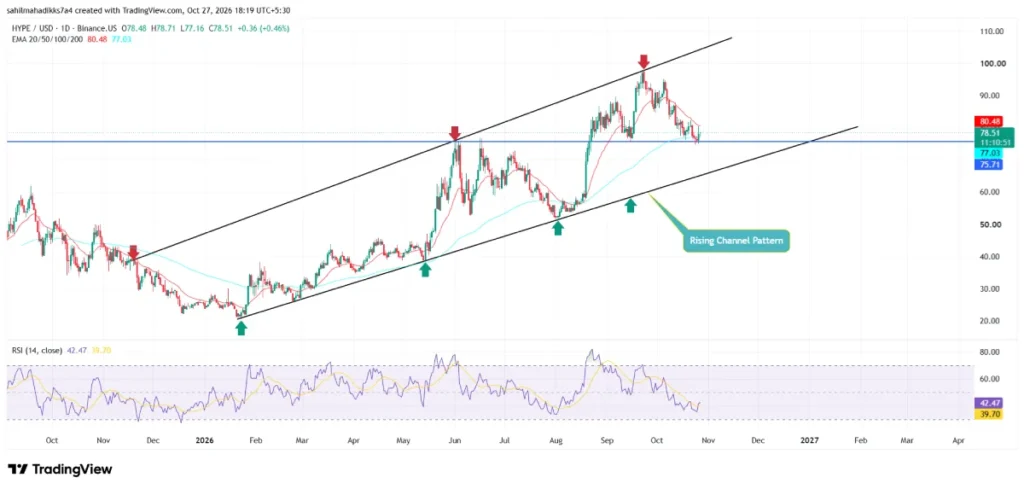
If history repeats, the HYPE buyers could recoup the bullish momentum at this support and drive the next recovery leap in price.
On the contrary, if price slips below the channel support, the selling pressure would accelerate and drive a prolonged correction.
