



Key Highlights:
- Japan’s land and transport minister, Tatsunori Ibayashi, says the administration will consider stablecoins for consumption tax refunds to foreign visitors.
- Japan’s tax-free shopping system is scheduled to switch to a refund-based model on November 1, 2026, needing customs verification before refunds are issued.
- Japan Tax Exemption and JPYC have partnered to explore stablecoin-based refunds, while government agencies examine broader on-chain payment applications.
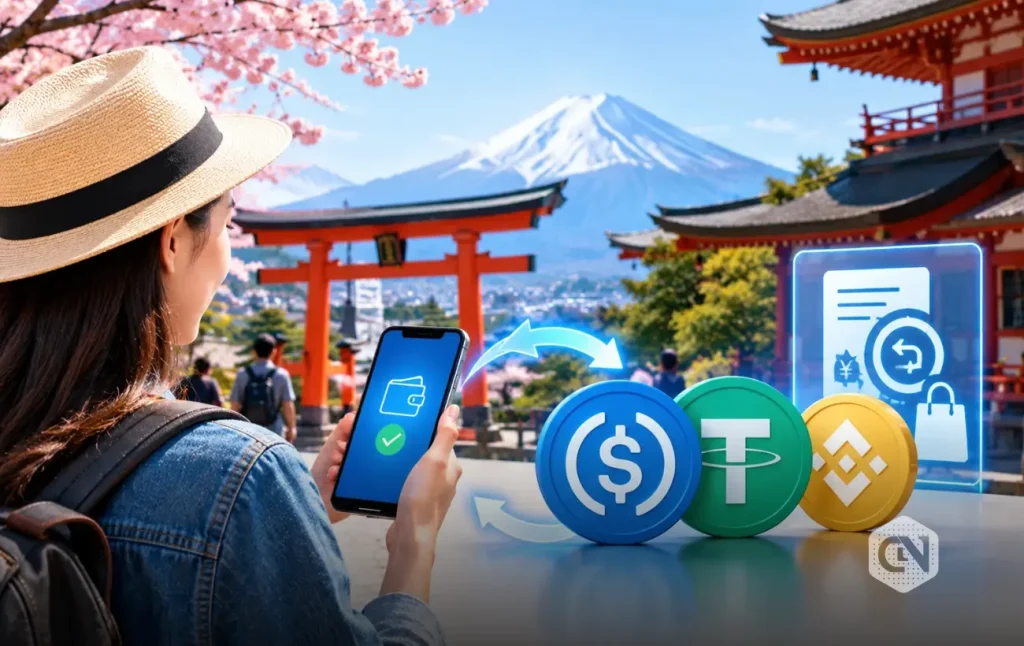
Japan is considering stablecoins as a probable payment option for consumption tax refunds to foreign visitors, reflecting growing administrative interest in blockchain-based financial services. On October 21, Minister of Land, Infrastructure, Transport and Tourism Tatsunori Ibayashi told the House of Representatives Committee on Land, Infrastructure, Transport and Tourism that the administration would assess stablecoins and other options for its tourist tax refund system.
Under the alleged approach, travelers would pay tax-inclusive prices when shopping and receive a refund equivalent to the consumption tax after customs verification upon departure. The consideration comes as Japan prepares to launch a refund-based tax-free shopping system in November and explore extra applications for stablecoins in public administration.
Japan Considers Stablecoins for Tourist Tax Refunds
According to CoinPost, Ibayashi indicated that the administration would consider stablecoins and other choices for the consumption tax exemption system used by tourists. He also highlighted a refund-based approach in which the tax amount would be returned after verification at departures. He said that the system should be designed from the user’s point of view. Ibayashi was appointed Minister of Land, Infrastructure, Transport and Tourism during the second Takichi cabinet reshuffle on September 17th.
Within the Liberal Democratic Party, he served as Secretary of the Tax System Research Council and Deputy Chairman of the Finance and Banking Division. Japan’s Tourism Agency plans to transition to a refund-based tax-free shopping system on November 1. Under the new arrangement, eligible travelers will pay the full tax-included price at participating shops. They must depart Japan within 90 days of the purchase and undergo customs inspection at an airport or port before receiving a refund equivalent to the consumption tax.
The refund will be handled by the retailer or a designated refund service provider. The change creates a potential role for digital payment infrastructure, including stablecoins, to facilitate refunds after customs checks. However, the minister’s comments indicate that stablecoins remain under consideration. They do not establish that the administration has selected them as the official refund method.
JPYC Support Japan’s Stablecoin Refund System
Japan Tax Exemption and JPYC Co., Ltd. formed a business alliance in March to develop a model for tourist tax refunds using JPYC, an electronic payment stablecoin pegged to the Japanese yen. The proposed system aims to allow funds to be transferred directly to a traveller’s digital wallet after customs verification.
As per the alleged plan, the model could eliminate the need for travelers to provide card numbers or bank account information at the point of sale. Instead, refunds could be deposited into their wallets once the required checks have been completed. The arrangement is intended to make the refund process more convenient, although the final implementation and the administration’s choice of payment method remain subject to consideration.
The initiative also comes amid broader discussions about using stablecoins for administration-related payments. On September 30, Japan’s Financial Services Agency held the first meeting of its “On-Chain Finance Forum for the AI Era.” At that meeting, the Digital Agency said it would examine the technical feasibility of using stablecoins for restricted-purpose benefit payments.
The Ministry of Finance has also rolled out a study group, which began discussions on October 8, to examine the implementation of government bonds on-chain. These initiatives point to wider interest across Japanese institutions in applying blockchain-based systems to financial and administrative processes.
For now, the potential use of stablecoins in tourist tax refunds remains part of that broader exploration. Japan’s November transition to the refund-based system will establish the new process for tax-free shopping, while further government consideration will determine whether stablecoins such as JPYC become part of the system’s payment infrastructure.

 GoogleNews
