




Key Highlights:
- Michael Saylor has opposed Zcash-style privacy on Bitcoin.
- StarkNet aims to grow the Bitcoin economy through Layer 2 scaling.
- The privacy debate centers on balancing anonymity with regulatory transparency.
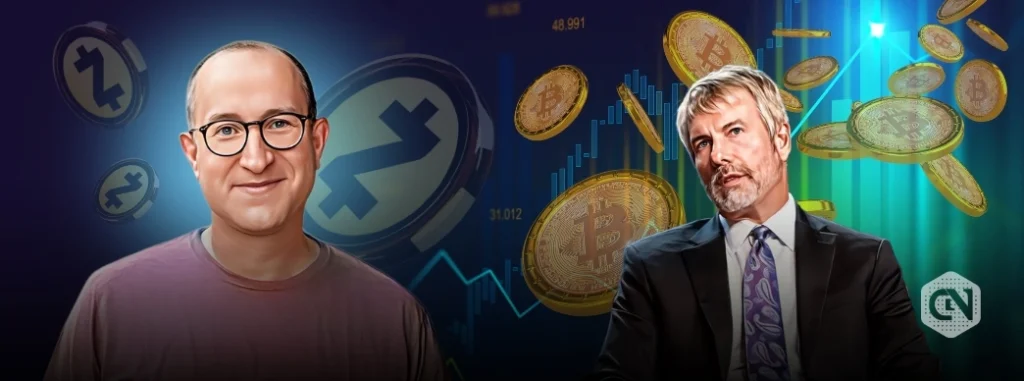
Eli Ben-Sasson, the co-founder of the privacy coin Zcash and key developer behind StarkNet, said that Michael Saylor from MicroStrategy (now known as Strategy) is not in favor of adding Zcash-style privacy features to Bitcoin through a social media post on X today, December 5, 2025.
According to Ben-Sasson, Saylor told him on their first meeting that Bitcoin should not include that kind of privacy, because if transactions become too hidden, governments might see it as a threat and try to shut Bitcoin down.
The tweet highlights a major debate within the Bitcoin community which questions if Bitcoin should become more private like Zcash, or should it stay transparent enough to keep regulators comfortable?
Supporters of privacy say anonymity protects financial freedom. Critics, on the other hand, worry that too much privacy could trigger government backlash and hurt Bitcoin’s global adoption.
The Privacy Debate: Security vs. Censorship Resistance
Michael Saylor’s concern is that if Bitcoin becomes completely private, like Zcash, where all transaction details are hidden, governments around the world might react badly. He worries that if authorities can not see what is happening on the network, they could accuse Bitcoin of enabling crime and then try to shut down miners, nodes, or even ban the network.
Eli Ben-Sasson and other privacy supporters disagree with Saylor’s thought process. They say that privacy is not a threat, it is actually a necessity. Without privacy, Bitcoin cannot fully protect financial freedom or prevent censorship. They also say that privacy is something that makes every coin equal (fungibility), so no one can block or reject coins based on their past history.
Ben-Sasson adds that privacy and regulation do not have to clash. Zcash already uses something called viewing keys, which let users share transaction details only with trusted parties, for example, an auditor or regulator, without exposing that information to the entire world.
This creates a possible middle ground, where users stay protected and transparency is also made available when it is required legally. It is important to note that it is essentially a model where Bitcoin could offer strong privacy without putting itself at risk of government backlash.
StarkNet: Growing the Bitcoin Economy Through Layer 2 Solutions
The discussion has also shifted to StarkNet’s wider goal of pushing the Bitcoin economy using Layer 2 tech. StarkNet, co-founded by Eli-Ben Sasson, is a zero-knowledge rollup built mainly on Ethereum but wants strong integration with Bitcoin.
The idea is that StarkNet could make Bitcoin more useful, allowing faster, cheaper transactions and smart contracts at scale. The staking and yield mechanism is built on StarkNet’s Layer 2 network and uses bridged or tokenized Bitcoin, not native BTC transaction fees.
STRK token holders and decentralized autonomous treasuries (DATs) can earn rewards through this Layer 2 ecosystem, but it does not redirect actual fees from the Bitcoin mainnet.
Ben-Sasson hoped Michael Saylor would see this as a powerful way to grow Bitcoin’s ecosystem, which may provide BTC holders new opportunities to earn and participate, and not just store value.
The conversation covered Bitcoin upgrades such as OP_CAT, which allows more advanced features. Saylor warned that big or fast changes could shake confidence while Ben-Sasson’s side argued its well-studied and delaying it could in fact slow down Bitcoin’s growth.
Ben-Sasson ended the tweet stating that the next discussion would be on quantum resilience.
Also Read: Bitcoin Bounces From $84K Low to $94K, ETF Inflows Fueling the Surge?
