





- Bittensor’s TAO jumped more than 20% today, March 25, 2026.
- Subnet growth and Templar’s Covenant-72B, is driving momentum and real utility.
- Rising institutional interest is positioning TAO as a key decentralized AI bet.
Bittensor’s TAO token has surged more than 20% today, March 25, 2026. With this surge, the price of the TAO token has crossed the $370 mark and the token has outperformed the broader crypto market, according to CoinMarketCap.
At press time, the price of the token stands at $374.70 with a surge of 22.7% in the last 24-hours as per CoinMarketCap.
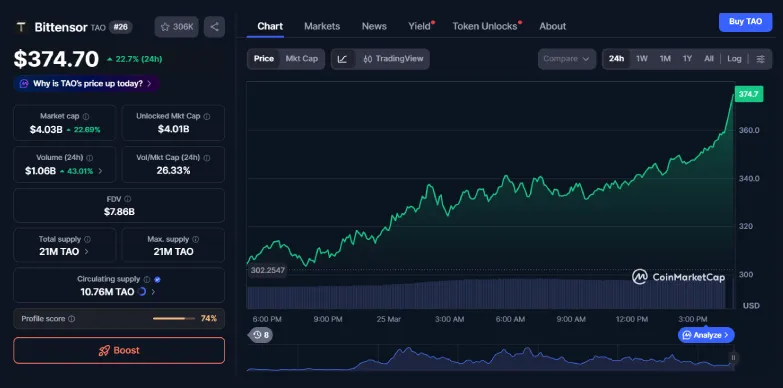
This rally has been fueled by subnet ecosystem growth and the groundbreaking Covenant-72B model on Templar subnet, then there are endorsements from big names within the AI space. All of this indicates that there is a breakout moment for TAO in March 2026.
Greer’s Bold Thesis Unpacked
In an interview with The Rollup, VC Investor Rob Greer (Stillcore Capital) shared his bullish outlook on Bittensor, discussing its long-term potential following the December 2025 halving.
Speaking with host Mark Jeffery, Greer positioned TAO as a supply-constrained asset with growing subnet demand, drawing comparison to early-stage Bitcoin and emphasizing a “proof-of-intelligence” model where emissions reward useful AI work rather than traditional mining.
Disrupting $1.5 T Centralized Labs
Greer criticizes what he sees as overpriced AI and crypto players, arguing that assets like Cursor are being valued at tens of billions while other smaller projects are priced far lower but deliver comparable or better efficiency. He frames Bittensor as a turning point, similar to an “iPhone moment”, where earlier hype-driven, speculative “vaporware” is being replaced by real, working infrastructure.
Rob Greer thinks Bittensor is a way better opportunity than expensive, corporate AI rounds.
“I actually think that people are going to be buying the TAO is the Bitcoin of AI. That’s the narrative” pic.twitter.com/UP1Xck6rQp
— The Rollup (@therollupco) March 23, 2026
Endorsements Ignite Institutional Fire
Along with Greer, Calacanis praised TAO and so did Chamath and Jensen Huang, who highlighted Templar’s decentralized training as central labs falter.
Moreover, Greer warns that as of now, only a few people understand and can access these AI tokens. If big platforms list them, regular investors will come rushing in. TAO is being framed as a future bet on decentralized AI, especially in a world where AI might disrupt jobs.
Subnet Stars Driving the Surge
On the Bittensor network, different subnets are starting to show real progress. Chutes (SN64) claims that it can run AI tasks, which are 85% cheaper than Amazon Web Services (AWS) and stayed fully online even as the geopolitical tensions got intense. This indicates reliability from the project.
Moreover, Templar (SN3) has scaled its AI models from 1 billion to 72 billion parameters and built Covenant-72B, which reportedly performs better than Llama2 (70B version). All of this while being trained across decentralized nodes and not by a single company.
Another project, Score, is working on enterprise-level sports prediction tools, with a public (doxxed) team and a structure that is easier for retail investors to understand. It is also a part of Stillcore’s portfolio, which shows growing institutional-style backing within the ecosystem.
Also, across the Bittensor network, 129 subnets now make up about 27% of TAO’s total market value, with the rise partly driven by hype around the Covenant model.
These subnets are not just speculative but they are generating revenue through a mix of real income (USD) and token rewards (emissions). Some, like Synth, are even using this revenue to buy back their own tokens, similar to how companies like Nvidia return value to shareholders.
Technicals and Road Ahead
Bittensor’s TAO token has jumped about 20% to $370 and is holding above a key support level at $340. If the rally continues, the next target is around $385, while a drop could bring it down to $271. The network is also expanding, with its emission system adjusting as it grows, now supporting 256+ subnets.
Looking ahead, investor Greer believes that TAO could reach a $1 trillion valuation by 2030, as spending on AI infrastructure shifts toward decentralized GPU networks like Bittensor instead of traditional players like OpenAI. The idea is that talent and resources could move into this ecosystem, creating a strong cycle of innovation.
At the core, contributors like Jacob Steeves (linked to DeepMind) are working to build decentralized AI systems, similar in philosophy to build decentralized AI systems, similar in philosophy to Satoshi Nakamoto. The goal is to create “sovereign AI” networks that operate independently of major powers like the US and China.
Also Read: TAO Price Slips to $270 Amid Global Pressure and AI Rotation

