





- EMURGO, a Cardano co-founding entity, partners with Slash Vision Labs to bring the Cardano Card to Japanese consumers through SecondFi.
- Cardano card would allow Japanese users to carry out crypto payments via the QR code system for their everyday needs.
- Bear flag formation drives the short-term consolidation in Cardano price before the next breakdown.
On Monday, May 18th, the Cardano price showed an insignificant loss of 0.1% to trade at $0.252. While the broader crypto market faced continued selling pressure due to Bitcoin’s breakdown attempt from $77,000, the ADA price shows resilience above the $0.25. The bottom buying pressure can be attributed to the recently announced partnership between SecondFi and Slash which plans to integrate Cardano card into the Japanese payment landscape.
Cardano Enters Japanese Payments Market Through EMURGO-Slash Deal
EMURGO, the commercial arm of Cardano announced a strategic partnership with financial technology firm Slash Vision Labs of Japan, with the goal of bringing the native cryptocurrency into the hands of regular Japanese consumers.
The partnership will focus on Cardano Card and will be handled by the Japanese card program manager, Slash Vision Labs. Slash’s proprietary stablecoin payment infrastructure is developed specifically for Japan’s financial regulations and reality of domestic payment systems. The country dominantly runs on a dense network of QR code apps, transit cards, and digital wallets rather than the tap-and-go card culture prevalent in Western countries.
The EMURGO’s participation is via its SecondFi self-custody platform, which operates more like a neobank than a traditional crypto wallet. The users can access financial tools commonly found in traditional banking products but do not give third party control of their assets.
Japan’s Regulatory and Market Context
Japan occupies a particular position in Cardano’s commercial history. The network’s token, ADA, has gained a lot of retail investors in Japan at the initial stages of the crypto adoption, and the market share has not seen much of a drop in comparison to other countries. Unlike many similar economies, Japan also settled many issues in relation to the classification of cryptocurrencies and licensing of exchanges, creating a more favorable environment for companies such as EMURGO to develop regulated financial products. The Financial Services Agency has taken a proactive approach in regulating cryptocurrencies for nearly a decade, making it more predictable than other markets in the region.
Slash Vision Labs has been making strides towards integration into the Japanese market with its own stablecoin card, known as Slash Card. That infrastructure is expanded to SecondFi’s users with the Cardano Card partnership. The settlement flows, local funding procedures and Japanese financial regulations’ requirements on the onboarding of consumer products are all being executed within Slash’s current processes.
Since Cardano’s journey began in Japan, we have always wanted our Japanese ADA holders to be able to do more than just hold and stake. Partnering with Slash, a leading crypto-native payments infrastructure provider in Japan, is a natural pathway for us to deepen our commitment to this foundational market. Following the successful launch of the Cardano Card and the debut of SecondFi, expanding into Japan’s vibrant blockchain community was the clear next step.” said Phillip Pon, CEO of EMURGO
Connecting Crypto to Everyday Spending
The real-world impact for Japanese users would be the ability to use their crypto assets (via stablecoin protocols) at stores that accept the dominant QR code payment systems used by the Japanese public. The cashless payment system in Japan is a complex mix of competitive systems, all of which have become integrated into consumers’ routines and lifestyles when paying for their food, transportation, and everyday shopping. Having a crypto-backed card linked to these networks has been one of the biggest hurdles preventing crypto from being useful beyond the trading and investment environment.
Stablecoins have the potential to become part of everyday payments, but delivering that experience in Japan requires infrastructure designed specifically for the local market. We are excited to partner with EMURGO and SecondFi to help bring practical, real-world stablecoin utility to users across Japan.” said Shinsuke Sato, CEO of Slash Vision Labs
The Cardano Card has not yet launched for Japanese users. There is a waitlist available on the website of SecondFi at secondfi.io, where the companies have said that card seekers will be notified before the general rollout. The announcement materials do not specify a launch date.
What This Means for Cardano and ADA
This partnership contributes to the Cardano ecosystem in a few indirect, but cascading ways. Japanese users transacting via QR code create regular micro-transactions data flows, which contribute to real-world utility metrics that institutional watchers are beginning to pay attention to in addition to price.
Stablecoin flows — primarily USDCX, Cardano’s privacy-focused cross-chain USDC — get locked into native wallets rather than sitting on external chains, gradually deepening the network’s total value locked. Each transaction on the stablecoin runs and completes on the Cardano network, which continues to charge network fees in ADA, all without the need for consumers to buy the token directly.
More importantly, entering Japan’s highly-regulated Web3 landscape gives Cardano a seal of compliance that resonates in enterprise discussions around the world. Payment integration price effects are more likely to be subtle, gaining momentum gradually and creating a utility base under the speculative valuation over time.
Cardano Price Face Major Breakdown Test at Bear Flag Pattern
Over the past week, the Cardano price showed a V-top reversal from $0.288 to $0.252, registering a loss of 12.8%. An analysis of the daily chart shows this pullback as a bear cycle within the formation of an inverted pennant pattern.
The chart setup is characterized by a sharp price drop, followed by a narrow consolidation within two converging trendlines. This temporary lateral trend typically allows sellers to regain their momentum and drive the next breakdown.
If the pattern holds true, the Cardano ADA1.48% price could drop another 2.85% and breach the bottom trendline to accelerate selling pressure. The post-breakdown fall could push the price $0.228 bottom support.
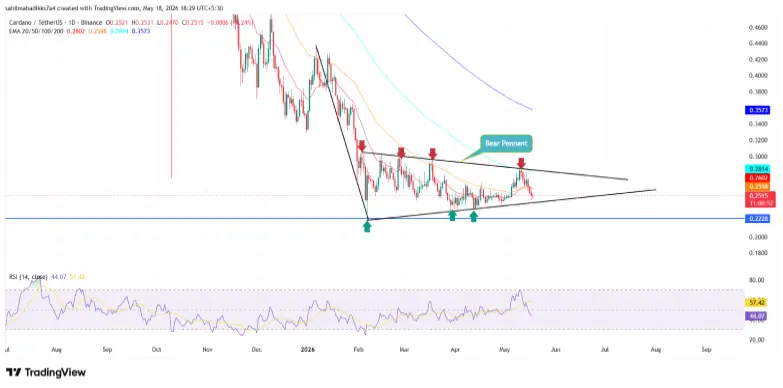
However, the price breakout will determine the true completion of the pattern. If the coin price breaks above the overhead trendline, the buyers will regain control over the short-term trajectory.

 GoogleNews