




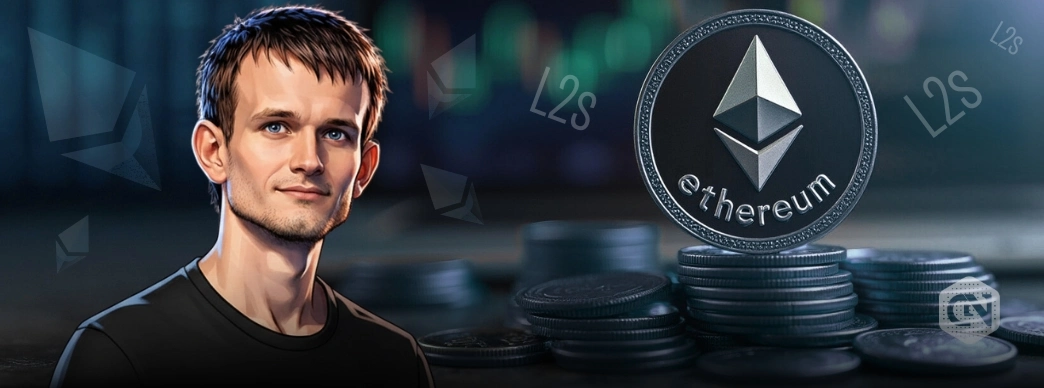
Key Highlights
- Vitalik Buterin stated that Ethereum’s own Layer 1 is scaling impressively, and this makes the vision of Layer 2 outdated
- He urges L2 projects to stop focusing completely on transaction throughput
- Instead, he highlighted areas like specialized networks for privacy, artificial intelligence, social media, or ultra-low latency that go beyond what the scaled Ethereum mainnet can provide
In the latest post on X (formerly Twitter), Ethereum co-founder Vitalik Buterin stated that “the original vision of L2s and their role in Ethereum no longer makes sense, and we need a new path.”
There have recently been some discussions on the ongoing role of L2s in the Ethereum ecosystem, especially in the face of two facts:
* L2s’ progress to stage 2 (and, secondarily, on interop) has been far slower and more difficult than originally expected
* L1 itself is scaling,…— vitalik.eth (@VitalikButerin) February 3, 2026
Vitalik Buterin has called for a re-planning of the role of the Layer 2 solutions, as their original purpose is now outdated. The inspiration from his thought comes after Ethereum’s main Layer 1 network, which recently achieved success in its scalability in transactions, while some Layer 2 development stalls.
Why Vitalik Buterin Wants to Rethink His Vision for L2s on Ethereum
In the latest post on X, Vitalik Buterin recalled the original “rollup-centric roadmap” for the network scaling. This plan relied on L2s to provide a large block space that was fully secured by Ethereum’s mainnet.
This security guarantee was meant to ensure transactions could not be censored or reversed.
In the tweet, Vitalik criticized simpler multi-signature bridge designs for failing to meet this high standard. However, the situation is different now.
With Layer 1 preparing for a major gas limit increase in 2026, transaction fees are expected to drop to very low levels. This means the main network can handle vastly more activity directly.
Vitalik Buterin stated in the post, “L1 is itself scaling. And L2s are not able or willing to satisfy the properties that a true “branded shard” would require. I’ve even seen at least one explicitly saying that they may never want to go beyond stage 1, not just for technical reasons around ZK-EVM safety, but also because their customers’ regulatory needs require them to have ultimate control.”
“This may be doing the right thing for your customers. But it should be obvious that if you are doing this, then you are not “scaling Ethereum” in the sense meant by the rollup-centric roadmap. But that’s fine! it’s fine because Ethereum itself is now scaling directly on L1, with large planned increases to its gas limit this year and the years ahead,” Vitalik Said.
He suggests that the ecosystem should view L2s as a broad spectrum of chains. On one end are networks fully secured by Ethereum. On the other are chains with looser connections are created for specific applications.
In the official post, he also revealed the next technical steps to support his future. He called for developing a “native rollup precompile.” This would allow the mainnet to natively verify the complex proofs, known as ZK-EVM proofs.

