


- The Bitcoin price faces an intact overhead supply at $74,000 resistance, signaling the continuation of its ongoing correction.
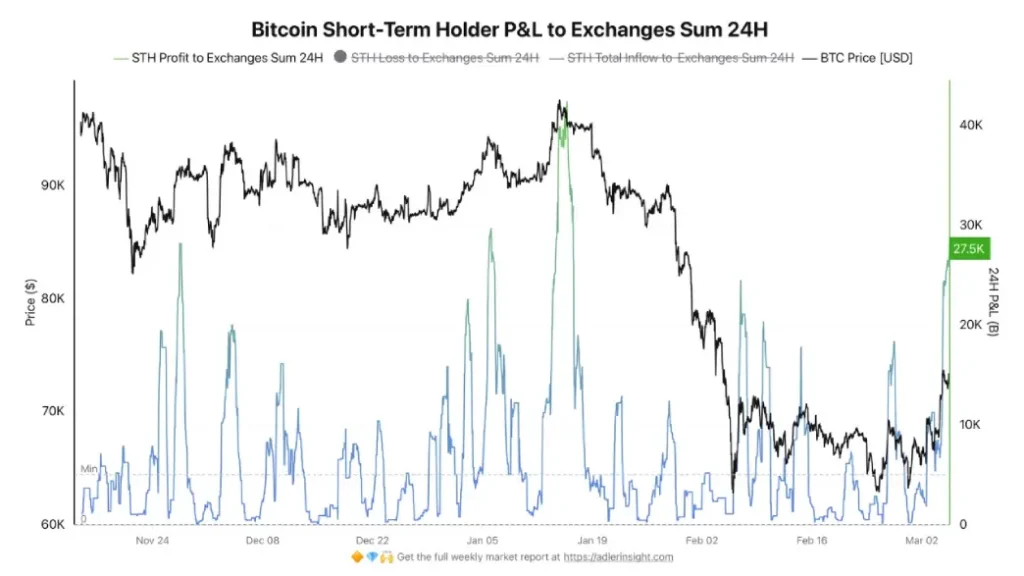
- Blockchain data shows over 27,000 BTC moved to exchanges in profit within the past 24 hours.
- The crypto fear and greed index at 18% suggest that the broader market sentiment remains strongly bearish.
The pioneer cryptocurrency, Bitcoin, is down 3.5% during Friday’s trading market hours to trade at $68,302. The downtick coincides with U.S. market correction following a triple threat of weak labor data, surging oil prices, and escalating geopolitical tensions including Iran. However, the Bitcoin price faces additional pressure as short-term holds rushed to book profit when the coin briefly surged above the $70,000 mark earlier this week. Is the $60,000 breakdown close?
BTC Faces Selling Pressure as $1.8B Profit-Taking Hits Exchanges
On March 6th, the cryptocurrency market experienced a significant outflow which pushed its market cap to 2.41% down to hit $2.33 Trillion. The primary catalyst fueling this sell-off include surging oil in the broader market amid geopolitical tension in the middle east which also raised risk-off sentiment among investors.
The bearish momentum further accelerated as the February 2026 US nonfarm payrolls shows an unexpected loss of 92,000 jobs against the market forecast of a 50,000 gain, with unemployment steady at 4.4%.
However, the weak job number may raise odds of Federal Reserve rate cuts, which historically triggered a recovery in Bitcoin.
That said, the potential uptick would still struggle to sustain higher ground as STHs (Short Term Holders) are preferring to take early profits.
On-chain metrics indicate that more than 27,000 BTC worth about $1.8-1.9 billion at prevailing exchange rates have been sent to trading platforms in gains over the last 24 hours. This represents one of the more significant single day profit outflows in recent months.
Participants that obtained positions about one week to one month earlier are still the primary group in positive territory with their average cost basis being around $68,000. Short-term holders, who are sometimes defined as those who are more sensitive to price action and outside sentiment, seem to prefer quick exits rather than long exposure.
Broader market conditions, such as cautious macroeconomic forecasts and continued geopolitical developments in the Middle East, have created an environment in which near-term caution is the order of the day. Bitcoin traded in the range of $68,000 – $69,000 in the early hours of March 2026, moving back from the recent peak on the back of high volatility and renewed selling interest from this cohort.
Bitcoin Price Reverts After Dead Cat Bounce
In the 48-hours, the Bitcoin price is down from $73,573 to $67,753, registering a 7.9% loss. This pullback signals intact overhead supply around $74,000 and a potential bearish reversal in the daily chart.
With sustained selling, BTC could lose another 8% and retest the immediate support at $62,600. Since early February, the coin price has been resonating within a narrow range from $72,600 and $74,000.
Amid this consolidation, If the sellers manage to replenish its prevailing bearish momentum, the coin price could breach the bottom support, and extend its current downtrend to $56,000.
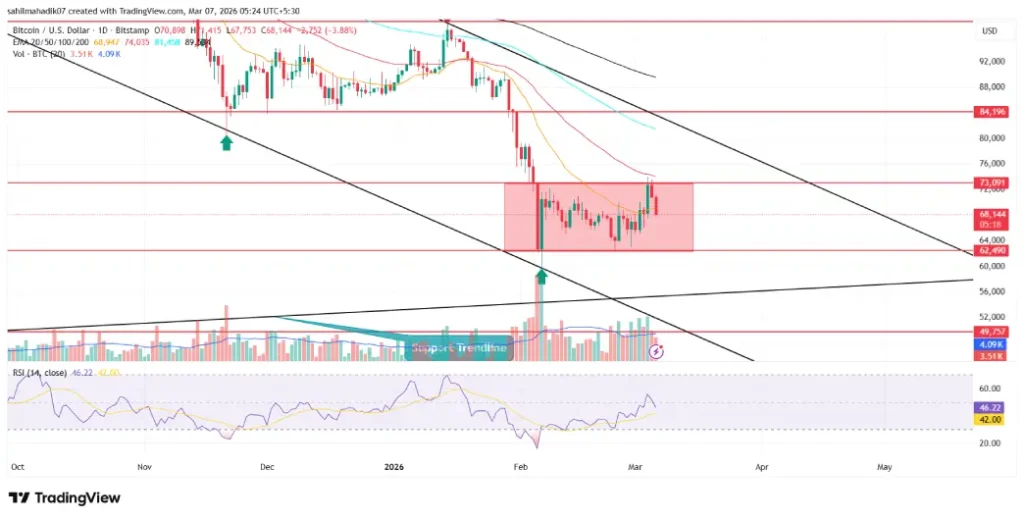
On the contrary, if the coin flips the overhead resistance of $74,000 into potential support, the buyers could strengthen their grip over this asset for a higher rally to $85,000 mark.
Also Read: 21Shares Launches First U.S. Polkadot ETF on Nasdaq Under TDOT Ticker
