


Key Highlights
- In February, the crypto market witnessed a sharp fall, in which Bitcoin plunged below $65,000
- This fall came after an institutional investment in crypto slowed down
- This downfall in the crypto market has also affected the major BTC holding companies like Strategy
In February, the cryptocurrency market witnessed one of the sharp falls, where it slipped below $65,000. After closing out 2025 on a high note near $90,000, the biggest cryptocurrency, Bitcoin, suffered over 50% loss from its all-time high at $126,000.
The sharp fall in the crypto has wiped out millions of dollars in investment and created turbulence on the trading market. There is panic in the crypto market.
Amid the dip in the crypto market, there is a discussion going around in the crypto market. Was this intense sell-off the beginning of the end for the bull market, or a simple drop after overleveraged positions? While the crypto market is going through a consolidation phase between $67,000 to $70,000.
February Bitcoin Charts Spark Fear in the Crypto Community
The data on the chart for February is showing very harsh data. This month, Bitcoin (BTC) fell below $61,000 on February 7, which is around a 50% drop from October 2025.
According to CryptoQuant, the 7-day average of realized net losses reached around $2.3 billion. This makes this sell-off among the largest loss events in the history of the crypto market.
Adam Morgan McCarthy, product specialist at Kaiko, stated in the interview, “The fall in Bitcoin prices has been largely tied to less interest in the markets and lower trading volumes. This leads to less liquidity, so any move higher or lower is exacerbated.”

(Source: Coinglass)
Deutsche Bank analysts stated in the report that U.S. crypto ETFs “have seen billions of dollars flow out each month since the October 2025 downturn.”
The analyst stated, “This steady selling in our view signals that traditional investors are losing interest, and overall pessimism about crypto is growing,” the analyst said.
According to the experts, this is one of the largest “capitulation events” in BTC history, which is similar to the 2021 crash, 2022 Luna and FTX collapse, and mid-2024 correction.
Apart from this, futures open interest also dropped by approximately 20%. This is a very important mark around $68,000. This is a sign of recovery as open interest, which can also be considered to rebound.
Reasons Behind the February Drop
There are many factors behind the fall of the crypto market in February. One of the major factors behind this fall was overleveraged positions. This situation was intensified after macroeconomic factors triggered volatility in the crypto market, including interest rates and global liquidity conditions.
According to CoinGlass data, on February 5, the crypto market witnessed a liquidation of about $10 billion in leveraged Bitcoin positions.
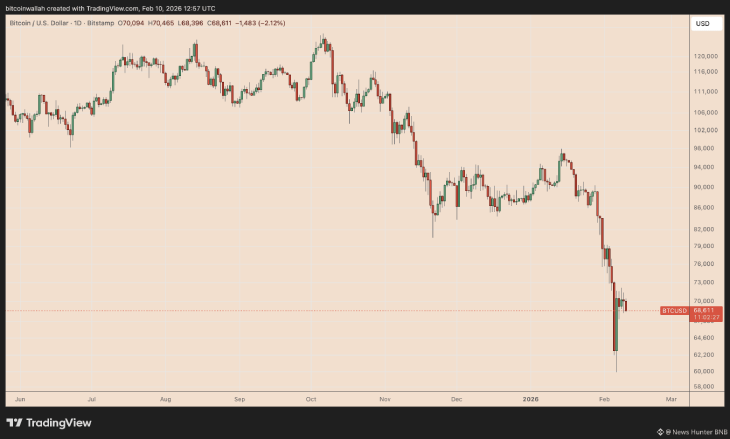
(Source: Tradingview)
Jeff Park, chief investment officer at Procap, stated that the sell-off in the crypto market has mainly come from reducing investment in spot Bitcoin exchange-traded funds (ETFs). This also includes deleveraging.
He stated that BlackRock’s iShares Bitcoin Trust witnessed record trading volume exceeding $10 billion on February 5. Most options have taken positions on puts rather than calls.
Apart from this, Goldman Sachs stated that February 4 was the worst daily performance events of the history of these funds. It is telling risk managers to demand rapid de-grossing across portfolios.
Despite the drop in the crypto’s price, ETF flows are following historical patterns. Instead of a sharp crash in the price, IBIT generated more than 6 million new shares, which helped to attract more than $230 million in added assets. The cumulative ETF market has witnessed over $300 million in inflows.
Bitcoin Holding Companies, Like Strategy, Faces Sharp Fall
The fall in Bitcoin’s price has also forced many Bitcoin-holding companies to rethink their decision to hold BTC on their balance sheet. Strategy, the Bitcoin holding company owned by Michael Saylor, has revealed a quarterly net loss of $124 billion in its Q4, 2025. This mainly comes from the $174 billion unrealized fair value loss from its BTC holdings.
After this announcement, this company’s stock dropped around 17% the next day. This has wiped out all surges that the company gained after the U.S. presidential election and fallen around 80% from its November 2024 highs.
As of now, Strategy holds around 713,502 BTC purchased at an average price of $76,052.
Conclusion: Is this a Collapse or a Correction?
In the end, there is a big discussion going on in the crypto community. The question is, is this the end of the bull cycle?
While many experts are saying that this is a small correction instead of a “structural collapse.” Fidelity’s director of global macro, Jurrien Timmer, stated that the $60,000 is the bottom of the current cycle. He stated that a new bull market will start after “a few months of backing and filing.”
He stated that the fall to “only” $60,000 is relatively small for a Bitcoin winter.
Also Read: Why ETH/BTC Above 0.06 Could Signal the Next Altseason
See less
