


Key Highlights
- The current war between U.S against Iran created economic pressure on the world, raising crude oil prices
- After losing value on the initial stage, BTC has managed to rebound quickly, currently trading at around $73,000
- BTC ETFs have witnessed an impressive inflow streak after the war started in the Middle East
It feels like the world is sitting on a ticking bomb right now after a major escalation in the Middle East, and its repercussions are also seen in the financial world.
The screens in trading rooms from Singapore to New York are showing red candles. The reason behind this is that the block in the narrow choke point, which is responsible for one-fifth of the planet’s oil. Tanker trackers showed that vessels are dropping anchors or diverting their route at full speed.
For the first time in modern history, Iran had made a major move. The Islamic Revolutionary Guard Corps announced that it is closing maritime traffic through the waterway. Within hours, at least 150 oil and liquefied natural gas tankers had halted in the Persian Gulf. Four vessels were damaged, and two crew members were killed.
While oil prices are increasing rapidly, there is a question in the market whether this shock in the global economy will provide benefits to the crypto sector or not.
While oil futures increased and equity indices collapsed, there was a major price momentum witnessed in the crypto sector.
Many times in the past, Bitcoin was criticized for its label as digital gold, and some people say that it only surges during a bull run. Also, they raise questions on its nature of inflation hedge.
Some recent price movements have sparked discussion in the community. From the weekend low near $63,000, Bitcoin rebounded more than 5%, trading near $66,500 by Sunday and holding above $67,000 into Monday. On the flip side, the S&P 500 futures and Nasdaq 100 fell 1.1% and 1.5%, respectively. Gold and silver initially soared on safe-haven demand but later gave back gains. Some analysts are calling gold’s chart “damaged.”
James Butterfill, head of research at CoinShares, called this the strongest real-world test of Bitcoin’s safe-haven thesis this cycle.
Escalation in the Middle East Shakes Global Economy
On February 28, the U.S. and Israel conducted joint air strikes on Iranian targets. By early March, Iranian forces had retaliated across the Gulf, and Lebanese fronts reignited. Not just this, the world’s most important energy route was under direct threat.
Shipping giants such as Hapeg-LIoyd and CMA CGM have announced the suspension of transits. UK Maritime Trade Operations warnings turned into de facto no-go zones.
The biggest nightmare turned into reality when Iran’s Revolutionary Guards announced that the strait was closed and warned to shoot down any vessel passing through the Strait of Hormuz. One of the busiest sea routes has witnessed a major drop in traffic, which normally handles 20% of global crude and a major supply of liquefied natural gas, according to trackers.
Many major news outlets confirmed that an “insurance-based shutdown” with dozens of tankers has paused their movement or diverted to other routes. Shipping giants, including Hapag-Lloyd and CMA CGM, suspended transit.
This war has quickly affected the global financial markets. Brent crude, which is the global benchmark, surged above 13% in early sessions. It briefly surged above $82 before settling around $84 a barrel. This is the highest since January 2025.
Sentosa Shipbrokers said, “Prolonged disruption of oil flows risks upsetting China, one of the Gulf’s main oil importers and a major partner of Iran, while cutting Iran’s own export revenue. This may limit the duration of the disruption.”
Fears of Inflation and Recession Aid the Crypto Market
Amid the war in the world’s most important economic region, there is fear of higher inflation in the crypto market. Arthur Hayes and other experts are arguing that the enormous U.S. military budget and other Federal Reserve accommodation are expected to print more money. This is the perfect setup that helps assets with hard supply caps, like BTC.
The rising price of crude oil could force easier policy later, and it can boost BTC as a hedge against currency debasement.
Some historical data suggest that while equities wavered, BTC followed a trajectory in the upward direction as inflation fears grew. Its fixed 21-million supply makes it more attractive than fiat currency, which quickly loses purchasing power during war deficits.
How Bitcoin is Emerging as a Safe Haven in the Middle East War
Amid the turmoil in the global financial market and war in the Middle East, Bitcoin is showing an impressive resilience, irrespective of its recent crash.
In the initial phase of 48 hours, when the first attack took place in Tehran, Bitcoin plunged from approximately $68,000 to $63,000 with around 7% drop in just a few hours. Once again, its correlation with equities was also triggered and hit multi-year highs as leveraged traders rushed to liquidate their positions.
According to some experts, Bitcoin was behaving like a “high-beta” tech stock, not digital gold. In the same period, the gold price surged over $5,400 per ounce while the dollar index climbed. This was the time when old patterns of sharp crashes were forming.
However, against all odds, BTC has managed to see a rebound quickly within a week. By March 4, BTC surged back to the $71,000 to approximately the $74,000 range. At the time of writing, BTC is trading at around $71,333 with a 6.8% hike on a weekly chart, according to CoinMarketCap. From its post-strike lows, the crypto was up more than 13% in days while traditional markets remained down.
According to the on-chain data, large wallets have started accumulating during the dip. Derivative funding rates also changed positively. After dropping in the initial phase, the crypto has started regaining momentum.
Institutional Money Flows into BTC ETFs and Public Companies Buy Dip
Since the war broke out, the institutional investment into BTC has witnessed a growth, which was absent during the last few weeks. U.S spot BTC ETFs witnessed $1.1 billion to $1.4 billion in net inflows across just three days, starting from March 2 to March 4. This is one of the strongest inflow streaks of the quarter.
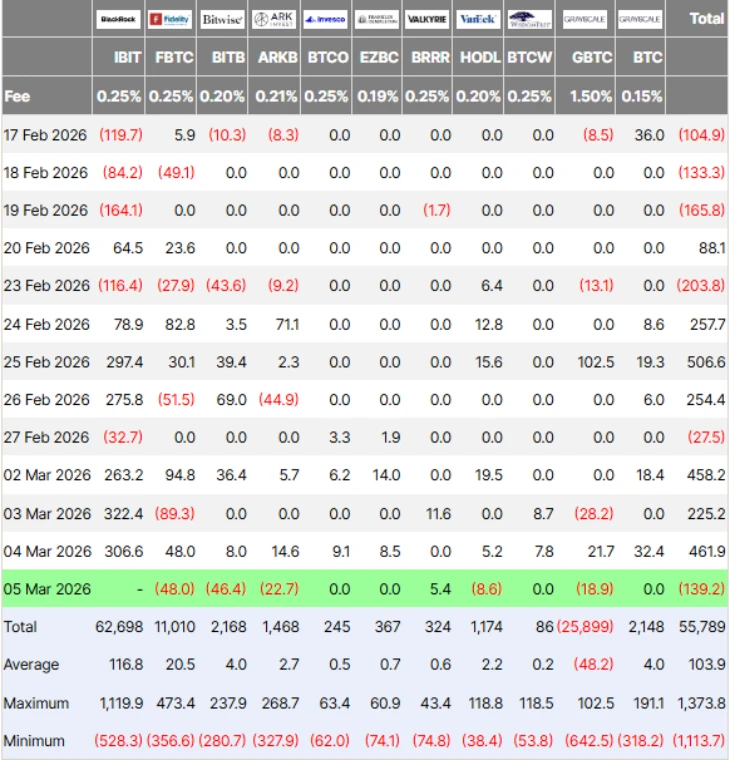
(Source: Farside)
On March 2, BlackRock’s iShares Bitcoin Trust, known as IBIT, accumulated around $263.2 in inflows. On March 3, it generated $322 in inflow.
Strategy has acquired 3,015 BTC for ~$204.1 million at ~$67,700 per bitcoin. As of 3/1/2026, we hodl 720,737 $BTC acquired for ~$54.77 billion at ~$75,985 per bitcoin. $MSTR $STRC https://t.co/rqDIhlUDNx
— Michael Saylor (@saylor) March 2, 2026
At the same time, institutions have also started buying dip. Strategy has added another 3,015 BTC for approximately $204 million. That lifted its corporate treasury to 720,737 BTC.
These constant inflows from institutions have provided the boost for the impressive rebound, providing their demand among them as a safe haven during war-like situations.
Conclusion
According to U.S. officials, the U.S. war against Iran is expected to stretch for weeks, and the Strait of Hormuz remains tense. This war will definitely create a lasting impact on the global economy. While the price of crude oil reached $84, there is fear of rising inflation and recession looming over the world.
However, BTC’s current momentum and institutional demand are giving bullish signals. After the initial drop, the cryptocurrency quickly rebounded. Corporations are continuously buying dip, while BTC ETFs are seeing an impressive streak of inflows. Whether this momentum will last longer or not, it completely depends on how long the war lasts.
As of now, the price momentum in BTC is sending a clear signal that it is proving itself once again as a safe-haven asset.
Also Read: Top Crypto Narratives Every Crypto Investor Should Master in 2026
See less
