


Key Highlights
- Amid the boom in AI development, blockchain technology can bring value, such as transparency, to these AI models
- In this race, the Ethereum blockchain can beat the competition and provide it an edge over other blockchains like Solana
- Centralized AI models are currently facing issues like data privacy, and making AI agents verifiable with proper auditing
Amid the boom in the AI market, where most big companies like Google, OpenAI, and Meta have accelerated the development of more efficient models, the recent tweet from Ethereum’s co-founder, Vitalik Buterin, has sparked discussion in the world.
On February 9, Vitalik Buterin shared a tweet on X, where he did not announce a new model or promises of overtaking other companies in this AI race. Instead, he mentioned something that sounds more impressive for developing better AI models. In his tweet, Vitalik proposed Ethereum as the coordination and payment layer for AI.
Two years ago, I wrote this post on the possible areas that I see for ethereum + AI intersections: https://t.co/ds9mLnrJWm
This is a topic that many people are excited about, but where I always worry that we think about the two from completely separate philosophical… pic.twitter.com/pQq5kazT61
— vitalik.eth (@VitalikButerin) February 9, 2026
In his tweet, Vitalik mentioned a framework for 4 major areas, which includes:
- Enabling trustless and private AI interactions
- Ethereum as an economic layer for AI agent transactions
- Cyberpunk mountain man vision with local LLMs
- Make much better markets and governance reality
Vitalik Buterin Suggests AI Leaders Choose Coordination Over Competition
Ethereum is not an ordinary blockchain that is designed to perform only specific tasks. It is more than that.
This was not the first time Vitalik talked about the amalgamation of AI and crypto. He wrote the same two years ago. In the recent post, he affirmed that Ethereum and AI must develop in good collaboration to keep this technology in the control of human hands.
He also raised concerns over unverified races that are removing human intervention. Instead, he mentioned Ethereum as the layer where AI agents can pay for services, post collateral, and settle disputes. With blockchain, all this can happen without asking permission from a centralized authority.
How Centralized AI is Facing Some Problems, and Blockchain Technology Can Resolve This Issue
There is no doubt that many incredible AI models and agents have already been introduced without the integration of blockchain technology. But the future of AI will be much different from today’s AI projects, and it demands some serious precautions and a careful approach.
In today’s world, very few companies hold control of the data center, the computing hardware, and the deployment. In this system, users put their personal information into AI models without audit or compensation. This can lead to problems like biasness, errors, and the manipulation of information.
There is also growing concern about the misuse of this AI, such as deepfakes.
Here is where blockchain technology can help. It is capable of providing immutability for transparent data. This can provide great help in model training, on which most AI models’ future depends.
Decentralized networks are also known for their capability to distribute computing and storage across different regions. This can help AI models to reduce their dependency on centralized servers.
How Ethereum Can Add Value in AI Development
Earlier this year, Ethereum officially announced the arrival of ERC-8004 on its mainnet. This standard is known as the Trustless Agents standard.
The Ethereum Foundation has also formed a team called dAI, which added ERC-8004 on the 2026 roadmap. It also collaborated with Google, Coinbase, and MetaMask on the draft.
We’re starting a new AI Team at the Ethereum Foundation (the dAI Team).
Our mission: make Ethereum the preferred settlement and coordination layer for AIs and the machine economy.The team will focus on two main areas:
– AI Economy on Ethereum = giving AI agents and robots ways… pic.twitter.com/9sWVS4dp0K— Davide Crapis (@DavideCrapis) September 15, 2025
ERC-8004 is mainly designed to work on three registries.
- Identity Registry – This provides each agent with a censorship-resistant NFT-based identifier.
- Reputation Registry – This stores approved feedback and the history of past performance.
- Validation Registry – It allows third parties to issue audits and certifications on-chain.
Now, this ERC-8004 resolves the biggest issues present in the currency AI industry. Earlier, there was a question like, when two autonomous agents meet on the blockchain, how do they know if the other can be trusted? The new standard is a perfect answer with on-chain resolution.
Can Ethereum Dominate the AI Space like DeFi
While Ethereum is still going through lots of upgrades and is expensive for some people, nobody denies the fact that it has become a popular infrastructure for the decentralized sector, along with Wall Street.
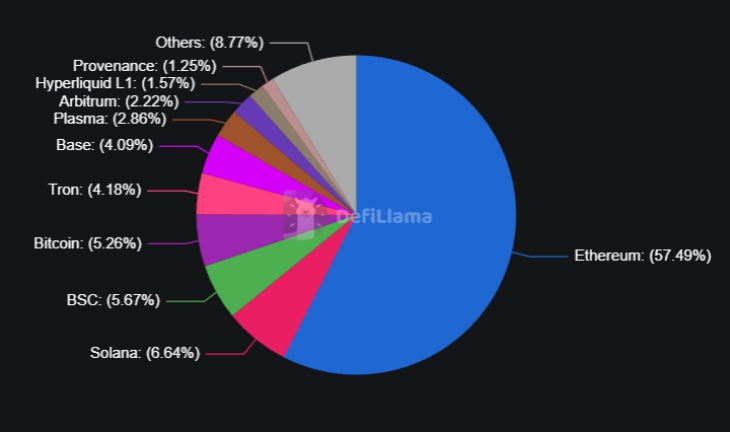
(Source: DeFiLIama)
According to DeFiLIama, Ethereum is currently holding up around 57% of all value locked in the DeFi sector, which is around $54.34 billion. This shows its domination over other blockchain networks like Solana (6.67%) and BSC (5.67%). This data is enough to understand the vastness of Ethereum’s ecosystem.
Many AI projects are already thinking about the integration of Ethereum. There is a project called Virtual Protocol, developed on Ethereum Layer 2, that has recently grabbed attention. The project recently announced that all qualified agents on its Agent Commerce Protocol would automatically register on ERC-8004.
It will assess the new agent’s performance and give a score based on their performance. This score will be posted on-chain, and it will be directly linked to the agent’s identity.
The Ethereum blockchain is continuously going through various phases of upgrades to address issues like high gas fees and congestion. It has already achieved major milestones through upgrades like Dencun.
Conclusion
Ethereum is quickly upgrading its platform with great scalability and making it perfect for resolving real problems that other blockchains have not yet addressed. Centralized AI models are not capable of providing transparency, and only blockchains like Ethereum can provide it.
Also Read: Ethereum Is Quietly Becoming Wall Street’s Blockchain — Here’s What the Data Says
See less
