




Key Highlights
- Web3 gaming is rapidly becoming a new interest for gamers, which comes with innovative technologies like blockchain
- These web3 games come with crypto rewards for their users in the form of digital assets that help creators to create a sustainable gaming economy
- However, there are some challenges, such as scalability issues on blockchains and unclear regulations, that can affect the growth of this new era of gaming
While the gaming industry is growing rapidly, Web3 gaming is also grabbing headlines. This genre of gaming is merging blockchain technology with a new era of gameplay to reward players with genuine incentives.
Unlike traditional Web2 games, where in-game assets vanish if servers shut down, Web3 is providing decentralized ownership through digital assets, such as non-fungible tokens (NFTs) and cryptocurrency rewards. This new era of Web3 gaming is opening doors of “play-to-earn” (P2E) models, where players can monetize their time and skill via tradable tokens.
The global Web3 gaming market was projected to surge to $39.65 billion in 2025. It soared by a 22.6% compound annual growth rate (CAGR). It comes with blockchain scalability improvements and rising player adoption.
Web3 Comes With Real Digital Ownership
In Web3 games, different kinds of digital assets like characters, weapons, and land parcels are minted as NFTs on blockchains such as Ethereum Layer-2 (L2) solutions.
These ERC-721 or ERC-1155 standard tokens are stored in player wallets, verifiable on-chain and transferable across marketplaces without developer intermediaries.
For example, if players win a rare sword in one game, it can be sold for cryptocurrency or used in metaverses. This is completely opposite to Web2, where game creators have control. This kind of process sometimes leads to asset devaluation post-launch.
Platforms like Immutable zkEVM come with gasless minting and trading. It is processing up to 498,000 daily transactions in Q1 2025 alone. This ensures low-cost transactions.
Crypto rewards are capable of being the independent crypto economy. It is distributed via smart contracts that automate payouts based on achievements.
Popular Web 3 Gaming Projects
In 2025, Axie Infinity distributed 10 million AXS tokens. These tokens are valued at $23.5 million. This helps them to revitalizing its economy on the Ronin chain.
These rewards are coming with deflationary models, where it uses burning mechanism. It reduces inflation risks seen in early P2E hype cycles.
The second project is Pixels. Pixels, which is a Ronin-based farming simulator, has also created records by surpassing 1 million daily active users (DAU). It combines gameplay with NFT land ownership and PIXEL token farming.
In this game, the players can generate revenue including diversified token and marketplace fees. This kind of gaming can contribute to Ronin’s dominance with 1.5 million monthly active users (MAU) as of late 2025.
Apart from this, there is Splinterlands. It is a Hive blockchain trading card game that comes with battle action and DEC os SPS token rewards. This decentralized game is ranking among DappRadar’s top chart for constant play sessions.
Alien Worlds, which is available on WAX and BNB Chain, is known for an impressive mining activity, where players earn Trilium (TLM) by deploying NFTs on virtual planets. This kind of approach is likely to enhance governance via DAO voting.
Blockchain Technology Enhances Gaming Economy
According to the report, blockchain games attracted over 4.66 million daily unique active wallets in Q3 2025. This number is representing 25% of all Web3 activity.
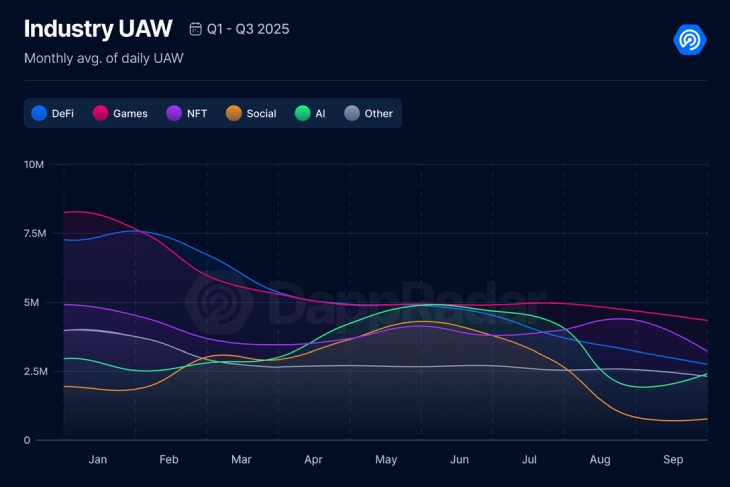
(Source: dappradar.com)
The secret behind this popularity in Web 3 gaming is on gaming-optimized blockchains. For example, Ronin, which is an EVM-compatible sidechain and widely popular, is coming with DAU (419,000 daily active wallets in Q3 2025). The main reason behind this is its capability to achieve sub-second finality with almost zero fees.
Another leading blockchain for gaming is Immutable zkEVM. This blockchain is using zero-knowledge proofs for Ethereum security while allowing easy integration of NFTs. Apart from this, Polygon’s AggLayer, which is integrated with Immutable, has also attracted many web3 games. This blockchain network is capable of providing cross-chain liquidity for unified economies, which is currently trending.
This onboarding process has also improved with account abstraction, which makes the process very easy. It allows email logins over seed phrases.
Loopholes in Web 3 Games’ Integration with Blockchain Technology
While new games are rapidly integrating blockchain technology, there are many challenges. One of the biggest problems in this sector is the high volatility of the cryptocurrency tokens. This can affect rewards. For example, AXS price changes have affected Axie players. Apart from this, the scalability issue is also a big loophole on congested chains.
Another factor that can affect the expansion of Web3 games is regulatory scrutiny. This is especially around the classification of tokens as securities. However, there are solutions for this kind of issue. This can be sustainable tokenomics that prioritizes “play-and-earn.”
Pixels’ model is a great example of this. There are also hybrid integrations like PerionDAO, which brings Web3 rewards to Web2 games like Fortnite.
Final Words
Web3 gaming is expected to experience explosive growth in the upcoming years. It is expected to hit $117 billion by 2034 at 18.1% CAGR. This growth could cross the traditional gaming sector via mobile and AAA titles like Illuvium.
There are new innovations taking place in this sector. It includes Interoperable standards (ERC-998 composable NFTs) and AI-driven economies, which will open doors for cross-game asset utility.
Also Read: Ethereum vs Silver: Will Traditional Silver Beat the ETH Surge?
See less

