

Key Highlights
- On-chain perpetual futures recorded $6.7 trillion in trading volume in 2025, which is over 300% jump from 2024
- Despite the competition from newbies, Hyperliquid handles $6 billion to $10 billion in daily volume.
- Everyday traders can now access the same timeless perpetual contracts with up to 50x leverage, with less speed and instant settlement.
When Bitcoin dropped more than 12% of its value in a few hours just last month, the traditional financial market was sleeping. Wall Street’s trading desks had closed hours earlier, which left many institutional investors powerless to respond until the next morning.
At the same time, some large hedge funds did not panic. They simply opened sizable short positions on Hyperliquid in real time. This helped them to protect their portfolios from the damage without waiting for the sun to rise over the CME.
These scenes are not rare anymore. Institutions that once confined themselves to CME futures and over-the-counter desks are now diverting their money into perpetual DEXs.
The migration of institutional capital into on-chain derivatives is showing a major change in how institutional investors use crypto.
The Adoption of On-Chain Perps Increases Among Institutional Investors
For many years, institutional money has been stuck with centralized exchanges for derivatives. However, this has changed in 2025.
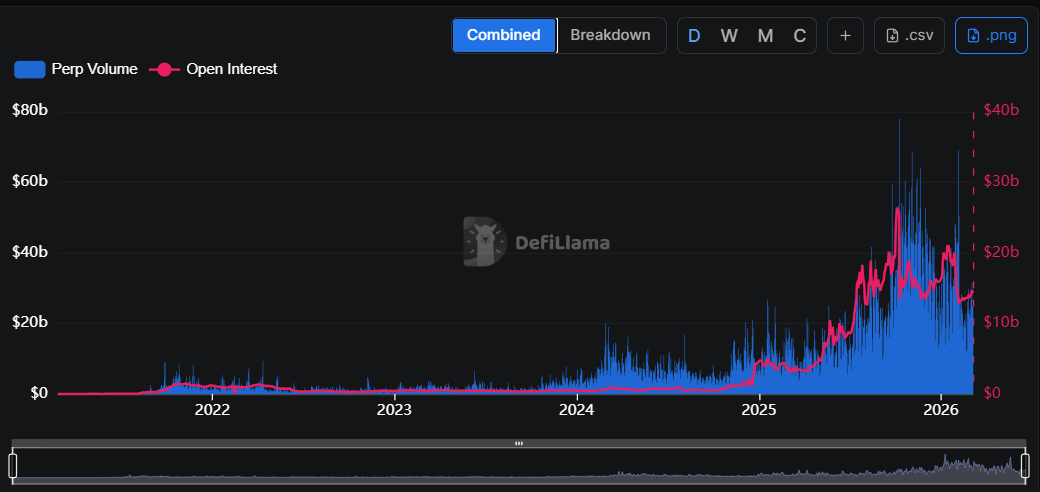
(Source: DeFiLIama)
According to data from DeFiLIama, the total trading volume on Perp DEXs reached approximately $7.9 trillion for the full year, which is a sharp over 346% hike from 2024. The sector managed to capture between 10% and 15% of the entire perpetual market, with its share spiking to 22% during peak months.
As of now, the 24-hour volume across these platforms is revolving around $24.7 billion. It has a combined open interest of around $14.3 billion.
Hyperliquid is the major player in this, as it dominates the sector with a major margin. According to DeFiLIama, it handles between $6 billion and $10 billion in daily volume and commands the lion’s share of open interest, often between $5 billion and $9 billion. Its BTC perpetuals can accommodate approximately $5 million in positions within a very tight 0.01% price spread, which shows the kind of depth that institutions require.
In the fourth quarter of 2025, new platforms like Aster, Lighter, and edgeX started attracting an impressive amount of volume. Lighter’s zero-fee model helped it grab a 20% share of trading volume in December, while Aster, backed by YZi Labs and supported by CZ, secured around 15%.
However, Hyperliquid is still dominating the market with around 49% share, which is around $7.5 billion. This shows that while some newbies are attracting volume through incentives, and greater liquidity.
Hedge funds and trading desks are now using these platforms for various reasons. This includes delta-neutral strategies, funding-rate arbitrage, and real-time hedging of spot holdings. They are doing so without the custody risk of moving assets off-chain.
This ecosystem is also supported by faster chains, zero-knowledge order books, and privacy layers. These enhancements in the ecosystem have boosted the speed and security that institutions are currently demanding.
Perp DEXs Turn Volatility into Daily Markets
Perpetual futures on DEXs have no expiry date. A trader can open a long or short position with leverage, and a funding rate mechanism keeps the contract price anchored to the spot market. That infrastructure allows traders to hold a position as long as they maintain their margin, which makes it a timeless tool for seeing volatility.
Institutions are now using this infrastructure for more than just crypto. On Hyperliquid, non-crypto contracts like silver, gold, and West Texas Intermediate crude oil are seeing massive volume.
Just days ago, on March 3, the WTI crude oil mapping contract on Hyperliquid saw its daily trading volume surge over $1 billion. It created a new record of $2.42 billion shortly after, with open interest reaching $66 million.
According to the HyperInsight tracker, among the top 10 trading pairs by real-time volume on Hyperliquid recently, only 4 were cryptocurrencies (Bitcoin, Ethereum, Solana, and HYPE). The other six were traditional assets, such as silver, gold, crude oil, the S&P 500, the Nasdaq 100, and Nvidia stock.
This shows real hedging of real-world exposure, settled instantly on-chain.
Regulators Aim to Establish Clear Regulatory Frameworks for Crypto
On March 3, 2025, Commodity Futures Trading Commission Chairman Michael Selig announced at the Milken Institute’s Future of Finance conference that the agency is weeks away from bringing true perpetual futures onshore in the United States.
Selig said, “working towards getting professional futures, true professional futures here in the U.S., within the next month or so. We expect to announce that very soon.”
“The prior administration drove a lot of these firms and the liquidity offshore,” he said. He stated that the move is designed to recapture liquidity that had fled to offshore and decentralized venues. He mentioned that the purpose is to create transparent frameworks that allow these products to be offered responsibly.
In July 2025, U.S. President Donald Trump signed the GENIUS Act into law, which established the first comprehensive federal framework for stablecoins. The Act requires stablecoins to be supported on a 1:1 basis by high-quality liquid assets. It clearly defines them as neither securities nor commodities, which clears the path for compliant on-chain settlement.
After this, SEC Chairman Paul Atkins and CFTC leadership launched “Project Crypto” and “Crypto Sprint.” These are the joint initiatives to match federal oversight and reduce regulatory fragmentation.
Summing Up
Less than a year ago, Perp DEXs were considered an experiment. But today, they can handle tens of billions of dollars daily and host real institutional capital. The competition among platforms like Hyperliquid, Aster, Lighter, and EdgeX is attracting innovation, lowering fees, and improving the overall user experience.
Whether it is an institutional or retail investor, they are using perps as the timeless hedge against volatility. The traditional trading is closing its doors, but blockchain never does.
Also Read: Tokenized Securities: How Blockchain is Transforming Capital Markets
See less
