
Developed in 2013, Telegram has attracted millions of users and is currently one of the most widely used messaging platforms with 1 billion monthly active users. Its strength could be considered as the balance of comprehensible interface and secure services, which are easily accessible despite the independent app development for third parties. Such an ecosystem is built around the Telegram API – the versatile and potent tool for developers and startups to create applications, bots, and services tied to the platform.
Through Telegram API, creating value and optimizing user experience, developing communities, and consequently altering the definition of development and helping startups with unique solutions are possible.
Understanding Telegram’s API
The API provided by Telegram is quite broad in its range of functionalities that will suit the needs of a developer. These are mainly the Bot API and the MTProto API. The Bot API is an HTTP-based interface for building new bots – automated accounts that can exchange messages with users, manage groups, and perform a range of tasks within Telegram.
This API facilitates developers to develop bots easily through simple ways of sending messages, handling updates, and accessing other services. However, the MTProto API provides enhanced integration with the messaging system and directly enables developers to perform message-handling operations, user-management tasks, and data-synchronization processes that run within the Telegram app. These possibilities allow the development of individual Telegram clients and applications, which can fully expand the platform’s potential.
How Does Bot Development Enhance User Experience?
The presence of bot development has greatly impacted the way users interact with Telegram. These are some of the ways that startups have embraced the Bot API to perform tasks and support their customers. For instance, inquiry, order taking, or even notification services can be automated by using bots, which is useful in running the business, as well as customer satisfaction.
The use of bots exists in several industries, such as entertainment and gaming. Telegram casino bots show that startups engage users within the platform and make gambling as simple and entertaining as possible. These bots can operate game mechanics, perform sales, and offer customer support, all within the Telegram platform.
When it comes to bots, Telegram’s API is highly versatile. It enables the creation of bots capable of performing particular functionalities, connecting to other services, and offering end-users a smooth ride. This capability is helpful to startups intending to bring unique solutions to the table without having to deploy major infrastructures.
How to Add Code Snippets
Code snippets are concise excerpts of programming code (like Python, JavaScript, HTML) shared in the platform’s text formatting options, such as tutorial examples or error logs.
Within the Telegram messaging application, users can format these snippets into distinct code blocks. To do so, Telegram provides Markdown formatting, which renders the text in a monospaced font, preserves its indentations, and often provides syntax highlighting.
This functionality is integrated into the application and requires no additional software; it is available in all Telegram chat types.
Telegram primarily supports two methods for code formatting:
- Inline Code for short phrases within a sentence
- Code Blocks for longer snippets with line breaks
Step-by-Step Guide for Adding Snippets in Telegram
For Inline Codes
Step:1 – Open Telegram and start a chat
Step: 2 – Type your code with incline code
- After writing your desired text, you can wrap the code part like this with single backticks
- Example: Type “ print(“Hello, World!”) “ to display print(“Hello, World!”).
For Code Blocks
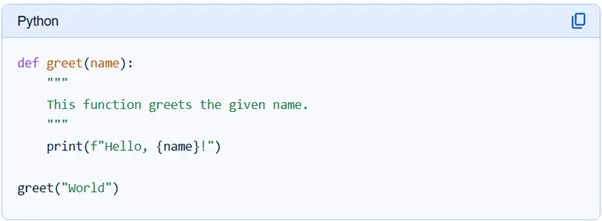
This uses triple backticks(“`) to create a full block. You can also optionally put the language’s name after the opening tags for syntax.
Step 1 – Open Telegram and start a chat
Step 2 – In order to type the opening tag, type three backticks in the message input box. In the same line, you can optionally add the language to start a new line.
For example: “`
Python
Step 3 – Type the entire code and then close it with three backticks.
Final result will look like this:
Popular Bot Example
- Using a Helper Bot (BoldCodeBot)
This is a special automated account within the Telegram application, which allows users to format code. You send it your plain code, and it sends back a nicely formatted version that you can then share. It handles the formatting rules for you, which is very helpful for beginners. It is best for quickly sharing error messages or scripts.
How to use it:
Step 1: In Telegram, search for “@BoldCodeBot” or a similar bot like “@MarkdownBot”.
Step 2: Open the bot’s chat and press the “Start” button.
Step 3: Send your code to the bot. First, type the language (e.g., ‘python’), then your code on the next line.
Step 4: The bot will immediately reply with your code inside a clean, formatted block.
Step 5: Simply copy that formatted code from the bot and paste it into your desired chat.
Step 6: For more options, you can send the command /help to the bot to see all its features.
Telegram for Community Engagement
These aspects define the need to use Telegram when constructing and developing communities. The adopted communication technology is responsive and is appropriate for hosting large audiences and channels, benefiting startups by reaching out to multiple attendees. Interactive elements like polls, quizzes, and threaded discussions provide tools for engaging in interpersonal communications, encouraging people to feel that they are part of the group.
The openness of the API makes it easy for different developers to develop tools and bots that help foster community engagement. For instance, bots can be built to help with moderating conversations, sharing developments, or even hosting an event in a community, thus enhancing the fun factor. Moreover, multimedia messaging and support for images, videos, and voice messages offer flexibility in the type of interaction that takes place and is valuable for the Telegram community.
Telegram’s Approach to Privacy and Security
Privacy and security are core values in Telegram, and the company understands the importance of these elements. The application utilizes end-to-end encryption for the Secret Chat feature, which does not allow any other person to access the conversation. Moreover, the MTProto protocol used in Telegram ensures the encryption of standard chats to protect users’ data while in transit.
For developers and startups, these security measures are significant when working with invasive user information. The privacy policies and security measures implemented by this platform help increase user trust, which is why applications that focus on data protection should consider using Telegram.
Additionally, due to the open-source client code, there is trust, decentralization, and easy verification of all security indiscretions by the community by the open-source code. This openness helps developers comprehend the security mechanisms utilized and create applications that conform to the best practices in data protection.
The Bottom Line
The API in Telegram provides the foundation and flexibility seen in more conventional communications API with added customizable features making it useful for developers and startups in further advancement of this communication niche. Using API, they can make bots that create a better experience for users and automate operations to make them effective. Telegram’s relentless focus on privacy and security makes it even more attractive to deploy applications requiring a secure communication channel. Telegram has developed its API as the digital world expands: API continues to be an effective weapon that unites developers and startups to provide enhanced communication solutions that will satisfy the needs of modern users worldwide.
See less