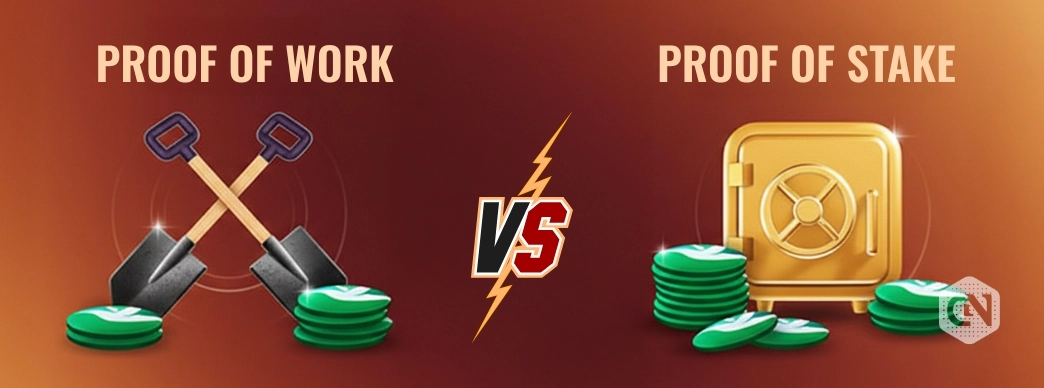
Key Highlights:
- Proof-of-Work (PoW) is a method that secures the network through mathematical puzzle.
- Proof-of-Stake (PoS) secures the network with staked cryptocurrencies.
- Both of these methods have pros and cons of their own.
Crypto networks use consensus mechanisms to make sure that everyone agrees on what is true and it does not need a central authority such as a bank or government. At a very basic level, consensus mechanism is the way through which the network confirms the transactions, stops double-spending, and keeps the blockchain secure. For this process, there are many nodes that participate in this process and they have to agree on which transactions are valid before they add them to the blockchain.
Mainly there are two ways or methods through which these nodes reach to an ultimate decision and they are known as Proof-of-Work (PoW) and Proof-of-Stake (PoS).
Apart from these two, there are other consensus methods as Delegated Proof-of-Stake (DPoS), which lets stakeholders vote for trusted validators, Proof-of-Authority (PoA) uses approved validators for efficiency, Proof-of-Space relies on disk storage, Practical Byzantine Fault Tolerance (PBFT) is common in private blockchains. Still the majority of public blockchains make use of PoW or PoS.
What is Proof-of-Work?
Proof-of-Work mechanism was first used by Bitcoin network in 2009. In this system, miners compete to solve complex mathematical problems or cryptographic puzzles.
In this process, the miners try different values which are known as the nonces, until they have found the one that creates a valid hash for a block. Finding this hash proves that a real computational ‘work’ was done.
With the help of this mechanism, the network is also secured as attacking it is extremely costly. To change past transactions or double-spend coins, an attacker will have to redo the computing work for many blocks and compete with the entire network and to do this, it would require a tremendous amount of energy and resources which makes attacks impractical.
Bitcoin’s PoW has successfully protected the network and has secured trillions of dollars in value throughout the time. The only downfall of the mechanism is the amount of energy that is consumed. The consumed energy is so huge that it can be compared to what some countries such as Thailand and Vietnam use in an entire year.
What is Proof-of-Stake?
In Proof-of-Stake, validators are picked on the basis of the amount of cryptocurrency they lock up, or ‘stake,’ within the network. The more the stake a validator has, the more the chances of being selected to confirm transactions. Validators here are chosen in a pseudo-random way, which is dependent on how much and how long they have staked, to create and verify new blocks.
If at all a validator tries to attack the network, by approving a transaction that is invalid or by supporting conflicting blocks, then they can lose part of their staked funds through a penalty. This penalty is known as slashing.
In slashing, the protocol takes care of the punishment and cuts a portion of their staked cryptocurrency. In serious cases, the validators can lose all of their stake and may be removed from the network all together.
Ethereum made a great switch in 2022, where it shifted from PoW to PoS. With this shift it addresses issues such as energy consumption and scaling issues. This upgrade is known as the Merge. With this shift, mining that needed a great amount of energy was replaced with staking and the energy consumption dropped significantly.
Proof-of-Work vs Proof-of-Stake
As we saw above, both of these mechanisms have two distinct ways through which these methods secure the blockchain networks. Even though both of them have their own strengths, but they even have weaknesses.
PoW is based on computational work and the method is designed in such a way that it makes attacking the network extremely costly and offering proven security. The only thing is that it is a slow, energy-intensive and hardware dependent method which can, in one way or the other, limit accessibility and lead to mining pool centralization.
PoS, on the other hand, is dependent on economic penalties, and it requires validators to stake cryptocurrency. This method is fast, saves energy and it is easier to participate through the staking pools.
However, PoS can favor wealthier participants and this is something that raises concerns as it risks centralization, has theoretical attack vectors like “nothing at stake” and is less battle-tested than PoW.
In the end, it all comes down to the goals that are to be achieved and the priorities of the network. It’s not about which method is better as each of these serves a different purpose and the choice is dependent on what the network aims to achieve according to its goal.
Also Read: Here’s Why Ethereum & Smart Contracts are the Backbone of Web3
See less