


Key Highlights
- In recent months, the concept of decentralized physical infrastructure has grabbed many headlines after surging to over $17 billion in market capitalization
- These sectors allow common people with hardware to become part of a larger ecosystem and earn rewards in the form of cryptocurrencies
- While this sector is steadily growing, some projects have drawn attention for their unique attributes
While the world’s main focus is on the Decentralized finance sector, there is silent innovation in the same sector taking place into the world. Let’s try to understand this through an example.
Here is the situation to imagine. You can think of getting paid in cryptocurrency for tasks and activities you are already doing on a daily basis. For example, you can earn crypto rewards by simply driving, by allowing applications to use a bit of your home’s internet, or by running tasks overnight.
This is not a sci-fi movie, but it’s actually the reality of today and it is happening right now in 2026 for hundreds of thousands of people, all through systems called Decentralized Physical Infrastructure Networks, or DePIN.
While the crypto sector is rapidly growing and attracting the attention of investors, DePIN has been growing steadily by creating real-world use. It turns common electronics into tools that can make money, which provides an alternative to massive companies like Amazon Web Services, Google Maps, and Verizon.
According to CoinMarketCap, the cumulative value of all DePIN projects is around $17 billion. At present, there are more than 1,000 different DePIN projects. These include wireless networks, community-based mapping services, and shared computing clusters for artificial intelligence.
What is DePIN and How Does it Work?
DePIN is the short form for Decentralized Physical Infrastructure Networks. The main purpose of this is to change how essential services are being created.
Instead of relying on large companies to own all the equipment, such as data servers or cell phone towers, a DePIN leverages blockchain technology to reward ordinary people for sharing their own resources.
This is how it works. A person can contribute something they own, such as a small wireless hotspot, a hard drive with extra space, or even their home internet connection. The network’s software confirms this service is being provided reliably.
In return, the person earns rewards in the form of cryptocurrencies as payment whenever others use the resource they shared.
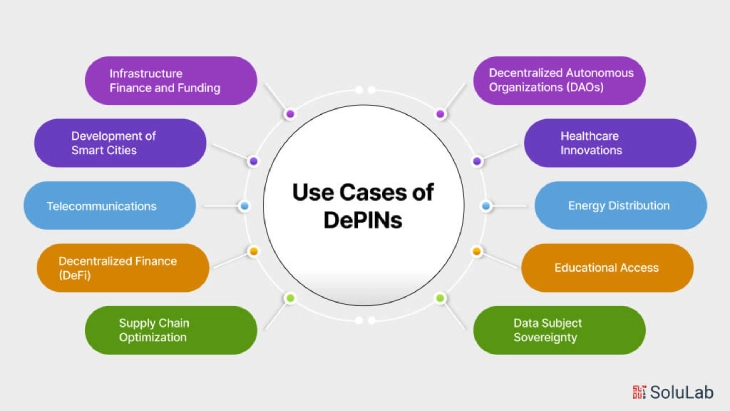
(Source: SoluLab)
The involvement of blockchain technology makes the entire ecosystem transparent. The supply of the service comes from a global community of individuals. The demand from users pays these contributors with crypto, and the blockchain records every transaction clearly, which removes the need for a controlling company in the middle.
This concept was first discussed by projects like Helium in 2019. However, this sector is now finally getting recognition in 2025 and 2026. The reason behind it is a growing demand for computing power for AI, gaps in the rollout of new 5G and 6G wireless networks, and growing public interest in private alternatives for services.
Many crypto analytics companies like Messari and CoinMarketCap are now listing DePIN as one of the fastest-growing areas in the decentralized sector. These platforms are now tracking important parameters like the number of active devices, the amount of data stored, and others, along with the token’s price.
Best DePIN Projects in 2026
Here are some of the best DePIN projects that are expected to grow in 2026.
1. Render (RENDER)
The widely known cryptocurrency was launched as RNDR, and later on, it was changed to RENDER in 2025. This project is a decentralized network that connects people who have unused graphics processing power (GPUs) with creative professionals who need it.
The service is used for demanding computing tasks such as 3D animation rendering, video processing, and artificial intelligence (AI) model training.
Many popular clients, including Hollywood studios and video game developers, are using this platform, called Render Network. This adoption led to record levels of work being processed in the final quarters of 2025.
At the time of writing this, the total market value of the RENDER token is now revolving around $784.13 million, along with the price at around $1.51, according to CoinMarketCap. According to the experts, this project could see an impressive growth in 2026, thanks to the demand for AI computing. Also, the platform provides similar professional tools to OctaneRender.
2. Helium (HNT)
This project is one of the oldest DePIN projects available in the world, as it launched the first decentralized network of hotspots for low-power Internet of Things (IoT) devices.
However, the project came into the discussion after the launch of Helium Mobile. This service partners with traditional mobile carriers to help manage their 5G network traffic. Over 400,000 hotspots now converge in cities across the United States. The subscribers of projects can even earn HNT tokens simply by using their mobile data on this network.
According to CoinMarketCap, the HNT token is trading at around $0.8784 with a market capitalization of $163.67 million.
3. Filecoin
Filecoin is the established leader in decentralized data storage. Its total market value is between $4 billion and $5 billion.
This project is developed on IPFS technology. It allows anyone to rent out their unused computer hard drive space to others. In return, they earn FIL tokens. This creates a secure and verifiable global marketplace for data storage.
One of the biggest advantages of this project is its cost. Some businesses, such as NFT collections, are actively choosing Filecoin because it can be up to 90% cheaper than traditional cloud services like Amazon Web Services.
A major technical upgrade in late 2025 improved Filecoin’s connection with other major blockchains like Ethereum. This integration has onboarded more users to the platform. The network now regularly handles more than a petabyte of new storage deals every single day.
Summing Up
While the DePIN sector is standing at a small level at present, the nature of its ecosystem and steady growth highlight its potential. Currently, this sector needs some awareness and attention from the developers.
However, the decentralization of physical infrastructure is actually becoming an enticing concept for tech innovations like AI. However, it is advisable to deal with this sector in a careful way.
Also Read: Crypto Bloodbath Coming? What if Trump Loses the Midterms and Faces Impeachment
See less
