


- Polygon highlights over $1.2 billion in Revolut stablecoin transfers on its network.
- The volume underscores Polygon’s role as a settlement layer for regulated fintechs.
- The $POL token has retraced, hovering near $0.094 after rejection at the $0.10 psychological barrier.
Polygon’s price is in troubled water, but its recent post might be the catalyst $POL needs to make a breakthrough. Polygon revealed that global banking giant Revolut has processed over $1.2 billion in stablecoin transfers via its network. This massive volume highlights Polygon’s role as the primary settlement layer for regulated financial institutions.
Despite this surge in fundamental utility, $POL price is currently trading at $0.0943 after a failed attempt to breach a key psychological resistance level.
The Revolut Stablecoin Money Stack
Revolut’s integration is a full-scale production environment where “real users move real money.” By leveraging the Polygon Chain for settlement, Revolut has achieved transaction costs that are a fraction of a penny, making it significantly more efficient than legacy banking systems. $POL is cheaper as gas fees on Ethereum are typically 426 times more expensive, while even Solana is four times more costly.
The scale of this operation is part of Polygon’s broader “Open Money Stack” vision. The integrated suite provides institutions with enterprise-grade wallets, regulated on-ramps through partners like Coinme, and cross-chain payment orchestration.
With Revolut currently seeking a U.S. national bank charter, the prospect of a chartered U.S. bank running its settlement infrastructure on $POL sends a powerful signal to the global financial sector regarding the future of regulated digital money movement.
Polygon Price Shows Some Promise
The 15‑minute chart shows a clear rejection at the $0.1000 mark, where selling overwhelmed the latest bounce. Since then, $POL has been in a short‑term cooling phase, printing lower highs and lower lows before finding temporary support around $0.0939.
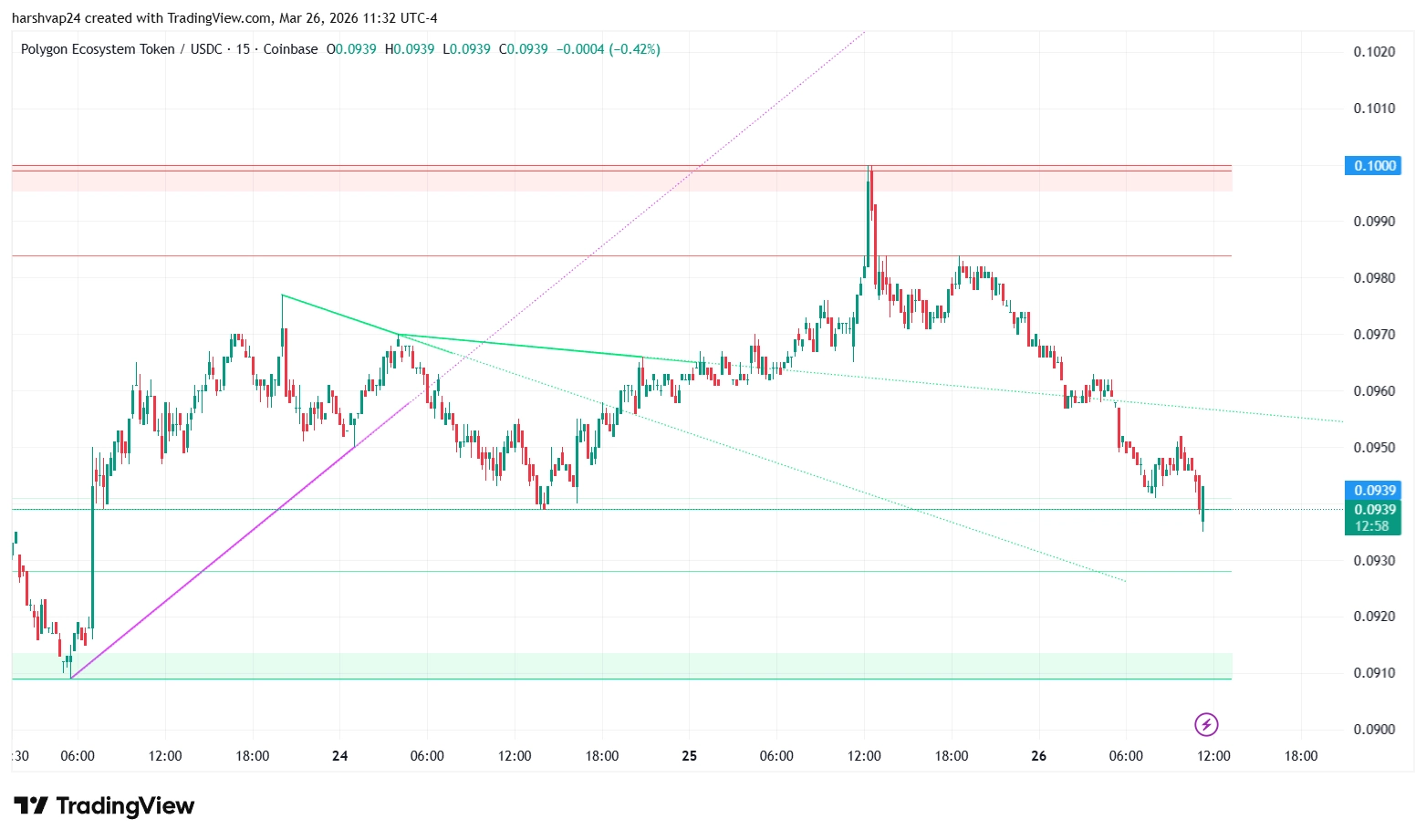
If $POL can hold the $0.0930–0.0939 zone and then force a clean break above $0.1000, it opens the way toward $0.18. The bullish move aligns price with the chain’s 264% year‑on‑year stablecoin growth and $932 billion in annual transfers.
For now, the token is struggling to reclaim its short‑term bullish trendline as the market absorbs the Revolut news against a backdrop of thin liquidity. A failure to hold that support band, by contrast, puts the $0.0910 demand area back in play and risks extended sideways movement.
Editor’s Note
While the current price action for Polygon reflects short-term technical hurdles, the fundamental growth of the network is undeniable. The $1.2 billion in Revolut volume is only a small share of the $2.4 trillion in total stablecoin volume that Polygon has processed till now.
As Revolut moves closer to its $9 billion revenue goal for 2026 and continues its push into the U.S. market, Polygon’s role as the “invisible” infrastructure behind global finance is noteworthy.
For the market, the challenge remains bridging the gap between this massive institutional utility and the token’s immediate price performance.
Also Read: Can XDC Network Price Hit $0.033 Post Startup Accelerator Launch?