


Key Highlights
- Amid a downward trend and geopolitical tension, the cryptocurrency market is entering March, where macroeconomic factors will decide its fate.
- These include the FOMC meeting, the inflation rate, and the ongoing war in the Middle East.
- While the crypto market has already taken a hit in the past due to macroeconomic factors, the upcoming announcements and events can help it to regain momentum.
The crypto market is going through a consolidation phase and entering March with uncertainty. Bitcoin is trading around $69,000, down around 25% year-to-date from its 2025 peaks. While it is trading at around $2,000 with 36% drop. The market capitalization of the crypto market is revolving around $2.37 trillion, according to CoinMarketCap, which is a major decline from its peak in 2025 at $4 trillion.
The major factors behind the drop in the market are intense sell-off pressure, depleting liquidity from the market, and various macroeconomic factors.
Will Crypto Market Rebound in March?
Despite the downfall in the crypto market, there is a steady institutional adoption, as Bitcoin ETF inflows have witnessed a $1 billion weekly inflow and $4 billion in outflows. This shows that BTC is gradually becoming a favourite asset for long-term holdings and regulatory clarity.
However, the crypto market is still a highly volatile sector, and it still quickly reacts to highly sensitive events, as witnessed in the past, based on its correlation with risk assets like stocks during periods of uncertainty.
March is expected to become a decisive month for the crypto market as there are many events scheduled in this month that could create an impact on short-term volatility in crypto markets. Major economic data includes the employment report on March 6, the Consumer Price Index on March 11, and the Federal Reserve’s rate decision on March 18.
Apart from this, the ongoing geopolitical tension is another major macroeconomic factor. The war between Israel, the USA, and Iran has already increased oil prices and diverted money into safe assets like gold, which soared to around $5,400.
If this war were prolonged, then it could destabilize the Middle East region and affect global trade. This could increase inflation and force central banks to delay rate cuts, where it can seize global liquidity conditions on which the market is depending.
1. Federal Rate Meeting
The Federal Open Market Committee (FOMC) meeting is expected to take place on March 17-18, and the crypto investors are watching it closely to see potential rate cuts. In January, the Fed held rates steady at 3.5% to 3.75% in January 2026, which matches the expectations after three cuts in late 2025.
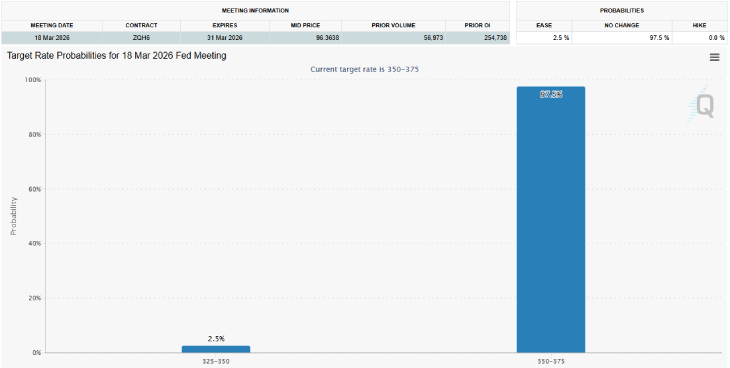
(Source: CME Group)
According to CME Group, there are fewer chances, around 2.6%, for a 25-basis-point cut and 1% for more, to any easing in March, with prediction markets largely favoring no change at 97%.
These odds come from higher inflation above 2% target and a cooling labor market, which is showing some resilience. It comes from the difference between policymakers on the future plan due to political chaos.
Historically, the crypto market reacts to Fed policy quickly. The cut in the Fed rate has pushed Bitcoin’s price throughout the cycle. If the Fed rate increases, it damages liquidity in the crypto market. On the other hand, if cuts in the fed rates have generally expanded funding for higher-yield alternatives.
For example, BTC has witnessed 34.5% volatility in early 2026 after facing intense macro uncertainty.
If the Fed decides to cut the rate in March and resume cuts in 125 to 150 basis points by year-end, it might reduce real yields. This could spark a rally in BTC and send it toward $100,000 to $120,000. Apart from this, it could also boost the confidence of institutional investors and start investing in ETFs.
2. Inflation Rate Data
The February CPI report is due on March 11. The Core PCE report is expected to be released on March 27.
If we talk about the past, January’s CPI has given some good news. It cooled to 2.4% year-over-year, and that is the lowest level since May 2021. In December, it was 2.7%. On the other hand, Core CPI hit 2.5%. That figure is its lowest since March 2021.
On a monthly basis, CPI has soared by around 0.2%, which is below what economists expected. The energy price has shown some good results, where the gasoline price fell by 7.5%.
According to experts, there is some more good news in February. They expect CPI at 2.41% year-over-year, where they expect Core CPI to hit 2.4%. This data shows that inflation is gradually cooling down.
For the crypto market, inflation is a very important factor. If inflation goes higher, investors start to invest money into safe assets like Treasuries or gold. This creates pressure on digital assets. If inflation stays low, Bitcoin and Ethereum become more attractive investments for investors as they see these digital assets as a hedge against traditional assets. This is especially true with U.S. debt raising long-term questions.
3. Geopolitical Tension between Israel, the U.S., and Iran
Last week, a new war started in the Middle East after the U.S. and Israel launched a joint military operation against Iran, called Epic Fury. The war between the U.S. and Iran is a wildcard for the market in March.
In retaliation, Iran has announced the blockage of the Strait of Hormuz. This is a very important waterway as one-fifth of the world’s oil passes through it.
Due to this, the price of oil has increased quickly and soared by around 13%, which could increase inflation. This could encourage investors to move their money into safe assets like cryptocurrencies.
Bitcoin has reacted quickly after the U.S.’s first strike on Iran, where it dipped initially, and then it bounced back above $69,000. According to CoinMarketCap, BTC is currently trading at around $69,033 with a 4% surge on a daily chart.
Summing Up
March is expected to be a crucial month for crypto markets. There will be three major factors, including the Federal Reserve’s interest rate decision, inflation data, and geopolitical tensions. If macroeconomic factors like interest rates and global conflicts cool down, Bitcoin and other altcoins could witness a rally toward higher levels. However, things can also go south if inflation increases or a major escalation of the current war in the Middle East occurs.
Also Read: Here’s How US Intervention in Iran & Israel War Can Affect Crypto Market
See less
