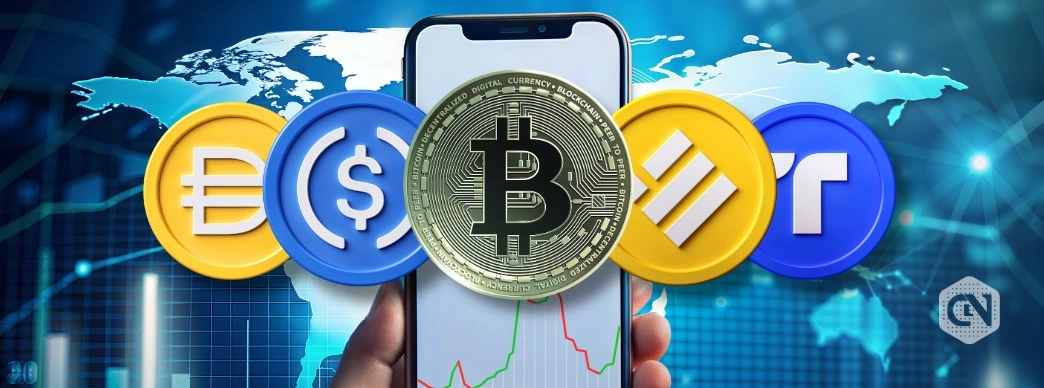
Key Highlights:
- With the help of stablecoins and Bitcoin, cross border payments now settle in minutes and not days.
- The fees for cross border payments using stablecoins and Bitcoin are way lower than what banks charge.
- Adoption of stablecoins and bitcoin is growing at a great speed.
In the past few years, cryptocurrencies have transformed how money moves across borders. Traditional international money transfer systems, which includes SWIFT, are usually slow, expensive and tied to the operating hours of the banks, which makes it difficult for people who are sending and receiving funds. On the flip side, Bitcoin and stablecoins have increased their popularity as alternatives as they offer what traditional money transfer systems lack.
Stablecoins, cryptocurrencies that maintain a stable value by being pegged to real-world assets like the US dollar, such as USDC and USDT have become partially dominant in cross-border payments.
Meanwhile, Bitcoin is something that attracts users because these users are seeking decentralized, peer-to-peer transfers that bypass intermediaries entirely, making it a practical option for individuals and businesses.
Stablecoins and Bitcoin, both of these digital assets are reshaping global remittances and financial inclusion worldwide.
Speed and 24/7 Availability
Traditional cross-border payments through the banks are known to take three to five business days to settle. This is mainly because there is so much to take into consideration, such as time zone differences, working hours of the banks, and holidays as well.
Stablecoins remove all of these delays by settling transactions in seconds or probably minutes on blockchains such as Solana or Ethereum Layer-2 networks, which operate 24/7 and no there is no downtime for these platforms.
Bitcoin transactions are a little slower than the stablecoin transactions but they usually confirm the transaction in about 10 minutes.
Due to this reason, stablecoins and Bitcoin transactions are suitable for urgent transfers at any given time. This speed is especially valuable for remittance. Migrant workers in countries like the Philippines or Mexico usually use this way of sending money as it avoids delays, and makes sure that the family receives funds when they need it the most.
Lower Costs and Fee Reduction
Traditional cross-border payment systems charge anywhere near 2-7% in fees as there are multiple intermediaries, foreign exchange spreads, and currency conversions. Stablecoins remove all of this cost and brings down the fees to anywhere near 0.5-2% with network fees sometimes costing as low as $0.01.
This helps businesses save a lot on high-volume international transfers. Bitcoin is also known for lowering costs by avoiding credit card fees and correspondent banking charges, and it just makes small cross-border payments more practical.
Many remittance firms now use a “stablecoin sandwich” model, which converts fiat into stablecoins and then to local currency. This allows same-day settlements without needing to pre-fund accounts across different countries.
Accessibility in Emerging Markets
Unbanked people can now access global payments through mobile crypto wallets, as to make these transfers. User needs a smartphone and an internet connection. This is significant because there is a great chunk of people around the world that lack access to traditional banking.
For example, due to stablecoins, countries like Brazil have high adoption rates of around 10% and the Philippines at 6-8%. Bitcoin also plays an important role in regions with volatile currencies, especially across Latin America, by allowing low-cost transfers.
The use of stablecoins has also increased and there are wallets that exceed 500 million addresses and adoption is on the rise as it is seen to be going up by 30% year over year.
Stability Meets Decentralization
USD-pegged stablecoins like USDT ($155B in circulation) and USDC ($60B) are designed in such a way that they avoid price volatility as they are backed with reserves such as US Treasury bills. The total stablecoin supply has crossed $250 billion which has doubled in just 18 months, and now processes more than $20-30 billion in transactions everyday, which is around 3% of global cross-border payment flows.
Bitcoin, even though it has its share of ups and downs, is usually used as a store of value and a hedge which offers secure and pseudonymous transfers that are powered by cryptography.
According to McKinsey, tokenized cash like stablecoins helps solve long-standing issues such as financial inclusion, with pilot programs scaling through transparent, provable reserve models.
Security, Transparency, and Programmability
The data on any blockchain cannot be changed and hence it prevents chargebacks and allows real-time transaction tracking, helping reduce fraud risks.
On-chain analytics tools such as Chainalysis automatically support AML and KYC screening. Bitcoin’s peer-to-peer structure improves privacy by removing intermediaries.
Smart contracts has also allowed programmable payments, such as Purpose Bound Money for use that is defined, which will improve efficiency of the treasury.
Market Growth and Adoption Stats
The crypto market has reached a $4 trillion valuation in 2025, driven largely by stablecoins, which surpassed $250 billion in supply and processed about $4.1 trillion in monthly transfers, around 3% of global cross-border payment flows.
Projections suggest stablecoins could grow to $2 trillion by 2028 and capture 20% of the $290 trillion global payments market by 2030. As stated above adoption is accelerating, with 26% of US remittance users now using stablecoins, crypto handling 23% of global flows, and strong uptake in emerging markets.
Bitcoin remittances exceed $50 billion annually in high-fee corridors like Mexico, while over 1.7 billion unbanked people are gaining access through more than 500 million stablecoin wallets growing at 30% per year.
a16zcrypto’s 2025 report also highlights blockchains reaching 3,400 transactions per second, institutional tools like JPM Coin processing $1 billion daily.
Regulatory Tailwinds and Future Outlook
Regulatory clarity from frameworks like the US GENIUS Act and the EU’s MiCA in 2025 has strengthened trust by enforcing reserve backing and compliance.
Yield-bearing stablecoins, such as BlackRock’s $2.9 billion tokenized fund, add income potential on top of payments. By 2026, nearly 90% of fintechs are expected to use stablecoin platforms, while Bitcoin continues to gain ground as a reliable remittance option. Together, these assets are positioning themselves to capture a meaningful share of the $5-7 trillion in daily global payment flows by offering faster, cheaper payment rails.
Conclusion
From the above reasons, it can be concluded that stablecoins and Bitcoin are becoming more practical day-by-day as their adoption increases for sending money across borders. Their speed, lower fees, and growing adoption is something that makes them a true alternative to traditional bamking systems, especially for remittance and emerging markets.
Also Read: Zerion Wallet Integrates TRON to Boost Stablecoin Ecosystem
See less