


While the cryptocurrency sector is growing rapidly, a new threat is emerging that could one day challenge digital security. This is quantum computing. This new technology will bring a major revolution in how machines process information.
Instead of using classical bits that are either 1 or 0, quantum computers use qubits. Qubits can exist in a state called superposition, meaning they can be both 1 and 0 at the same time. They also use a property called “entanglement.” This allows them to perform certain calculations incredibly faster than the best supercomputers we have today.
Rapid Progress in Quantum Computing and a Threat to Cryptography
The year 2025 saw impressive progress in the quantum computing field alongside artificial intelligence (AI) and cloud computing.
In October 2025, Google announced a major achievement in this sector, which involves error-corrected logical qubits. This advancement reduced error rates by a huge amount, making large-scale, reliable quantum systems much more feasible.
This progress has directly raised concerns in the world of cryptography. Technical experts are raising an alarm on this rapid development, saying that these machines are getting closer to being able to run a specific algorithm that could break modern encryption.
Quantum computing is best done in the permanently shadowed craters on the Moon
— Elon Musk (@elonmusk) November 2, 2025
This issue is also growing beyond theory as the world is seeing real-world tests of these concerns. On January 12, a company called BTQ Technologies launched a “Bitcoin Quantum Testnet.” This is the first known fork of Bitcoin designed to be safe from quantum computers. It uses new, quantum-resistant encryption standards approved by the U.S. National Institute of Standards and Technology (NIST).
This testnet is a reflection of a full quantum-proof Bitcoin system, including wallet creation, transaction signing, and mining. The purpose is to protect an estimated $2 trillion worth of Bitcoin market capitalization.
Can Quantum Computing Really Break Bitcoin’s Encryption?
A report from the consulting firm Deloitte revealed that a quantum system could break Bitcoin’s transaction process if its error rates fall below a specific threshold. This threshold is being rapidly advanced by new hardware, like IBM’s 2025 Condor processor, which has 1,121 physical qubits.
(Source: Federal Reserve)
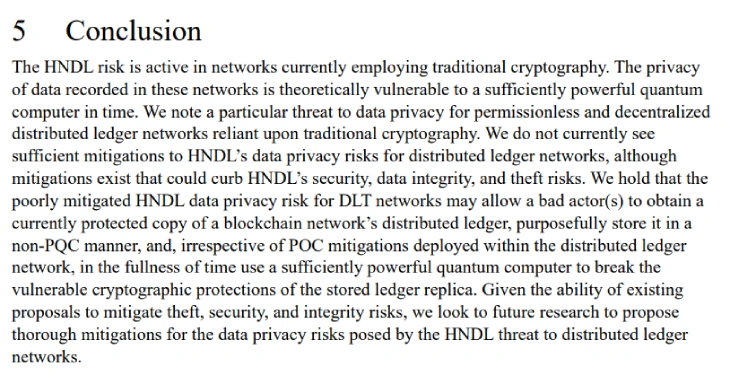
Another study from the U.S. Federal Reserve in October 2025 also unveiled risks to Bitcoin’s historical transaction data. According to blockchain analysis firm Chainalysis, they estimate a timeline of 5 to 15 years for these quantum threats to become real.
However, the remarkable advancement in artificial intelligence has sped up quantum research in 2025, which could compress this timeline.
Experts’ Opinion on the Quantum Threat
Michael Saylor, the Executive Chairman of the biggest Bitcoin holding company, Strategy, has recently shared tweets on X. He stated that “quantum computing won’t break Bitcoin–it will harden it.”
The Bitcoin Quantum Leap: Quantum computing won’t break Bitcoin—it will harden it. The network upgrades, active coins migrate, lost coins stay frozen. Security goes up. Supply comes down. Bitcoin grows stronger.
— Michael Saylor (@saylor) December 16, 2025
He mentioned a “Bitcoin Quantum Leap” where the network upgrades to quantum-resistant protocols. In this view, only active coins would be moved to safety, while permanently lost coins would be frozen. According to him, this could reduce Bitcoin’s supply from 21 million.
Others, like Adam Back, the CEO of Blockstream, also downplayed the impact of quantum computing on the Bitcoin network. He has said that Bitcoin faces no quantum threat for the next 20 to 40 years. He mentioned the large gap between theory and practical implications behind his views.
On the flip side, investor Chamath Palihapitiya warned that the risks to older cryptography are real. He urged the community to plan for protocol forks to implement new security, while noting that it may be too late to protect already-exposed old addresses.
In a similar statement, Charles Edwards of Capriole Investments has also shared his view on this matter. In a December 2024 post, he projected a 50% chance of a quantum risk materializing within 5 to 10 years. To back his view, Charles Edwards cited research on guidance from quantum computing firms listed on the NASDAQ stock exchange.
David Duong from Coinbase has also mentioned structural risks to wallet security and mining in January 2026, saying that about one-third of all Bitcoin could be exposed to vulnerabilities based on current address types.
Bitcoin Community Works on Countermeasures
While quantum computing is advancing with every passing day, the Bitcoin community has already taken a position to counter its future threat. Developers are continuously exploring ways to upgrade the protocol.
Groups like Bitcoin Optech are exploring ways to make the network quantum-resistant. This involves integrating new signature schemes like the lattice-based ML-DSA, which is part of the NIST’s finalized post-quantum cryptography standards from 2024.
They have proposed upgrades, like BIP-360, which is the process of soft-forking the network to enable quantum-safe addresses. This would allow users to migrate their coins without breaking the existing system.
Chainalysis also reported that active development is happening for both Bitcoin and Ethereum. These new developments mainly focus on new address types and improvements to existing tools like Schnorr signatures.
Ethereum’s co-founder, Vitalik Buterin, has also acknowledged this in a recent post on X (formerly Twitter). “We should resist the trap of saying “let’s delay quantum-resistance until the last possible moment in the name of ekeing out more efficiencies for a while longer”. Individual users have that right, but the protocol should not. Being able to say “Ethereum’s protocol, as it stands today, is cryptographically safe for a hundred years” is something we should strive to get to as soon as possible, and insist on as a point of pride,” stated in the post on X.
Final Words
According to experts, the theoretical threat of quantum computing poses a great threat to Bitcoin’s main encryption. An advanced machine could break the digital signatures that protect user funds. However, these advanced machines are still in the development stage, and it is still likely years away.
However, the Bitcoin community and other leading blockchains are engaged in proactive research into post-quantum cryptography and protocols. So, one can say that the community is aware of the challenge and is preparing to counter it.
Also Read: Strategy Acquires 13,627 Bitcoin as MSCI Index Decision
See less
