

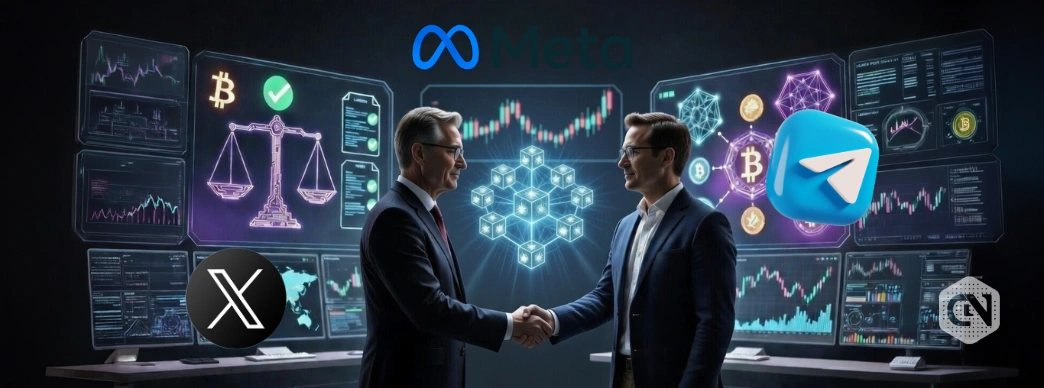
Key Highlights
- In the upcoming few years, many social media platforms are expected to accelerate the integration of cryptocurrency and stablecoin on their platform
- Meta is actively testing and planning third-party stablecoin payments integration into WhatsApp
- Elong Musk confirmed that X Money will enter early public access as soon as April 2026; meanwhile, TON Pay has allowed Telegram’s 1.1 billion users into a one-tap crypto checkout layer via Mini Apps
The world is evolving rapidly, and so is the financial system. While fiat currency is still dominating the financial sector, digital assets like cryptocurrency and stablecoins are gradually penetrating traditional finance, where the change is inevitable. These digital currencies are not intended to replace the traditional financial system, but they are definitely becoming an efficient alternative option.
But another economy is rapidly growing its social media economy. For years, we have watched cryptocurrency and social media exist in a state of detente, where crypto communities build on centralized platforms like X (formerly Twitter), while Web3 social protocols struggle to gain mainstream traction.
Social media used to run on attention and ads. Creators had to chase algorithms just to earn small amounts of money, while platforms took 30% cuts and kept audiences locked inside their own ecosystem. But the cryptocurrency is addressing this problem by using concepts like tokenization, on-chain identity, and programmable payments. This allows creators to own their content and their earnings.
And, this is not just a topic of discussion. Telegram’s 1.1 billion users are already using crypto inside the application. Meta is planning to add stablecoins to its platforms in the second half of this year. Elon Musk’s X (formerly Twitter) is preparing to launch X Money’s early public access in April. According to the report, the creator’s economy is expected to reach around $500 billion to $1 trillion by 2030.
Crypto and Tokenization Help Social Media to Evolve from Platform Control to User Ownership
Centralized platforms are focusing more on engagement, while ignoring creator earnings. On these platforms, intermediaries are taking big cuts from ad revenue, brand deals, and subscriptions. Cross-border payments are likely to take 3% to 5% fees, and multi-day waits
However, crypto can address these problems by using the attributes of the protocol. Smart contracts automate royalty payments, while stablecoins help users to execute transactions instantly.
On-chain graphs allow users to take their social connections anywhere. Apart from this, micropayments finally become useful when fees drop enough, and transactions get completed in under a second.
There is a concept called tokenization at the centre of this change. Social tokens or fan keys allow communities to invest in creators. These token holders get rights to participate in the governance or exclusive access through smart contracts.
Similarly, non-fungible tokens (NFTs) can turn posts into collectibles with built-in royalties. This allows creators to automatically send 5% to 10% back to creators without any kind of manual work.
Stablecoins like USDT are removing price risk for daily use, where layer-2 networks are reducing gas costs, while TON handles Telegram-scale traffic. The composability layer makes this powerful. A Lens profile can plug into any app for tipping, lending against reputation, or DAOs governing community treasuries. This innovation will help change incentives from platform lock-in to user sovereignty.
1. Telegram Uses Ton’s Native Payment Layer
Telegram is showing this model working in real life. Its Open Network blockchain is working inside the app with more than 100 million connected wallets. In February 2026, Telegram launched TON Pay, which is a tool that allows Mini App developers to accept TON and USDT payments through simple one-click checkouts.
Transactions confirm in under a second and cost less than 1 cent. This makes tipping, subscriptions, and buying things inside chats smooth and easy. Merchants can track sales through dashboards. Users never have to leave their chat window to pay. Creators earn money from channels through on-chain donations or paid content, avoiding the high fees that app stores usually charge.
2. Meta Plans to Integrate USD-Pegged Stablecoins
Meta has also taken some steps to integrate digital currencies on its platform. After shutting down its Diem project in 2022, the company is now adding third-party stablecoin payments to WhatsApp, Instagram, and Facebook. According to sources familiar with the plans, the rollout is expected for the second half of 2026 through a new wallet and partnerships with vendors like Stripe.
Meta is focusing on its practical use, as businesses will get low-cost cross-border payments. Creators will receive instant payouts without dealing with traditional banking delays. Meta is not launching its own coin this time. Instead, it is using existing USD-pegged stablecoins. This allows them to add stablecoin payments to Messenger and Instagram shopping.
3. X (formerly Twitter) Tests X Money
X has recently announced that it is testing its X Money, and after closed internal testing, the company has decided to limit external testing in early 2026. In the past, Elon Musk has continuously talked about high-yield accounts, debit cards, and clear crypto integration as a part of his dream for turning X into an everything app.
𝕏 Money early public access will launch next month
— Elon Musk (@elonmusk) March 10, 2026
Smart Cashtags is already showing live asset prices on the platform. The dollar sign button in chats is ready for direct transfers. X has secured money transmitter licenses in many states and is developing yield-bearing accounts that could easily connect to digital assets.
Conclusion
In a short period of time, crypto is not likely to take over social media completely. Instead, there will be hybrid systems where big platforms add blockchain features while decentralized networks will become real alternatives.
Creators will carry their identities with them across different apps. They will earn money in stable value with royalties paid automatically. Communities will be able to govern themselves through tokens. It is clear that the social media platform that wins will treat users as owners, not products.
Also Read: TradFi-Crypto Convergence: Rise of Institutional Bridges
See less
