


Key Highlights:
- Ethereum’s daily usage has increased over the years.
- Large staked supply and liquid staking tokens create the “staking paradox” which mutes scarcity signals.
- Even though the blockchain has solid fundamentals, ETH price lags.
Ethereum is seeing great growth in 2026 but the price is not reflecting this growth. As we all know, the Ethereum network is highly active and has more than 500,000 daily users, which is a noticeable rise from late 2025. At the same time, around $180 billion is locked into DeFi, showing steady participation and capital inflow.
Layer-2 networks like Optimism and Arbitrum are also seen to be improving performance, handling transactions faster and at lower cost than before, even surpassing Bitcoin in throughput. In late 2025, the Pectra upgrade went live. The Pectra upgrade was also done in the last quarter of 2025. This upgrade also helped in reducing fees and making the system more efficient. But still, the price of ETH is at a very low rate compared to the present time.
At press time, the price of the token stands at $1,967.59 with an uptick of 1.7% in the last 24-hours as per CoinGecko.
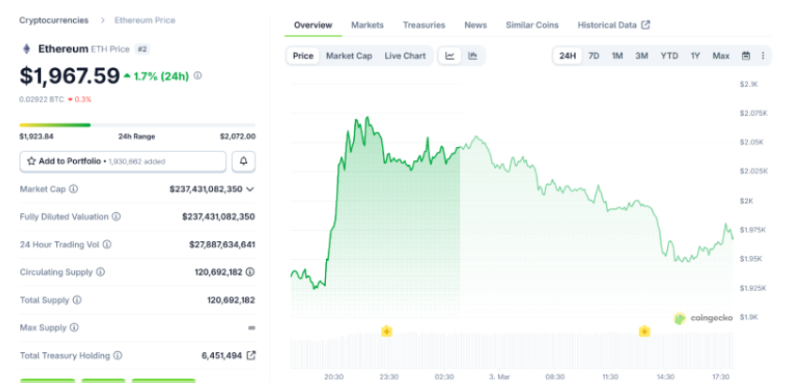
As discussed above, we can see that there is a clear gap between the usage and price movement. This gap is known as the “staking paradox.” A major part of the total supply of ETH is locked in staking. This locked supply is responsible for providing strength to the Ethereum network. So, basically, the Ethereum network is growing steadily, but the price is not rising to the expected level.
The Usage Explosion: Ethereum’s On-Chain Renaissance
After the Pectra upgrade, the total number of validators has crossed 1 million. Also, the daily transactions on the Ethereum network have gone above 1.5 million. A major part of this transaction is from stablecoins such as Tether and USD Coins, which make up 60% of the total transaction volume.
Other areas are picking up too. NFT platforms like Blur are seeing renewed activity as well, with monthly trading volumes around $2 billion. Meanwhile, restaking platforms such as EigenLayer have locked in about $25 billion worth of ETH-based assets.
The data supports this growth. Insights from researches show unique smart contract interactions are also up, driven by trends like AI-based applications and tokenized financial products.
So while Ethereum’s usage and importance continue to expand, its price has not fully caught up with these fundamentals yet.
Cracking the Staking Paradox
Since the Merge in 2022, more than 30 million ETH, which is about 28% of the total supply, has been staked. Validators when they stake their ETH earn about 3.5% annual returns, which adds up to billions of dollars in rewards each year.
Now, in theory, staking should push prices up because it locks up ETH and reduces the amount that is available for trading. Less supply usually means higher prices, but this is actually not happening.
The reality is much more complicated. While staking reduces liquid supply, the rewards being generated, and eventually sold, create constant selling pressure. That’s where the “staking paradox” comes in.
Key Dynamics at play include:
Illiquid supply is not truly illiquid
A large portion of staked ETH is tied to liquid staking tokens like stETH from Lido and rETH from Rocket Pool. These tokens can be freely traded, which means staked ETH is really “locked away.” After recent upgrades, users can also unstake more easily. In 2026, around 500,000 ETH is being unstaked every month. So, while ETH locks are locked on paper, a meaningful portion is still moving around the market.
Extra rewards bring extra pressure
There are restaking platforms available such as EigenLayer and Karak. These platforms are known for offering higher yields as they let users reuse their Ethereum that are staked. Even though this offer seems very tempting but it does not come without risks. But at the same, these rewards do not just sit idle, they usually get sold or reinvested, and in this way more ETH gets into the circulation regularly.
Opportunity cost is rising
There are also other opportunities that provide higher yield, which is exactly what investors want. Examples include Solana, Bitcoin, XRP or high-yield DeFi chains or L2. In front of these high-yield providing options, ETH’s ~3.5% yield does not look very tempting. With Bitcoin attracting large inflows through ETFs, and chains like Solana offering much higher DeFi yields, some investors are moving their capital elsewhere. Data from Nansen suggests that capital is rotating into higher-risk, higher-return plays.
Macro Headwinds and Regulatory Shadows
Then there is global uncertainty that affects crypto market the fastest. The current situation US and Iran and regulatory laws in the European Union has also had investors move toward safer assets like Bitcoin, which is also considered as the ‘digital gold.’
At the same time, Ethereum still carries higher perceived risk due to smart contract vulnerabilities, especially after recent hacks. Capital is also spreading out. New ETF interest in Solana and XRP is pulling attention away from ETH.
On the sentiment side, data from LunarCrush shows Ethereum’s social dominance has dropped, as newer narratives, like AI-focused projects such as Fetch.ai, start gaining attention.
Breaking the Paradox: Catalysts Ahead
ETH is not doomed, it is currently just misunderstood. The upcoming upgrades like Fusaka, EIP 7702, and Glamsterdam, could cut fees, simplify onboarding, and push L2 activity. If staking yields fall and ETF inflows rise, liquid supply could shrink, creating a potential price squeeze.
Ethereum’s growth is real, even if the price has not caught up yet. Patience and smart participation could pay off as adoption drives value.
Also Read: Ethereum Price Eyes Breakout as Exchange Supply Hits 2016 Lows
See less
