


Key Highlights
- Unlike other blockchains, Hedera is using a unique Directed Acyclic Graph (DAG) mechanism with “gossip about gossip” and virtual voting.
- This unique mechanism helps it to achieve over 10,000 TPS and 3 to 5 second finality.
- It is also governed by major companies like Google, IBM, Boeing, FedEx, and others.
While major blockchains, like Ethereum and Solana, are continuously getting the limelight, there is a trojan horse silently developing something totally different from other blockchain networks. This is none other than the Hedera network.
As of now, Hedera has processed over 71 billion transactions. In the last 24 hours, the network executed more than 461,000 transactions. It maintains certified throughput, which is more than 10,000 transactions per second with 2.9-second finality.
Its market capitalization is still low in comparison to other blockchains, which currently revolves around $4.1 billion, with HBAR trading around $0.096. Its DeFi total value locked is revolving around at just $59.79 million.
However, Hedera is not just another random blockchain. It was developed in a very different manner.
What Is Hedera, and How Is It Different from Other Blockchains?
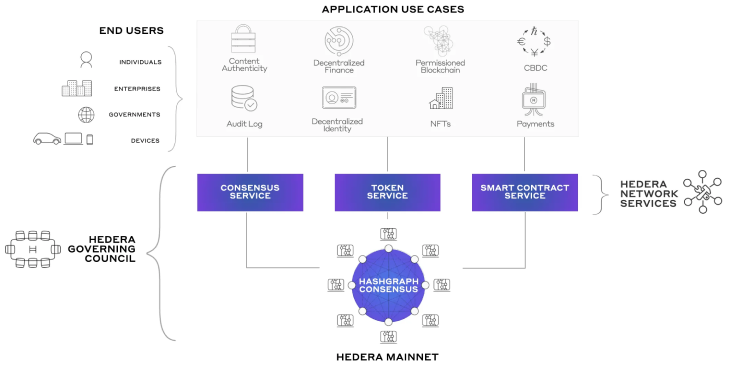
Hedera is an open-source public distributed ledger technology (DLT) platform that allows decentralized applications through three major services. This includes smart contracts compatible with Ethereum’s Solidity, consensus services, and native tokenization.
But unlike traditional blockchains that combine transactions into sequential blocks, this DLT uses hashgraph consensus.
(Source: Hedera)
Hashgraph is not a blockchain. It is a direct acyclic graph structure powered by unique mechanisms like “gossip about gossip” and virtual voting. Every node shares information with randomly selected other nodes, and those nodes share with more nodes. Through this gossip protocol, each node eventually knows everything that every other node knows.
This kind of mechanism provides it with an edge over other DLT networks. Traditional blockchains often discard forks, wasting energy and creating opportunities for miner-extractable value where transactions can be front-run. Hashgraph incorporates every transaction without forks, which ensures fair ordering through consensus timestamps.
Hedera is the only public distributed ledger technology with a mathematical proof of asynchronous Byzantine Fault Tolerance, the highest security standard in distributed systems. Carnegie Mellon University verified this proof using the Coq proof assistant.
With a unique mechanism, Hedera is processing transactions in parallel, delivering deterministic finality in seconds, and charges fixed, predictable fees starting at $0.0001.
These fees are denominated in U.S. dollars, not subject to gas auctions that spike during congestion. The network runs on far less energy than a single Visa transaction, as it consumes just 0.000003 kWh per transaction, and is officially carbon negative.
Apart from this, its compatibility with the Ethereum Virtual Machine allows developers to port Ethereum decentralized applications easily while enjoying enterprise-grade performance.
All in all, Hedera is solving the blockchain’s major problem of scalability, security, and decentralization without the compromises that plague many competitors.
Governance Model Provides Enterprise-Led Stability
Hedera also has a unique governing council model. Up to 39 permissioned nodes are run by rotating global organizations across industries. Currently, 31 members from 16 Fortune 500 companies govern the network.
This is not a collection of anonymous validators. The council includes Google, IBM, Boeing, Dell Technologies, LG, Deutsche Telekom, and Ubisoft. In February 2026, FedFX joined the council, which made it a major milestone for supply chain applications.
This hybrid approach delivers regulatory compliance, including built-in OFAC sanctions screening, and stability that pure decentralized networks often lack. The underlying codebase is now open-sourced under the Linux Foundation as Project Hiero, ensuring long-term neutrality and community development.
Recent Major Developments and Integrations
Apart from FedEx joining the council in February 2026, the same month saw Axelar connect Hedera to more than 60 blockchains. This integration will open doors for smooth cross-chain liquidity and expand access to on-chain finance across multiple ecosystems.
Hedera is also joining the front of real-world assets. Santiment rankings consistently place Hedera first in “real-world asset” development activity, measuring GitHub commits, code contributions, and overall developer output.
This is a huge development because real-world assets represent tokenized bonds, funds, and institutional products connecting blockchain infrastructure with traditional finance.
Archax, Lloyds Bank, and abrdn completed the United Kingdom’s first tokenized foreign exchange trade using government bonds and money market funds as collateral on Hedera. RedSwan has tokenized over $5 billion in commercial real estate on the network.
Apart from this, Australia’s first native AUD stablecoin, AUDD, launched on Hedera, supported by the network’s Stablecoin Studio.
Hedera is also becoming a part of the boom in real-world applications. Avery Dennison’s atma.io platform tracks more than 10 billion individual items through supply chains using Hedera. Major banks, including South Korea’s Shinhan and South Africa’s Standard Bank, run payment systems on the network.
The Guardian platform enables auditable carbon markets for governments and corporations.
Conclusion
Hedera is not attracting the next memecoin trend or trying to go viral on social media. It is gradually working to develop its network as a building infrastructure, where major corporations and even governments can actually use it every day. It is using a technology that can provide impressive capabilities, like faster transactions that normal blockchains can not match. It can also execute thousands of transactions per second with low fees.
Apart from this, its council governance is something unique, where major companies like Google, IBM, Boeing, and FedEx are actively involved to run the network. Due to this, billions worth of tokenized assets are already available on the network. Banks in Asia and Africa are running a payment system on it. All in all, it is expected to become the trust layer for the global digital economy.
Also Read: Ethereum Hits Record Usage But Price Lags, Staking Paradox Explained
See less
