

Key Highlights
- Amid the escalating situation with the U.S., Iran has adopted cryptocurrency to evade global sanctions
- The Iranian regime is using cryptocurrencies to fund illegal activities and fund proxy groups, including the Houthis in Yemen, Hezbollah in Lebanon, and Hamas in Palestine
- The Central Bank of Iran has also accumulated at least $507 million in Tether’s USDT stablecoin during 2025
Amid the tension between the U.S. and Iran, with large U.S. military buildups in the Persian Gulf including two carrier strike groups and large airpower deployments and protests in Iran, the Islamic Republic is also facing economic isolation. There is a war-like tension in Tehran.
The Iranian Rial is seeing historic lows, where it is trading near 1.5 million per dollar compared to 700,000 a year earlier. Apart from this, the banking sector is also facing catastrophic situations as the channel has been severed.
Today, Treasury’s Office of Foreign Assets Control sanctioned over 30 individuals, entities, and vessels enabling illicit Iranian petroleum sales and Iran’s ballistic missile and advanced conventional weapons production, as part of Treasury’s ongoing campaign of maximum pressure…
— Treasury Department (@USTreasury) February 25, 2026
Not just this, the Treasury’s Office of Foreign Assets Control recently sanctioned more than 30 entities, individuals, and vessels.
Amid this economic pressure, Tehran has diverted its attention to crypto and is using it as an alternate financial system.
Iran Adopts Crypto to Counter Economic Pressure by U.S.
According to blockchain analytics firms like Chainalysis, Iran is using a multi-layered ecosystem to overcome pressure created by sanctions. Iran’s crypto activity reached an estimated $8 billion to $10 billion in 2025.
Chainalysis’s report revealed that Iranian wallets received a record $7.8 billion, while TRM Labs stated that around half of 2025 volumes were diverted to the Islamic Revolutionary Guard Corps (IRGC) after tracking more than 5,000 IRGC-linked addresses moving about $3 billion in crypto since 2023.
Elliptic reported that the Central Bank of Iran acquired at least $507 million in USDT stablecoin in 2025 to evade global sanctions.
Nobitex, Iran’s largest exchange, estimates around 15 million Iranians engage with digital assets, with 11 million registered users. Funds frequently move from local exchanges to self-custodied sanctioned economies.
Iran-linked Crypto Wallet Activities Soars
Iran’s crypto volumes reached a record level in the last year. The Chainalysis report stated that Iranian wallets received $7.8 billion, up from $7.4 billion and $3.17 billion in 2023. TRM Labs revealed that the total activity was nearly $10 billion.
According to the local exchange Nobitex, approximately 15 million Iranians are using crypto, which is 1 in 6. They use it mainly as a hedge against 50% inflation and the weakening Iranian rial, which has crossed 90% since 2018.
During the January 2026 protests and internet blackouts, on-chain data revealed sharp spikes in Bitcoin withdrawals from centralized exchanges to self-custodian wallets. This shows the cryptocurrency’s censorship-proof nature to use it for capital preservation.
According to some reports, state actors are largely using cryptocurrency for illegal activities. Chainalysis stated that over 50% of fourth-quarter 2025 volumes were linked to IRGC addresses. There is a confirmed report that IRGC flows surpassed over $3 billion in 2025, which is up from $2 billion in 2024.
These crypto activities are allowing the Iranian regime to fund illegal activities. By using these cryptocurrencies, they can enable illegal oil sales, allowing Iran to bypass sanctions on its energy exports. These crypto funds are being used to fund proxy groups, including the Houthis in Yemen, Hezbollah in Lebanon, and Hamas in Palestine. They also allow procurement of dual-use goods, items that can serve both civilian and military purposes.
All of this happens by bypassing SWIFT and other banking restrictions that have isolated Iran since the 2018 U.S. withdrawal from the JCPOA, the nuclear deal.
Central Bank of Iran’s USDT Accumulation
(Source: Elliptic)
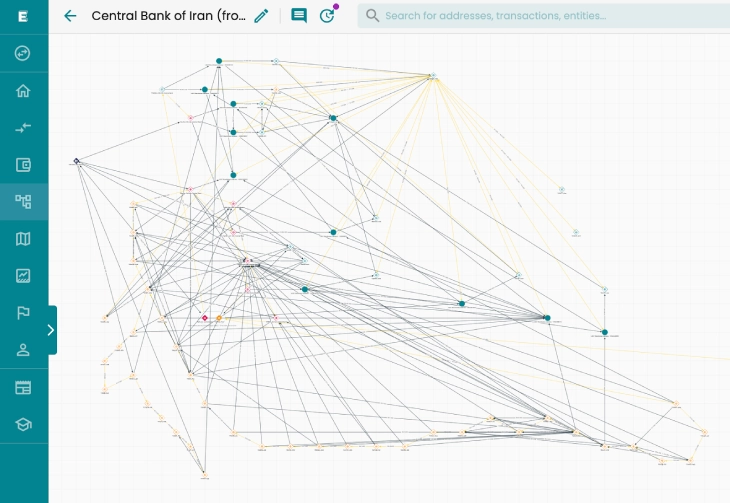
The most technically advanced component involves the Central Bank of Iran itself. Elliptic’s January 2026 analysis stated that a number of wallets under CBI control silently acquired at least $507 million in Tether’s USDT stablecoin during 2025. These transactions happened mainly on the TRON blockchain. The main reason behind this blockchain is its low fees and high transaction rates.
Some leaked documents confirmed two large purchases in April and May 2025, paid in Emirati Dirhams via intermediaries. This process converted fiat currency into what analysts call “synthetic dollars,” operating outside U.S. jurisdiction.
Until early June 2025, a huge number of USDT transactions are going to Iran’s largest crypto exchange, Nobitex. There, USDT was swapped for Iranian rials or simply held to inject dollar liquidity into open-market operations. This helped the fiat currency to maintain stability during periods of extreme volatility.
Then came June 15. Tether blacklisted certain wallets, freezing $37 million in CBI-linked funds. USDT was bridged via cross-chain services from TRON to Ethereum. It was converted through decentralized exchanges like Uniswap or Curve. Then it was diverted across additional chains or compliant centralized exchanges.
Conclusion
As Geneva talks go forward under the fear of U.S. strikes, the adoption of cryptocurrency in Iran is expected to grow. These decentralized digital currencies can help Tehran to find alternative options while funding its illegal funding to proxy groups across the Middle East.
However, there are many private and government agencies monitoring these crypto transactions. Also, the growing regulatory clarity in 2026 will implement stricter identity verification for crypto transactions. And it will need real-time monitoring of Iranian IP clusters to detect and block suspicious activity.
Also Read:Crypto Hacks that Could Have Been Prevented with Precautions
See less
