


Key Highlights
- Prediction markets, like Polymarket and Kalshi, have given a signal of price movement in the crypto market in the past.
- Prediction markets allow participants to stake real capital on multi-outcome resolutions.
- Prediction markets are developing relative strength with altcoins by allowing quick price discovery.
There are new kinds of crypto-based platforms that are taking the world by storm. As of now, cumulative trading volume across leading prediction platforms is reaching $4.47 billion for the week, according to the data from DeFiRate. There are two leading players currently available in the market, Polymarket and Kalshi.
Kalshi, the CFTC-regulated U.S. exchange, led with $2.59 billion, which is 6.75% up week-over-week. On the other hand, Polymarket is leading it with $1.82 billion. This comes during the recent series of records, including $6.18 billion the week of January 26 and $5.9 billion the previous week.
Crypto-based markets are now the third-largest category on both platforms, with 24-hour volumes reaching $42.7 million on Polymarket and $18.6 million on Kalshi. Kalshi’s 30-day crypto volume has soared 348.6%, according to DeFiRate tracking.
Citizens Bank’s latest report says that the industry is at a $3 billion plus annualized revenue run-rate, already up from $2 billion in December. The report says that it could follow the trajectory of $10 billion by 2030.
Institutional liquidity providers such as Jump Trading and Susquehanna International Group have been involved in order books, while Intercontinental Exchange, which owns NYSE, announced the investment of $2 billion in Polymarket last October.
This growing investment and popularity is a real-time pump that influences prices in crypto catalysts faster than traditional polling or analyst notes.
How Prediction Market Probabilities are Becoming an Important Indicator
Unlike social-media hype or on-chain data that can be changed, prediction markets are used to attract participants who stake real capital on binary (like yes or no) or multi-outcome resolutions. This kind of prediction markets help traders to get “market-implied probabilities.” So many times, these data outperformed polls, such as the 2024 U.S. election cycle.
In 2026, the same mechanism is now being used for the crypto sector. The surge in volume on regulated platforms influences the market faster than X (formerly Twitter) narratives or Glassnode alerts.
These kinds of prediction markets are capable of providing much-needed liquidity, with open interest exceeding $1.3 billion combined as of late February.
For example, when Polymarket odds on “CLARITY Act passage by March 1” soared above 78%, altcoin beta quickly turned higher. This was not the first time, as this kind of pattern was also seen during regulatory developments, crypto-based ETF approvals, and others.
Real Case Studies During Major Events in 2025 and 2026
There are many examples available in the crypto market where prediction markets successfully provided signals for the price movement in the crypto market.
In January 2026, Polymarket volume on the question “crypto market structure legislation signed in 2026” surged over $10 million. For this, odds surged above 70%. At the same time, within 48 hours, Solana, XRP, and other layer-1 tokens witnessed around 4% to 8% relative outperformance while Bitcoin’s dominance dropped.
These kinds of movements are widely known as early rotation signals. The Altcoin Season Index, which had declined below 25. In the following weeks, it climbed toward 30% to 40%.
NEW: Major investigation dropping February 26 on one of crypto’s most profitable businesses where multiple employees abused internal data to insider trade over a prolonged period of time. pic.twitter.com/Losou2CZ2N
— ZachXBT (@zachxbt) February 23, 2026
The ZachXBT insider-trading market generated $16.3 million in volume within 48 hours. Some specific tokens, such as MET, HYPE, and PUMP, which were largely traded against in the “which company next?” contract, dropped 10% to 20% in the same session before any on-chain wallet movements or official announcements. This is the best example of how these prediction markets can influence the crypto market.
Markets pricing Solana as the dominant chain for event contracts by mid-2026 have attracted the attention of the community. ETF Trends mentioned in early January that Solana already led blockchain revenue in 2025, largely due to prediction-market activity.
Blue-chip altcoins linked to high prediction market volume narratives, including AI agents, RWAs, and decentralized oracles, are showing a strong early-year relative strength.
How Prediction Markets Influence the Crypto Market and Altcoin Price Movement
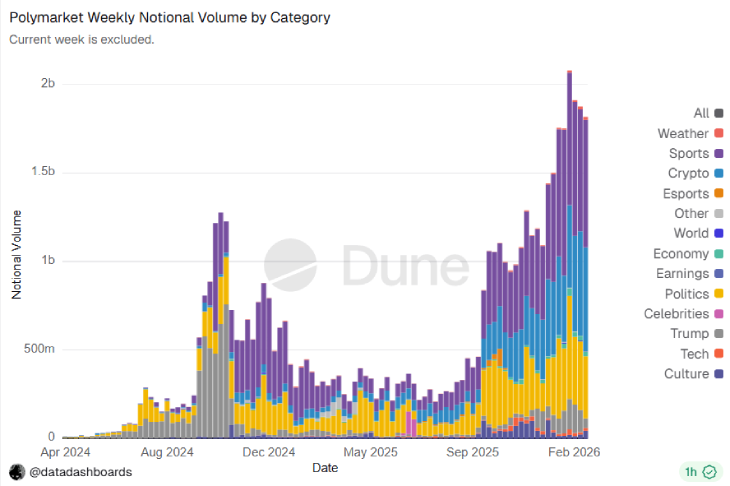
(Source: Dune Analytics)
Dune Analytics dashboards reveal that crypto contracts are now the second most tradable contracts on Polymarket after sports. Just one year ago, this category was in fourth place, and the current jump comes after its notional volume increased by around 10 times.
When crypto-category 24-hour volumes soar to $400 million, altcoin market-cap share has risen in 7 out of the 8 cases since the fourth quarter of 2025.
Some experienced traders are monitoring second-order signals. These include “spread compression” in multi-outcome markets, such as contracts asking “BTC best month 2026.” They watch for open-interest spikes in alt-specific contracts like “Will SOL ETF approve before July?” And they track cross-platform details between Kalshi, which is regulated and uses fiat, and Polymarket, which runs on USDC on-chain.
Conclusion
With Coinbase, Robinhood, Crypto.com, and other platforms planning to launch native prediction platforms, it is very likely that prediction markets’ cumulative volume will reach $1 trillion.
For altcoin traders, these prediction markets can provide important indicators during the volatility in the market. The new change is to watch Polymarket and Kalshi crypto-category volume and odds change as the first derivative of capital rotation.
Also Read: Tariff Chaos Tanks Bitcoin – Why Strategy Is Still Buying
See less
