


Key Highlights
- After staking, RWA yield farming is becoming an attractive option for earning passive income
- There are many RWA tokens available in the market that provide an impressive yield through different mechanisms
- Amid the progress in regulatory development, tokenized assets are providing investors with an option to invest in on-chain assets that follow regulatory compliance
In early 2026, Real World Asset (RWA) yield farming became one of DeFi’s most attractive ways of earning passive income. Tokenized treasuries, private credit, and institutional-grade fixed income can now provide on-chain yields, which sometimes can be more than traditional finance.
While general RWA products like US Treasury-backed tokens are providing stable 3.5% APYs, similar to real-world rates, the real alpha comes from staking the native governance or utility tokens of RWA protocols. With the help of protocol revenue, these tokens can provide an impressive APYs around 20% in verified cases.
The total market capitalization of tokenized RWA is around $25 billion, excluding stablecoins. Institutional adoption of this sector is rapidly growing. Yield farmers are now flowing capital into RWA-native tokens to get profits backed by real-world economic activity.
RWA Yield Farming Becomes New Way to Generate Passive Income
The RWA sector is rapidly becoming popular in 2026, thanks to regulatory clarity. Tokenized public-market assets soared to roughly $16.7 billion by late 2025, with private credit and treasury products leading the charge.
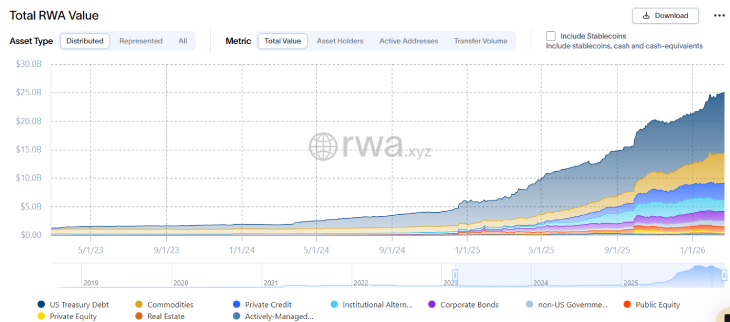
(Source: rwa.xyz)
BlackRock’s BUIDL fund is responsible for approximately 45% share in tokenized treasuries, while Ondo Finance’s OUSG and USDY products have combined TVL over $2 billion across chains.
The recent regulatory developments in the digital asset sector have helped the RWA sector to bring off-chain assets via oracles and custodians. Investors are now earning daily yields on tokenized T-bills, with OUSG at 3.4% as of now. They can lend them as collateral or layer protocol incentives on top. According to the data, total RWA TVL across DeFi soared over $8 billion in protocol coins.
Top RWAs with 20% APY Tokens in 2026
While there are many RWA tokens available in the market with higher APYs, here are some verified tokens where staking the native RWA protocol token can deliver APYs of around 20%. However, it is important to understand that APYs are dynamic.
1. MANTRA (approximately 20%)
MANTRA is the leading compliance-based Layer-1 blockchain, which is dedicated to real-world assets. It allows tokenized securities to stay under clear regulatory frameworks.
It has a native token called OM, which is mainly serving two different purposes. It is useful in securing the network through delegated proof-of-stake as well as earning rewards from inflation plus fees. According to Coinbase, the average reward rate is around 19.18%, which is up 7.63% over the past 30 days. Kiln reward rates reached as high as 20.79%.
Over 27% of the total supply is currently staked on the chain, which is around $22.1 in the staking market capitalization.
The MANTRA has planned a major change in the next month, March. According to the sources, some platforms are implementing a 1:4 conversion from OM to MANTRA as the project migrates and rebrands certain features. On this project, early stakers are expected to get more benefit. This project becomes a leading contender in the current market for high-APY with less slashing risk.
2. Maple Finance (SYRUP)
Maple Finance is a popular player in the RWA sector as it dominates the on-chain private credit sector. It underwrites overcollateralized loans to institutional borrowers, which means that the loans are backed by more value than the amount of money.
Syrup pools, including syrupUSDC and SyrupUSDT, use a mechanism where they generate real loan interest. According to the past data, Seasons 1 through 8 averged 19.8% total APY. In February 2025, the pool provided 14.7%.
In 2026, the project will step up its game. According to an official report, 25% of all protocol fees will now be used to fund SYRUP buybacks, which are distributed to stSYRUP holders.
The platform has recently generated record monthly revenue, with an all-time high of $2.49 million.
3. Ondo Finance (ONDO Token with USDY/OUSG layering)
Ondo Finance is providing two different ways to get exposure to the Treasury through tokenized products. OUSG, which holds US treasury bills, is paying 3.4% APY and has over $708 million in total value locked. On the other hand, USDY, a variable-rate note adjusted monthly, currently provides 3.55% APY.
While holding these directly helps to gain real-world yields, farmers use some techniques to boost their returns. They stake these tokens into integrated DeFi protocols like Aave, Flux, and Pendle. While some farmers use Ondo-adjacent vaults. By doing these, they can boost their combined APY to around 15% to 22% in verified pools during high-liquidity periods.
The ONDO governance tokens are also able to participate in revenue-sharing mechanics with external farming. With more than $1.5 billion in total value locked across its products and expanding its operations to new services, Ondo is the leading institutional gateway for RWA yield optimization.
Conclusion
RWA yield farming is the biggest example of how on-chain assets are filling the gap between traditional finance and DeFi. Generally, base asset yields revolve around 3% to 5%, but staking the protocol tokens changes the equation. MANTRA OM, Maple SYRUP, and the ecosystem around Ondo can provide 15% to 22% APYs, which is backed by real revenue.
However, there is a risk associated with this. These APYs can be affected by smart contract exposure, regulatory news, interest-rate volatility, and liquidity drop. That is why it is important to verify on-chain data using tools like DefiLlama. Also, use hard wallets to ensure the security of assets and diversify your investments into different products.
Also Read: On-Chain Derivatives 2026: Find Out Why They Are Outpacing CEXs
See less
