


Key Highlights
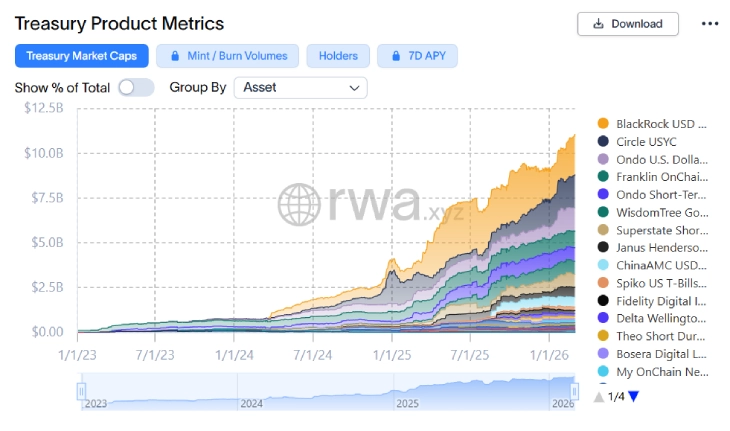
- The market grew 22% in just 2 months, from $8.9 billion on January 1 to over $10.9 billion by March 1, 2026
- Major protocols, including Aave, MakerDAO, and Morpho, integrate tokenized Treasuries, which allows users to earn 4% to 5% yields while borrowing against them for strategies like leveraged yield farming without liquidation risks
- Laws like the CLARITY Act GENIUS Act have standardized oversight
Decentralized finance, or DeFi, is changing fast. One of the biggest changes comes from something called tokenized treasuries. These are digital versions of U.S. government bonds that now live on blockchains.
As of March 2026, these assets are not just for earning yields anymore. They have become something bigger. They now work as the main collateral across many on-chain systems. In simple terms, other financial products and protocols use them as backing, just like cash or bonds are used in traditional finance.
The numbers show how big this has become. The total market value of tokenized treasuries has now passed $11.4 billion. That is real money moving onto blockchain rails.
Why are they growing so fast? There are three reasons. First, they settle instantly. No waiting days for bank transfers. Second, they trade 24 hours a day, 7 days a week. Markets never close. Third, they are composable. Developers can build new financial products around them easily, stacking and combining them like Lego blocks.
This blog will help you to understand how tokenized treasuries work. It will look at how they grew from a niche idea into a multi-billion-dollar market. It will explore how they integrate with existing DeFi protocols. And it will check where they might go next.
Tokenized treasuries are connecting two worlds, where it brings stability to traditional government bonds. On the other hand is the efficiency and flexibility of blockchain technology.
What are Tokenized Treasuries
Tokenized treasuries are digital tokens that represent ownership in real U.S. government bonds or money market funds.
Regulated companies issue these tokens. Each token is backed one-to-one by actual Treasury bills sitting in custody. So for every token in circulation, there is a real dollar of government debt held somewhere safe.
This yield comes from the underlying asset. U.S. Treasuries currently pay around 4% to 5% annual interest. Token holders receive that yield, but with all the advantages of blockchain technology.
Smart contracts do most of the work. They handle issuance automatically. They track interest as it builds up. They process redemptions when holders want to cash out. All of this happens without manual paperwork or slow intermediaries.
The difference from traditional Treasuries is night and day. Old-school government bonds settle through legacy banking systems. They take time. They involve multiple parties. Tokenized versions live on public blockchains like Ethereum, Solana, or Polygon. Also, one can trade it instantly.
This makes them incredibly useful in DeFi. Protocols can integrate them seamlessly. They become programmable collateral that developers can build around.
Here is a real example. Someone can hold tokenized treasuries earning 4% yield. At the same time, they can use those same tokens as collateral to borrow stablecoins. And unlike crypto collateral, treasuries do not have wild price swings. There is no risk of sudden liquidation because the underlying asset barely moves.
Regulation has helped this growth. The GENIUS Act, passed in 2025, created clear rules. It standardized how reserves must work. It set capital requirements. It laid out rules for redemptions. This clarity gave institutions confidence to participate.
The Rise of Tokenized Treasuries in 2026
The tokenized treasury market has grown from $8.9 billion on January 1, 2026, to more than $10.9 billion by March 1. That is a 22% increase in just 2 months, and it happened while the crypto market was going through ups and downs.
This is now a sudden spike. It follows a much bigger trend. Since 2024, the market has grown 50 times over. The reason is simple: Institutions want yield, and they want it efficiently. With interest rates staying higher for longer, tokenized Treasuries offer a perfect solution.
(Source: rwa.xyz)
According to data from rwa.xyz, U.S. Treasuries are now dominating the real-world asset space. They make up about 90% of all on-chain value in this category. The average yield right now sits at 4.14%.
Clearer rules are a big part of it. Laws like the CLARITY Act in the United States have created a single framework for tokenized securities. The SEC and CFTC now have clearer lines of oversight. This removes the uncertainty that kept many institutions on the sidelines.
Banks, asset managers, and corporate treasuries are putting idle cash to work. Instead of letting money sit in low-yield accounts, they move it into tokenized Treasuries. They get 24/7 access to their funds and faster settlement times. No waiting for bank business hours. No delays from legacy systems.
Looking ahead, the potential is enormous. Industry projections suggest the tokenized asset market could reach anywhere from $2 trillion to $18.9 trillion by 2030. Treasuries are expected to capture a significant piece of that.
How They Work as On-Chain Collateral
Tokenized treasuries are finding their true calling in DeFi. They work perfectly as collateral. The reason is simple. They are stable. And they can be used in endless combinations with other financial tools.
In DeFi protocols, these assets back loans, derivatives, and liquidity pools. Unlike Bitcoin or Ethereum, they do not swing widely in price. A lender knows that collateral will not vanish overnight in a market crash. This makes them trustworthy in a way that native crypto assets often are not.
Major protocols have taken notice. Aave, MakerDAO, and Morpho all now integrate tokenized Treasuries. Users can deposit them and borrow stablecoins like USDC or DAI. This opens up strategies that were not possible before.
Someone deposits tokenized Treasuries into a lending market. They earn the underlying Treasury yield, around 4% to 5%, just for holding. At the same time, they can borrow against those same assets. Lenders typically allow borrowing 70% to 80% of the value. The borrowing rates are often lower than the yield they are earning.
Summing Up
By 2030, tokenized assets could reach trillions in value, with Treasuries serving as the gateway for other real-world assets like equities and real estate. Innovations, including AI-based agents and zero-knowledge proofs, will enhance privacy and scalability across these systems. Expect more cross-chain bridges and institutional pilots in the coming years.
All in all, tokenized treasuries are enhancing decentralized finance by providing stable, yield-bearing collateral that brings elements of reliability with blockchain innovation.
Also Read: Ethereum Hits Record Usage But Price Lags, Staking Paradox Explained
See less
