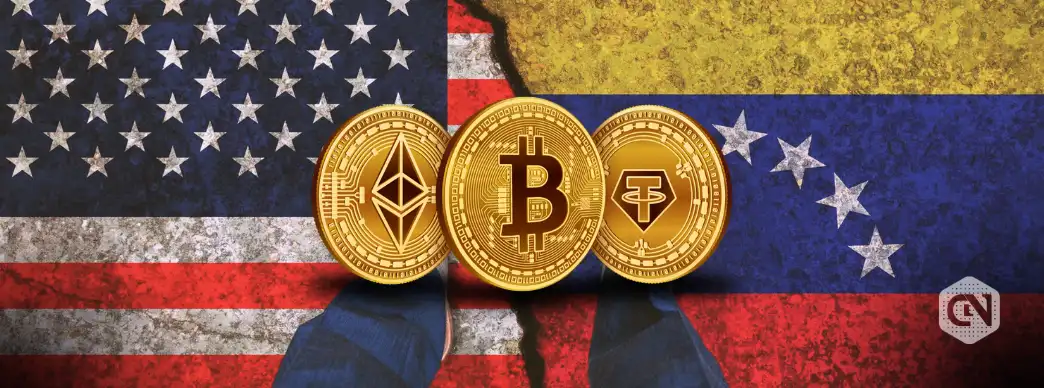
Key Highlights:
- Tension between US and Venezuela and capturing of Venezuela’s President Nicolás Maduro sent shockwaves through global markets.
- Crypto showed immediate reaction to this situation.
- Bitcoin is being seen as a geopolitical asset and not just an investment product.
In early January 2026, there was a rise in geopolitical tensions between the United States and Venezuela. The United States launched military strikes and captured Venezuela’s President Nicolás Maduro in an operation that shook the entire global politics.
Capturing a sitting head of state in a foreign country is extremely rare in modern times. This capturing immediately grabs attention because it directly challenges sovereignty and international norms.
Amid all of this uncertainty, cryptocurrencies gathered a great amount of attention as investors turned to digital assets as a hedge against geopolitical instability and economic turbulence.
Conflict Origins
Tension had been building between these two countries for years. The US had accused Nicolás Maduro of narcoterrorism, and when Venezuela took over oil operations that foreign companies used to run, Washington criticized that as an unfair seizure.
The US sanctions and military pressure then worsened Venezuela’s economy which was already deteriorating. The sanction also dropped bolívar’s value and pushed many people to use dollars or informal markets to get by.
Caracas tried to lessen its dependency on the US dollar, but this was mostly a mere response to the sanctions that were implemented rather than a strategy to change how the trade worked.
By late 2025, growing economic hardships led to increased US naval operations in the Caribbean, which helped set the stage for a dramatic escalation in the conflict, leading to US direct action that shocked the entire world.
Immediate Crypto Reaction
Before the attack, the crypto market was hovering somewhere around $2.8-$2.9 trillion dollars and right after the attack, the crypto market experienced an immediate uptick.
Bitcoin was hovering around $87,000-$88,000 mark but after the attack, the cryptocurrency experienced an uptick of almost 5% and was observed to be moving within the range of $91,000-$93,000. This surge was one of the highest gains since November.
When Bitcoin rises, most of the crypto market tends to rise with it, though the gains can be uneven. Ethereum also crossed the $3,000 mark and other altcoins such as XRP, BNB, Solana, Tron, Dogecoin, Cardano, and Hyperliquid gained up to 18%. The crypto market surged above $3 trillion as investors started investing their money into digital assets right after the attack.
Cryptocurrencies that are linked to President Trump also gained momentum. WLFI rose about 16% and TRUMP climbed almost 7.5% after the attack.
Traditional financial markets, on the other hand, took a while to respond to this geopolitical shock. Crypto’s around the clock trading showed rapid movements and gains as investors started to lean towards digital assets amid uncertainty.
Why Did Investors Shift to Digital Assets?
When the US-Venezuela conflict got out of hand, the market grew nervous about the oil supply, inflation and currency stability. The price of oil became uncertain, and the investors were worried that the traditional markets would react slowly or face disruption.
During such a period, many people moved their money into Bitcoin and other cryptocurrencies because they are easy to buy and sell at any given time and these currencies are not tied to any single country.
As a result, Bitcoin bounced back quickly after early volatility, and other cryptocurrencies followed. This move by the investors confirmed that they are using digital assets as a quick hedge during global uncertainty.
Venezuela and its Bitcoin Stash
Venezuela always attracted global interest due to its oil reserves, but the attention as of now has shifted to claims that the country might also have a huge amount of Bitcoin. President Trump also commented that the US would “run Venezuela” has added fuel to the speculation that Washington’s interest could also spread beyond oil and to digital assets as well.
Does Venezuela Really Have a $60 Billion Bitcoin Stash?
According to Bitcoin Treasuries.net, Venezuela is confirmed to hold only 240 Bitcoins, which are worth $22 million and the country stands on the 9th position amongst governments that hold Bitcoin.
However, reports from platforms suggest that Venezuela may secretly control 600,000 to 660,000 Bitcoins, which is almost 3% of Bitcoin’s total supply. However, there seems to be no blockchain proof to support these figures.
Why are Experts Skeptical?
Crypto analysts like Muricio Di Bartolomeo, co-founder of crypto lender Ledn, told Fortune that building such a huge Bitcoin reserve without anybody knowing is difficult and especially because Venezuela has a long history of corruption and unexplained losses of state assets.
However, there are theories that Venezuela might have turned to Bitcoin to move and store value outside the US controlled financial system when sanctions, hyperinflation, and asset freezes made dollars and gold risky or hard to use.
How Much Bitcoin Does the US Hold?
The US government is one of the largest government holders of Bitcoin with around 325,000 Bitcoins valued at roughly $30 billion as per CoinGecko.
Most of these holdings have come from criminal seizures which include Silk Road darknet market, crypto seized from scams and illegal investment schemes, drug trafficking investigation and others.
Back in March 2025, Donald Trump announced the creation of a Strategic Bitcoin Reserve, signalling stronger US interest in Bitcoin as a long-term asset.
Oil or Bitcoin?
We all know that oil is the central attraction but some analysts also believe that Bitcoin could also be strategically important. If Venezuela actually holds a huge Bitcoin reserve and if the US seizes it, experts believe that that Bitcoin will be frozen or added to the US Strategic Bitcoin Reserve, not sold.
Why This Matters For Crypto Markets?
This whole idea that the governments may compete over Bitcoin has affected market sentiment. It shows that Bitcoin is being viewed as a strategic, state-level asset and not a speculative investment. It also reaffirms that in times of global crisis, crypto is being viewed as a part of the global power game and it starts behaving like a hedge against instability.
Also Read: Bitcoin Gains Amid Venezuela Chaos, Says Arthur Hayes
See less