Key Highlights:
- RWAs need their own blockchains so that it can handle issues such as compliance and scalability.
- With dual-layer design, it lets assets follow rules and trade globally.
- As of now $18.6 is already live onchain, with trillions inbound, specialized L1s will power the tokenization economy.
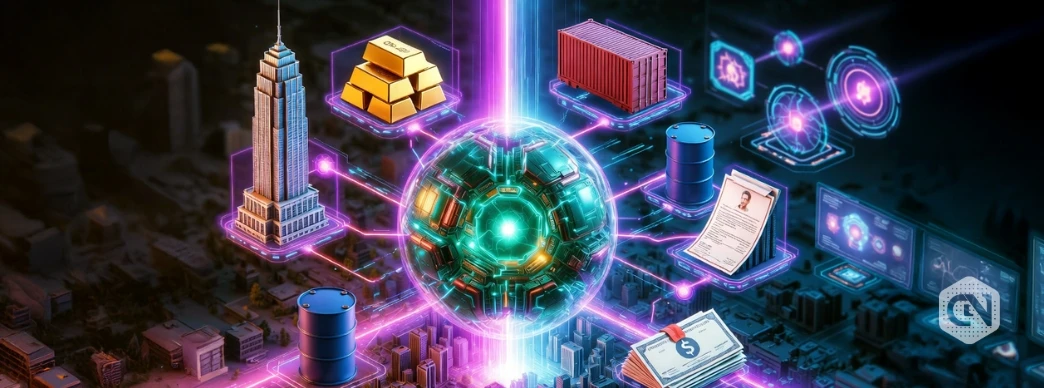
Big money is moving into tokenized real-world assets (RWAs). BlackRock’s BUIDL fund, a tokenized US Treasury product, raked in nearly $2.2 billion across multiple chains by early 2026 and now even works as collateral on exchanges like Binance. JPMorgan jumped in too, rolling out a tokenized money market fund on Ethereum in late 2025. Tokenized US Treasuries alone are over $8 billion and total on-chain RWAs (minus stablecoins) tripled to $18.6 billion in 2025. By 2030, some say this market could hit $16 trillion.
Here’s the catch, current blockchains have not been built for all of this stuff. DeFi, NFTs, payments, all of this can be easily processed by the current blockchains but for real estate, private credit and other RWAs need rules, real-world data and the ability to handle huge volumes, most chains cannot keep up.
That’s why a blockchain made specifically for RWAs is not just cool, it is a must if we want to tap into this massive market.
Existing Blockchain’s Shortcomings
As stated above, the regular blockchains were not built for real-world assets (RWAs). Ethereum can handle smart contracts, but when demand spikes, gas fees soar and trades take forever. Ripple’s XRPL is great for cross-border payments, but it cannot manage complex rules for assets. Avalanche promises speed with subnets, but each one runs solo, splitting liquidity and security.
Other attempts come with compromises. Permissioned chains like Hyperledger Fabric follow the rules but they are not really decentralized. Public chains like Polygon or Solana are fast, but struggle with local laws, think EU MiCA KYC or US SEC’s on-chain AML checks.
Hedera is speedy but is controlled by a council, with fees tied to USD risking FX issues. Polymesh solves compliance with KYC at the protocol level, but shuts out unlicensed users.
The problem? Compliance and decentralization are often treated as opposites. RWAs need both, ownership that’s verifiable under local laws, plus open validation so there’s no single point of failure. Trying to shoehorn them onto normal chains leads to hacks, oracle manipulation, or even regulators knocking at the door.
The Compliance-Decentralized Paradox
RWA are not confined by borders or types. EU real estate follows packaged retail and insurance-based investment products (PRIIPs) rules, US carbon credits answer to Environmental Protection Agency (EPA) standards, and Singapore private credit plays by Monetary Authority of Singapore (MAS guidelines). No single chain can handle all that without putting up barriers.
That is where purpose-built RWA blockchains come in. They use a modular, dual-layer setup, one layer handles local rules (think built-in KYC/AML), while a permissionless base layer keeps security and settlements open to everyone. This “polychain” approach lets assets stay compliant and tap global liquidity, no need to trade openness for rules.
Beyond Compliance: Data, Interoperability and Scale
RWA connects the physical and digital worlds. Chainlink can give price feeds for Treasuries but real-world assets also need legal proof, like property titles or credit scores. Normal blockchains rely on generic oracles that can be hacked or tricked. RWA-native chains use verifiable credentials (like DID) and legal oracles, so the data holds up in court.
Interoperability is key too. RWAs move across chains, US Treasuries might settle on Ethereum, then trade on Avalanche. Standards like IBC or CCIP help out , but only L1s with native bridges avoid messy wrapped token risks.
And do not forget scalability. Ethereum can handle 15-30 TPS, but global real estate trades trillions every year. Polychain setups solve this by running multiple chains in parallel, 10 chains at 1,000 TPS each equals 10,000 TPS. Sharded networks like zkSync have even hit 20,000 TPS, proving big-volume RWA trading is doable.
Developer and Economic Foundations
EVM compatibility lets new chains tap into Ethereum’s huge toolkit, Solidity developers, MetaMast, audited libraries, without starting from scratch. WebAssembly (WASM) runtimes let chains upgrade smoothly to meet new rules, like changing travel or reporting requirements.
Using a single token for gas and staking makes things easier for treasuries. Zero-inflation designs, paid for by fees, make sure everyone’s incentives stay aligned as trading volumes grow.
Regulatory Tailwinds
New regulations in 2026 are speeding things up. Europe’s MiCA says tokenized funds need compliant chains. US pilots, like NYDFS greenlights, prefer fully auditable L1s. Singapore’s Project Guardian is testing RWA interoperability. All of this is pushing chains to build compliance in from the start, instead of tacking it on later.
The Infrastructure Flywheel
RWA blockchains become the settlement backbone for entire ecosystems, tokenization platforms, marketplaces, launchpads. On-chain activity generates fees, which pushes security and attracts more projects.
As more RWAs come onboard, liquidity grows, which is not the case in general chains, where liquidity gets diluted by memes and speculation.
Final Thought
RWAs need their own blockchain so that issues such as regulatory compliance, connecting real-world data, scaling and interoperability can be carried out smoothly. With $18.6 billion already live and trillions coming, general-purpose chains just cannot keep up. Purpose-built L1s are set to power the tokenized economy.
Also Read: On-Chain Derivatives 2026: Find Out Why They Are Outpacing CEXs
See less