


Key Highlights
- In the latest podcast, Tomasz Kajetan Stańczak has revealed that developers will focus on L1 Scaling and Institutional Privacy in 2026
- Earlier, Vitalik Buterin also urged the community to focus on long-term goals instead of chasing the latest trends
- Two major hard forks, Glamsterdam in mid-2026 and Hegota in late 2026, are designed to enhance Ethereum’s capacity
In a recent interview on the ETHPanda Talk Podcast, Tomasz Kajetan Stańczak, the newly appointed co-executive of the Ethereum Foundation, shared a crucial detail about new developments in the next year, 2026.
Tomasz Stanczak: Ethereum to Focus on L1 Scaling and Institutional Privacy in 2026
In an interview with ETHPanda Talk, Nethermind founder Tomasz Stanczak revealed that while researcher Dankrad Feist believes L1 scaling remains unfinished, Ethereum is shifting focus to Faster… pic.twitter.com/WqHGVOg7QO
— Wu Blockchain (@WuBlockchain) January 2, 2026
Stańczak, founder of the key development team Nethermind, mentioned that while Layer 1 scaling remains an “unfinished” challenge, as noted by Ethereum researcher Dankrad Feist, the foundation is now directing its focus in the new year toward two major areas, including faster transactions and improved privacy features.
These priorities will help them to meet the growing demands of institutional users who need both confidentiality and secure settlements.
Tomasz Kajetan Stańczak’s statement is showing their strategy for the new year, where developers are planning to balance scalability with enterprise-level requirements. His move from bootstrapping Nethermind, which has contributed to critical projects like Flashbots and the Starknet Foundation, to a leadership role at the Ethereum Foundation shows a concerted effort to streamline main development. It also plans to make it ready for new technologies, like artificial intelligence.
The interview has started a discussion in the crypto community about the foundation’s evolving role.
Vitalik Buterin Urges Refocus on Decentralization and Resilience
Ethereum co-founder Vitalik Buterin has also been vocal about the network’s important evolution. During a speech at Devconnect Buenos Aires in late 2025, Buterin shared a number of upcoming Ethereum Improvement Proposals (EIPs) designed to safely increase the network’s capacity while preserving its decentralized nature.
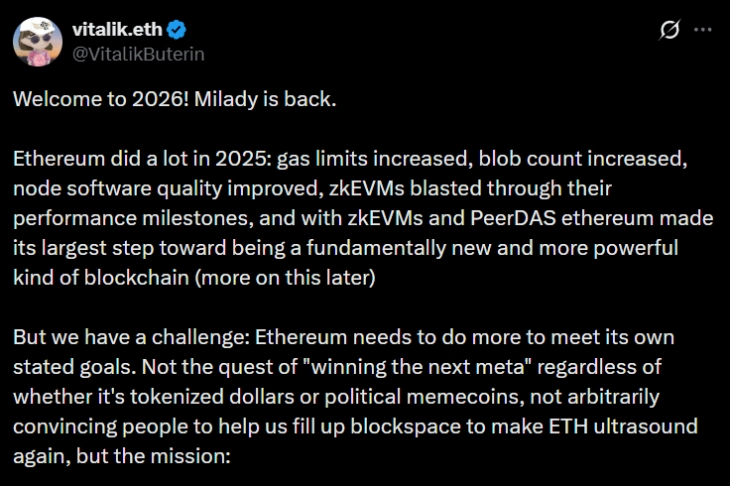
(Source: Vitalik Buterin on X)
Buterin mainly highlighted Proposer-Builder Separation (PBS) and Block-level Access Lists (BAL) as major upgrades that will allow a secure increase in the gas limit by the end of 2026, which will make the network more powerful.
Vitalik Buterin issued a major warning to start 2026, which urges the community to refocus on Ethereum’s original plan as a censorship-resistant “world computer.” He argued that without built-in privacy-preserving features, users might flee to a centralized alternative that better protects financial data.
Buterin also introduced a practical “walkaway test” for applications. This test raises questions about whether they would continue to function if their original developers disappeared or if a major centralized service like Cloudflare failed.
Apart from this, he raised major concerns about quantum computing, warning that current elliptic curve cryptography could be broken before the 2028 U.S. Presidential election. This makes an urgent need for quantum-resistant upgrades within 4 years.
In his statement, he also urged the community to focus on the main goals instead of chasing the latest trends. He said, “Ethereum needs to do more to meet its own stated goals. Not the quest of ‘winning the next meta’ regardless of whether it’s tokenized dollars or political memecoins.”
“zkEVMs blasted through their performance milestones, and with zkEVMs and PeerDAS, Ethereum made its largest step toward being a fundamentally new and more powerful kind of blockchain,” he stated.
Glamsterdam and Hegota Hard Forks
In the latest revelation, the Ethereum team has revealed two major hard forks planned for 2026.
The first, known as “Glamsterdam,” is planned for mid-2026. This upgrade focuses on dramatically boosting execution throughout. It will introduce parallel transaction processing, which significantly raises the Layer 1 gas limit toward 100-200 million. This will start shifting validators toward verifying zero-knowledge (ZK) proofs.
These changes, including the implementation of EIP-7928 for Block Access Lists, are expected to push Layer 1 transaction capacity toward 10,000 transactions per second (TPS). An increase in data “blobs” per block will further support Layer 2 networks.
The second fork, currently referred to as “Hegota,” is targeted for later 2026. This upgrade is expected to develop fundamental privacy primitives directly into the protocol and improve censorship resistance through mechanisms like FOCIL for faster transaction inclusion.
Also Read: Ethereum Network Sees Shift in Staking Behavior as Entry Queue Grows Larger Than Exits
