


Chainlink Price Prediction


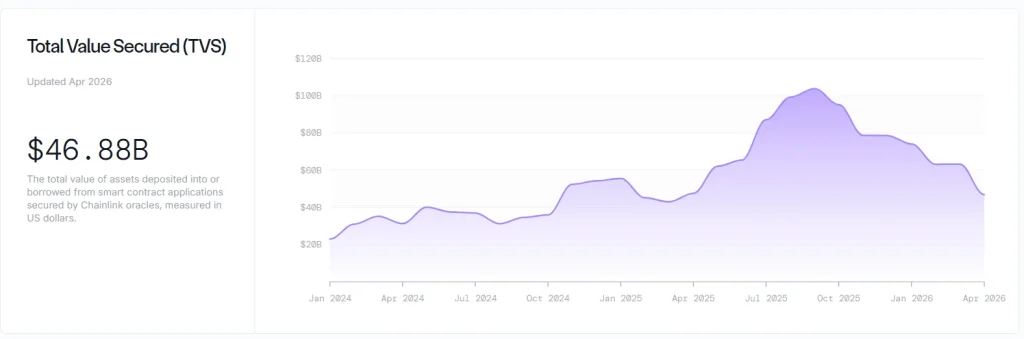
Chainlink (LINK) has developed beyond a simple oracle network to be the definitive infrastructure layer of the global on-chain economy. It provides the secure bridge required of blockchains to interact with real-world data and has secured almost $46.88 billion in assets across decentralized finance (DeFi) by solving the oracle problem.
The increasing utility of the platform is highlighted by the fact that it is now used by financial giants, such as Swift, UBS, and J.P. Morgan, who leverage the Cross-Chain Interoperability Protocol (CCIP) of Chainlink to bring the traditional capital markets on-chain. To long-term investors, institutional integration is a fundamental change of speculative assets to an essential utility.
In our 2026-2030 prediction, we use a weighted multi-factor model to analyze how surging demand in the Real-World Asset (RWA) tokenization, macro-economic changes, and the competitive environment will influence the intrinsic value and price trend of the LINK token.
Key Takeaways:
- Chainlink’s price is driven by oracle demand, CCIP adoption, and RWA integration.
- LINK token value could hit $15-$18 in 2026 if geopolitical tension in the Middle East comes to peace, capital returns to risky assets like cryptocurrency, and DeFi witnesses sustained demand.
- Reaching prices over $100 requires a full crypto super-cycle plus network revenue growth
- LINK’s value depends on real utility metrics, not just market sentiment or speculation
- Institutional validation continues despite a 77% price decline from LINK’s ATH
Chainlink Statistics
Our Prediction Methodology
Price forecasting in crypto is fundamentally uncertain, which is why we base our projections on a weighted, multi-factor model instead of relying on guesswork or market sentiment.
1. On-chain Usage Metrics (35% Weight)
Our model puts the heaviest load, approximately 35% on-chain usage metrics. This encompasses volumes of CCIP transfers, Total Value Secured in DeFi, involvement in staking, and the generation of fees. These are the signals that are most difficult to counterfeit, and which are most indicative of real economic demand.
2. Macro & Market Cycles (25% Weight)
Approximately 25% is due to macro and market cycle conditions. The price ceiling of any altcoin, irrespective of its fundamentals, is determined by the process of halving of Bitcoin, Federal Reserve policy, and global liquidity.
3. Institutions & RWA Adoption (20% Weight)
We attribute 20% to the institutional and RWA adoption – we are looking at how many pilot programs have been transferred into real production deployments with partners such as Swift, UBS, and J.P. Morgan. This is slow-moving, yet it leaves a long-lasting demand that has a staying power even during recessions.
4. Competitive & Sentiment Landscape (20% Weight)
Rivalry risk of competitors such as Pyth Network and cross-chain substitutes has a weight of 12% as a moderating risk factor. Whale behaviour and sentiment indications fill out the remaining 8% – useful in timing, but never considered a stand-alone thesis.
Check out our review methodology for detailed insights into how the CryptoNewZ team creates price predictions.
CryptoNewsZ Opinion
In 2026, we expect Chainlink’s price to continue consolidating until mid-year, depending on broader market pressure amid escalating military tensions between the U.S. and Iran. Thus, the LINK token could plunge to $7 support and maintain its base range around $8 to $11. However, the second half could witness renewed recovery and change a potential high of $15.5-$18.
Chainlink (LINK) Overview: What Still Matters in 2026
Chainlink operates as the industry-standard decentralized oracle network, bridging the gap between blockchains and real-world data. Unlike closed blockchain systems that cannot natively access external information, Chainlink enables smart contracts to interact securely with off-chain data sources, APIs, and traditional systems.
The network’s core offering includes Data Feeds for price information, Cross-Chain Interoperability Protocol (CCIP) for secure asset transfers across blockchains, Data Streams for low-latency market data, and Automation services.
The LINK token serves multiple functions: paying node operators for oracle services, securing the network through staking, proposing and evolving value-capture mechanisms tied to fees, staking, and service usage.
It’s not just what Chainlink does in 2026 but how far it has integrated. Most protocols can’t just opt for a simple technical switch from Chainlink, as it’s been integrated with over 2400 DeFi, tokenized asset platforms, and financial institutions worldwide.
Switching costs are genuine, compliance certifications are one-of-a-kind, and institutional partnerships are in production, not pilot. This is the depth and breadth Chainlink brings to the table that sets it apart from all other oracle networks in operation today.
Chainlink Price Prediction for Next 30 Days
Following a decisive correction in January 2026, the Chainlink price shifted its trajectory sideways above the $8 floor. Interestingly, the consolidation remained within two converging trendlines, indicating a bearish pennant pattern.
The chart setup is commonly spotted within an established bear trend, as it allows sellers to recoup the bearish momentum before the next breakdown. Currently trading at $9.55, the coin price is just roughly 2% away from challenging the pattern’s resistance trendline.
A potential breakout from the overhead trendline will invalidate the bearish thesis, bolstering a price rally towards $11.76 or $13.
On the contrary, if the LINK token faces supply pressure at the resistance trendline, the asset price could revert to the $9.35 floor and breach the bottom trendline. A possible breakdown below this support may drive an extended correction to $7.5.
Chainlink Price Predictions 2026–2030
| Year | Bear Range | Base Range | Bull Range |
|---|---|---|---|
| 2026 | $6 – $7 | $8 – $11 | $15.5 – $18 |
| 2027 | $15.2 – $18 | $21 – $25.75 | $31 – $36.25 |
| 2028 | $18 – $23 | $30.5 – $36.5 | $44 – $48 |
| 2029 | $25.5 – $30 | $38 – $44 | $53 – $60 |
| 2030 | $20 – $27 | $40 – $55 | $60 – $85 |
Chainlink (LINK) trades around $9.50 as of early April 2026, down over 38% year-over-year amid broader market corrections, yet its oracle network secures tens of billions in DeFi value. Long-term Chainlink price forecasts depend on CCIP expansion, staking rewards, and RWA tokenization.
Review our price predictions hub for more insights into the long-term crypto price forecasts for other crypto assets like Ethereum and Solana.
Chainlink Price Prediction 2026
2026 is expected to be a scaling year for Chainlink as CCIP adoption and staking expansion move from early rollout to broader usage. We project a base price range between $8 and $11.
The key driver will be CCIP scaling. Annual transfer volumes need to rise substantially from current levels to justify sustained valuation expansion. Growth across major DeFi protocols, stablecoin issuers, and wrapped asset ecosystems will be important as well. If CCIP becomes a preferred standard for secure cross-chain messaging, network usage could increase steadily throughout the year.
Staking also plays a structural role. With tens of millions of LINK already locked, future upgrades that connect staking rewards directly to protocol revenue could reduce circulating supply further and encourage long-term holding. If institutional tokenization pilots begin shifting into production use, demand for oracle services could strengthen further.
If adoption accelerates and the broader crypto market enters a strong rally, LINK could enter a bullish run and revisit prior cycle highs, reaching $15.5-$18 by the end of 2026.
On the bearish side, if macro conditions stay tight and cross-chain usage fails to scale, LINK may trade between $6 and $7 throughout the year.
Chainlink Price Prediction 2027
2027 is expected to focus on deeper integration and revenue consistency. If Chainlink continues expanding across DeFi and tokenized asset markets, we project a base price range between $21 and $25.75.
By this stage, CCIP adoption should be clearer. Either it becomes widely integrated across major protocols, or growth slows. Real-world asset tokenization will also play a larger role. If banks and asset managers move from pilot programs to production-scale deployments using Chainlink for pricing, proof of reserves, and cross-chain communication, that would strengthen long-term revenue visibility.
Staking participation could also expand, further reducing the liquid supply. If network fees increase and part of that value flows back into staking rewards, LINK may begin trading more like productive infrastructure.
In our bullish scenario, LINK is projected to rise towards $31-$36.25 with a strong institutional-driven rally supported by favorable macro conditions.
If competition gets more intense or adoption growth slows down, LINK may remain between $15.2 and $18 under bearish conditions.
Chainlink Price Prediction 2028
According to our analysis, 2028 is likely to be influenced heavily by the broader crypto cycle, particularly following the Bitcoin halving. Historically, post-halving periods have supported strong liquidity expansion and altcoin rallies. We project a base range between $30.5 and $36.5, assuming LINK maintains steady ecosystem growth.
If capital flows back into high-quality infrastructure projects and CCIP volumes expand massively, Chainlink could benefit from rising transaction demand across DeFi, gaming, and tokenized asset markets. Much higher institutional confidence, together with strong retail participation, could push LINK toward $44-$48 in an optimistic scenario.
Still, infrastructure tokens do not always lead during peak hype cycles. If attention shifts toward faster Layer-1 platforms or new narratives dominate investor focus, LINK could see lower gains even in a strong market.
In a muted rally or under regulatory pressure targeting cross-chain tools, LINK could trade between $18 and $23, reflecting slower adoption growth despite broader market strength.
Chainlink Price Prediction 2029
By 2029, the market may shift from rapid expansion toward stabilization. We project a base range between $38 and $44, assuming Chainlink is still embedded in major DeFi and tokenized asset systems.
At this stage, sustainability becomes critical. If real-world asset markets grow and institutions rely on Chainlink for compliance-grade data feeds and verification, demand could remain steady even as speculative activity cools. In a very bullish scenario, LINK could hold between $53 and $60, supported by strong infrastructure usage.
Late-cycle environments often bring capital rotation. If emerging technologies, alternative oracle models, or new staking frameworks attract attention, Chainlink may face slower relative growth. In a weaker market phase or prolonged consolidation period, LINK could decline toward $25.5-$30.
Chainlink Price Prediction 2030
Our Chainlink predictions depend more on revenue, institutional reliance, and long-term utility than on hype cycles. We project a base price range between $40 and $55, assuming Chainlink maintains a meaningful role in the crypto infrastructure stack.
If tokenized assets expand into multi-trillion-dollar territory and Chainlink remains a major provider of secure price feeds and cross-chain messaging, it could benefit from stable and recurring demand. In a strong adoption scenario with growing fee generation and high staking participation, we expect LINK to reach bullish ranges between $60 and $85.
On the downside, if Oracle services become highly competitive or if value capture mechanisms fail to scale effectively, LINK may struggle to command premium valuations. In that case, LINK could range between $20 and $27, reflecting loss of major relevance in a competitive infrastructure market.
Chainlink Price Analysis: Decoding the Chart
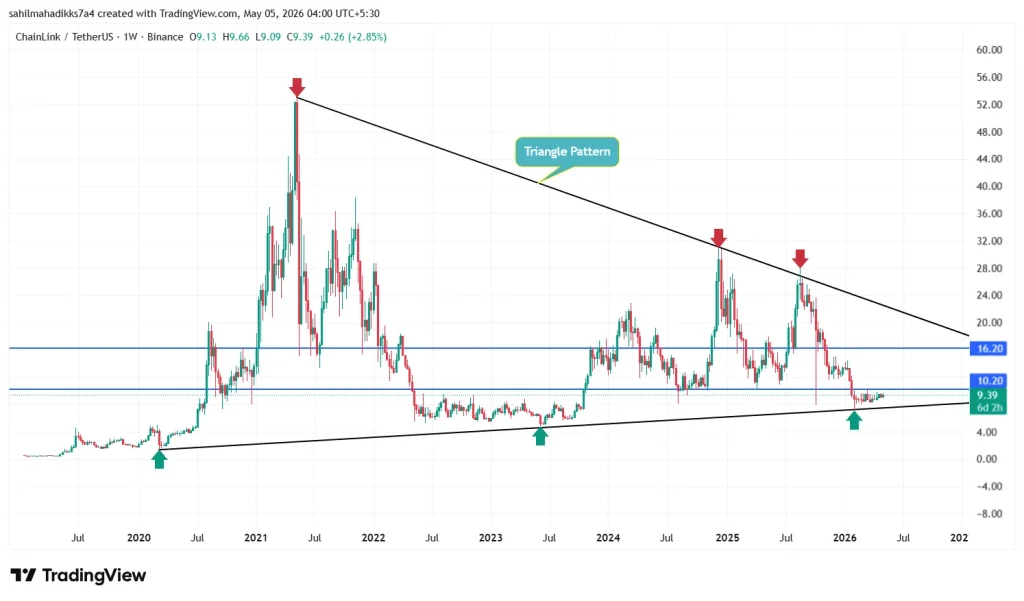
The technical outlook of Chainlink price shows a multi-year sideways trend within the formation of a symmetrical triangle pattern. As shown in the figure below, the chart setup consists of two converging trendlines, which act as dynamic resistance and support for the price.
The LINK token price bounced at least thrice from either trendline, indicating the strong influence of the pattern on trader behaviour. Currently, the price action is hovering above the bottom trendline of the pattern, which historically acted as an accumulation zone before the market recovery.
If the support holds, the potential upswing could challenge the triangle resistance at $15.
Key Price Levels & Infrastructure
- Immediate Resistance: The $15.6-$16 stand as a significant resistance against LINK buyers as this level coincides with the multi-year triangle pattern.
- Primary Support: Since 2020, the ascending support trendline of the triangle has acted as a major accumulation of this pattern, which is currently holding around $15.67-$16.5.
- The Pivot Zone: Until the chart setup is intact, the Chainlink price will prolong its consolidation trend within the two trendlines. Therefore, a potential breakout near $6 accelerates the buying pressure for a potential rally.
Fundamental Analysis: Is the Chainlink Network Actually Growing?
The most notable aspect of Chainlink in 2026 is the disconnect between the performance of the network and the price of the token. The fundamentals tell a story of accelerating adoption and coin price lags severely amid the broader market impact.
Network Scale
In September 2025, Chainlink had surpassed an all-time high of over $100 billion in Total Value Secured (TVS), more than doubling its September value of $38 billion. Approximately more than $70.9 billion of that amount is represented by aave v3 alone. Since inception, the network has enabled over $30.01 trillion in cumulative transaction value — real economic activity triggered by oracle data, not speculative volume.
CCIP Momentum
The pace of cross-chain activity is also increasing. In late April 2026, CCIP volume increased by 260% in just one week. Coinbase has chosen CCIP as the bridge infrastructure for all Coinbase Wrapped Assets. Lido made it the official cross-chain interface of wstETH. Maple Finance has now surpassed 3-billion cross-chain deposits through the CCT standard.
Institutional Validation
The relationship between Swift and Chainlink would shift to pre-production in late 2025. The DTCC has successfully finished a pioneering project with 24 leading financial institutions. UBS was the first global asset manager to implement the Digital Transfer Agent standard of Chainlink.
Chainlink is the only oracle to complete a SOC 2 Type 2 examination of CCIP and Data Feeds in 2026, and thus the only oracle to achieve a SOC 2 Type 1, Type 2, and ISO 27001 certification. Since that time, the SEC and CFTC have considered LINK to be a digital commodity.
Token Demand Surge
LINK became the first ETF to be available in 401(k) and IRA accounts, as the Bitwise Chainlink ETF, started trading on NYSE Arca in early 2026. By the end of April 2026, cumulative inflows of spot ETFs crossed $111.5 million by their end. Exchange reserves have fallen by 25% since 2024, and 3.3 million LINK, a whale accumulation, was recorded in just one week in April. The difference between what the network is trading and what the token is being valued at is still the key point of concern to any investor.
Chainlink Reserve Structural Supply Reduction
The Chainlink Reserve is a strategic on-chain reserve of LINK that is financed by on-chain and off-chain enterprise revenue. The Payment Abstraction system automatically changes payments made in either stablecoins or ETH into LINK, which accrues in the reserve.
The reserve had amassed more than 3.44 million LINK (worth approximately $33.2M) since launch. This generates a constant, revenue-generating buy pressure on the token, structurally decreasing the circulating supply without any action being taken by the retail investors.
Chainlink Roadmap: What’s Coming
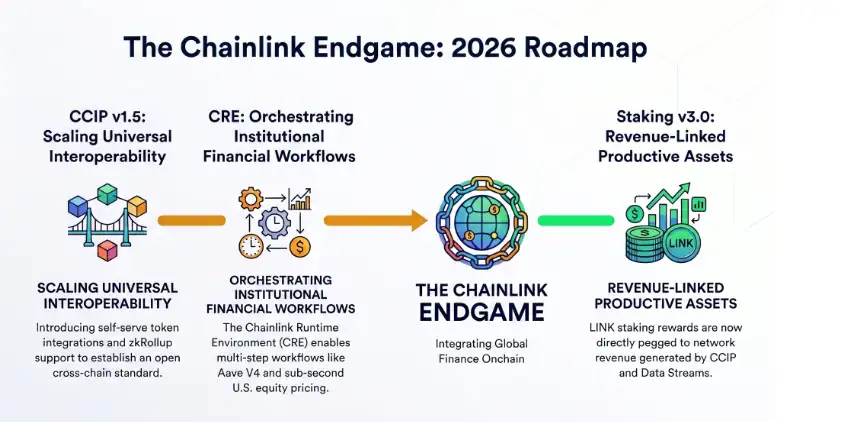
The development roadmap of Chainlink in 2026 and beyond will focus on three key themes: scaling CCIP, expanding the institutional product suite, and evolving the economic model of the token.
CCIP v1.5: The most immediate catalyst on the roadmap. The upgrade also adds self-serve token integrations, such that token issuers can connect assets to CCIP without the involvement of Chainlink Labs. It also incorporates zkRollups that are EVM-compatible and expands the reach of CCIP into the fast-growing Layer-2 ecosystem. The launch of the mainnet, after extensive beta testing by institutional partners, is a significant move towards making CCIP an actual open cross-chain standard, and not a managed service.
Data Streams: In 2026, the 24/5 U.S. Equities Streams were launched, offering continuous and sub-second pricing information of major U.S. equities and ETFs directly on-chain. xStocks has already implemented Chainlink as the official oracle infrastructure of 50+ tokenized equities. With more and more RWA platforms scaling into production, the number of demands for high-frequency, compliance-grade price data grows along with them – and currently, Data Streams is the only product in the market that is implemented to serve it.
Chainlink Runtime Environment (CRE): CRE is the more long-term architectural play. It allows developers to create automated, multi-step workflows between on-chain smart contracts and off-chain systems, APIs, and compliance infrastructure. Aave adopted CRE for V4 market automation. Chainlink oracle services are now available in the AWS Marketplace, a distribution channel that could potentially have a significant impact on the number of developers entering enterprise environments.
Staking v3.0: This is a longer-term growth, but possibly the most impactful to the investment case of LINK. With staking rewards pegged directly to the fees of CCIP and Data Streams revenue, instead of being based on the current base-yield model, LINK will be transformed into a productive asset with a yield that grows as the network grows. Such a shift, should it be provided, could radically alter the way institutional investors model the value of LINK.
Key Drivers That Impact Chainlink Price Action
Network Expansion
CCIP v1.5 is shaping up to be one of Chainlink’s most important catalysts in 2026. The protocol’s success in securing high-value cross-chain transfers is directly tied to long-term LINK demand. CCIP transfers experienced some growth in 2025, reaching around $7.77 billion. For bullish valuations to hold weight, that figure likely needs to scale higher by late 2026.
Staking adds another layer of demand. Staking v0.2 secures roughly 45 million LINK, about 6.4% of the circulating supply, with a base yield near 4.3%. Future upgrades could increase participation to 200 million LINK while incorporating fee-based rewards.
Ecosystem & DeFi Growth
Chainlink currently secures approximately $46.8 billion in Total Value Secured (TVS) across DeFi. Higher TVS indicates deeper integration and greater difficulty for protocols to switch oracle providers. Once major protocols structure core systems, such as liquidation engines around Chainlink feeds, replacing that infrastructure becomes operationally risky.
Institutional & RWA Adoption
Real-world asset tokenization may be another massive avenue for growth besides DeFi. Tools like the Automated Compliance Engine aim to meet institutional KYC and reporting requirements. Ongoing tokenization pilots with global banks could transition into production deployments, expanding usage. Broader regulatory clarity and traditional finance participation would further support infrastructure demand.
Whale Behavior & On-Chain Signals
Large holder activity provides insight into institutional sentiment. January 2026 data shows whales accumulated 16.1 million LINK (roughly $225 million) while exchange reserves dropped 25% since 2024, typical accumulation patterns preceding price movement.
Whale accumulation trends and reduced exchange reserves suggest long-term positioning. If large holders distribute, it could trigger volatility regardless of fundamentals.
Macro & Crypto Market Cycles
Bitcoin’s four-year halving cycle historically drives altcoin price action. But with 95.2% of the Bitcoin supply already mined, halving effects may diminish.
Federal Reserve policy, regulatory clarity, global liquidity conditions, and traditional finance crypto integration pace all influence crypto prices. Chainlink’s institutional focus positions it favorably if regulatory clarity improves.
How High Can Chainlink (LINK) Go—Realistic vs Extreme
Let’s ground this discussion in simple market cap math. Chainlink has roughly 727.09 million LINK in circulation, which is just about 72.7% of its 1 billion maximum supply. At $50, LINK would carry a market cap of around $36 billion. At $100, that rises to $72 billion. A $150 price implies $109 billion, while $500 would push the valuation to roughly $363 billion.
For perspective, a $363 billion market cap is in the range of Ethereum’s valuation during strong market conditions. For LINK to justify that level, it would need to become as economically important as one of the largest blockchain platforms in the world.
A move toward $100 is possible, but it would require several factors aligning. That likely means a strong crypto bull cycle, massive CCIP adoption, sustained growth in real-world asset tokenization, rising network revenue, and increased staking participation that reduces circulating supply. From current levels near $12, $100 is within reach, but it would be difficult to achieve.
By contrast, reaching $500 seems highly improbable under current industry structures. Oracle services represent specialized infrastructure, not broad computing platforms. Even optimistic long-term projections struggle to justify valuations above $100-$150 without structural shifts in value capture.
A realistic long-term range under favorable conditions sits between $30 and $85 by the end of the decade.
Chainlink vs Pyth Network vs Red Stone vs Band Protocol
Chainlink has an estimated 70% of the value secured in the oracle market, a leading position earned through eight years of network development and integration. But competition is intensifying, and it is worth understanding where the pressure is real and where it is overstated.
| Metric | Chainlink | Pyth Network | Red Stone | Band Protocol |
|---|---|---|---|---|
| Oracle Model | Push (+ data stream pull) | Pull (first-party) | Push + Pull + Hybrid | Push |
| Chains Supported | 75+ | 100+ | 110+ | 30+ |
| Key Strength | Compliance, breadth, enterprise moat | Sub-second speed, high-frequency DeFi | Modular flexibility, fast integrations | Cosmos ecosystem |
| Key Weakness | Slower to new chains and verticals | Monetization unproven (Express Relay wound down) | Small team, limited enterprise track record | Minimal mindshare outside Cosmos |
| Notable Integrations | Celo, Cronos, Astar | Aave, Swift, DTCC, Coinbase, Lido | Solana-native DeFi, Polymarket, Data Marketplace (7 institutional publishers incl. Fidelity & Euronext) | BlackRock BUIDL, Apollo ACRED, Ethena, Morpho |
Risks That Could Break the Bull Thesis
No long-term investment thesis comes without risk. While Chainlink’s positioning in the oracle and cross-chain infrastructure market is strong, several factors could weaken the bullish outlook.
Slower CCIP Adoption
A big part of Chainlink’s long-term revenue expectations assumes that CCIP becomes a widely adopted cross-chain messaging standard. If that adoption fails to happen, the broader growth narrative weakens significantly.
The cross-chain interoperability market is highly competitive, and there is no guaranteed dominant standard. If alternative solutions offer lower costs, better user experience, stronger security assurances, or deeper ecosystem integrations, developers may choose those platforms instead. In that scenario, CCIP could fail to be foundational infrastructure and stay as a niche solution.
Without sustained transaction volume and enterprise integration, projected fee generation tied to cross-chain activity would need to be revised downward.
Oracle Competition
Although Chainlink currently holds a dominant position in the oracle market, the pressure from competition is increasing. Pyth Network’s first-party oracle model focuses on low-latency data feeds, which are particularly valuable for high-frequency trading and derivatives platforms. If Pyth captures a substantial share of high-value trading applications, Chainlink could lose dominance in one of the most economically important segments of the market.
The most structural threat would come from Layer-1 blockchains integrating native oracle functionality at the protocol level. If future blockchain architectures eliminate the need for external oracle networks, the total market for third-party oracle providers could shrink.
Regulation
Regulatory classification is a key external risk. If LINK were to be classified as a security, particularly due to staking rewards or revenue-linked mechanisms, the compliance implications would be massive.
That could result in exchange delistings, registration requirements, restricted retail access, and ongoing reporting obligations. Also, institutional participants may avoid infrastructure tied to tokens with unresolved regulatory exposure.
Prolonged Crypto Winter
Chainlink’s fundamentals cannot be entirely separated from broader crypto market cycles. If Bitcoin enters a long bear market, altcoins would likely experience disproportionate drawdowns.
Infrastructure tokens have historically struggled during extended bearish markets, regardless of underlying development progress. Sustained weakness, particularly if LINK were to trade below key long-term support levels for an extended period, could test investor interest and reduce institutional capital inflow.
Our Final Verdict on Chainlink Outlook
Chainlink’s position heading into the next five years is both promising and complex. Chainlink holds a dominant share of the blockchain oracle market at 63-70% with strong network effects that make it difficult for competitors to displace existing integrations. Business partnerships with Swift, major banks, and government agencies provide institutional validation that most crypto projects lack.
CCIP offers a specialized cross-chain infrastructure that addresses real technical problems, while the staking mechanism provides demand. The first-mover advantage, combined with technical complexity, creates major barriers to competition, and developer activity is still among the highest in crypto.
There are still several weaknesses that could limit Chainlink’s upside or delay any real price appreciation. Institutional adoption moves slowly compared to retail-driven Layer-1 hype cycles, meaning fundamental progress doesn’t immediately translate to price gains.
Competition from Pyth, API3, and emerging oracle networks continues to intensify, with each offering technical advantages in specific use cases that could break up the market. High token concentration, with 45% held by the top 100 wallets, presents some volatility risk if large holders decide to distribute. The network also depends heavily on broader crypto adoption for major price gains, tying LINK’s success partially to factors outside Chainlink’s control.
This makes LINK best suited for long-term investors focused on utility who can tolerate volatility while waiting for institutional adoption to play out over multiple years. The 2026-2030 trajectory rides on whether Chainlink can turn technological leadership into revenue growth.
The most realistic middle ground sees Chainlink being one of several successful oracle and cross-chain providers. This competitive but successful scenario supports gradual appreciation toward $30-$50 by 2030 in base cases, with potential for $60-$85 in bullish scenarios.
Chainlink Price Prediction FAQs
Is Chainlink a good long-term investment?
Is Chainlink a good long-term investment?
Chainlink offers good long-term potential for investors who believe oracle infrastructure could become critical to blockchain adoption across DeFi, institutional finance, and Web3 applications. That said, LINK’s history of extreme volatility despite growing network usage makes it a high-risk investment suitable for risk-tolerant investors.
Will LINK reach $50 again?
Will LINK reach $50 again?
LINK reaching $50 could be possible by 2028-2030 under favourable bullish conditions. This requires successful CCIP v1.5 adoption, a sustained crypto bull market, and massive institutional integration. The $35 billion market cap at $50 would position Chainlink comparably to major Layer-1 platforms without requiring dominant status.
Is LINK staking risky?
Is LINK staking risky?
Chainlink staking through Staking v0.2 carries far less risk compared to high-yield DeFi protocols, but is not risk-free. Some of the primary risks include smart contract vulnerabilities despite extensive auditing and the 21-day unbonding period, which creates liquidity risk.
What will LINK be worth in 2030?
What will LINK be worth in 2030?
According to expert analysis, LINK price forecasts for 2030 project a range from $18-85 depending on adoption and competitive dynamics. Bullish projections expect LINK to reach $60-85, which would require Chainlink becoming foundational infrastructure for global tokenized finance, with RWA markets exceeding $10 trillion and network revenue reaching $1.5-2 billion annually.
Will Chainlink price rise again?
Will Chainlink price rise again?
Chainlink price could experience appreciation over multi-year timeframes based on fundamental growth metrics, but the timing is uncertain. Key catalysts include CCIP adoption acceleration, institutional tokenization scaling, and broader crypto market recovery. Investors focused on the 2027-2030 timeframe have a higher probability of making returns.
Where will Chainlink be in approximately 5 years?
Where will Chainlink be in approximately 5 years?
In the next 5 years, Chainlink’s positioning depends on the evolution of the oracle market and institutional blockchain adoption trajectories. The most probable outcome sees Chainlink remaining a top-3 oracle network, capturing 40-50% of the market while coexisting with specialized competitors, trading in the $30-60 range based on sustainable infrastructure utility.
Will Chainlink ever reach $100?
Will Chainlink ever reach $100?
Chainlink reaching $100 is possible, but requires multiple factors to align nearly simultaneously. The conditions necessary would include a full crypto super-cycle, CCIP capturing up to 70% of the cross-chain market, RWA tokenization reaching $5+ trillion with Chainlink dominance, and the network generating over a billion in annual revenue. Long-term holders should consider $30-50 as a more realistic range for the 2028-2030 timeframe.

