Key Highlights:
- Solo mining can earn the full 3.125 BTC reward but payouts are rare and unpredictable.
- Pool mining shares rewards frequently and predictably, minus small fees.
- Solo suits high-power miners; pools are easier, lower-risk and consistent.
Mining is what keeps Bitcoin running safely. Think of it like a massive digital lock, miners use powerful computers to solve puzzles, and whoever solves one first gets to add the next block to the blockchain and earn rewards.
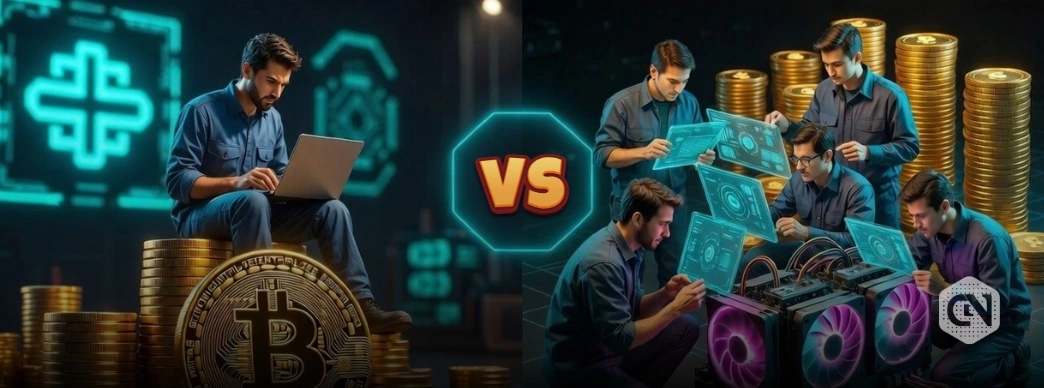
Now, there are two main ways people mine, and both have very different ways of functioning. Solo mining is like playing the lottery alone. You use your own machine, rely only on your computing power and if you crack the puzzle, the entire reward is yours. It is easy to say because for anybody to mine, they need solid hardware and cheap electricity. Many solo miners can go months (or years) without winning anything.
Pool mining, on the other hand, is more like a team project. The miner joins a group of miners, everyone contributes computing power and when the pool is able to crack the code and win a block, the reward is shared based on how much work each person put in. The payouts are smaller, but they are, however, steady and predictable, and less of a stress.
Mining Origins
Cryptocurrency mining started off with Bitcoin in January 2009. Its creator Satoshi Nakamoto, introduced something called proof-of-work in the Bitcoin whitepaper. In simple terms, PoW is like a digital race. Computers here compete to solve tough math puzzles. The first one to crack it gets to confirm transactions, add a new block to the blockchain, and earn newly created Bitcoin as a reward.
The very first block, known as the genesis block, was first mined on January 3, 2009. This moment officially started crypto mining. This took place during the global financial crisis, positioning Bitcoin as a people-powered, decentralized alternative to banks and traditional finance.
Why Mining Matters
Without miners and mining, the Bitcoin network can be tricked into spending the same coin twice. Mining stops such activities by making everyone agree on one shared version of truth, no boss, no bank and no central authority.
The main idea here is that the miners put in the real work (computer power + electricity) and in return, the network rewards them. Right now, after the 2024 Bitcoin halving, miners earn 3.125 BTC per block, plus extra income from transaction fees. These rewards are what motivates people around the world to keep the network running 24/7.
This setup does something powerful, it democratizes money creation. Anyone with the right hardware can participate. Over time, this has helped Bitcoin grow stronger and pushed innovation, especially in specialized mining machines like ASICs, built purely to mine faster and smarter.
The trade-off? Mining consumes a lot of energy. That’s why it’s often at the centre of sustainability debates, balancing network security with environmental impact.
Types of Mining
Two primary types dominate are solo mining and pool mining.
- Solo Mining: Miners operate independently using their hardware to compete against the global network.
- Pool Mining: Miners join groups, pooling hash power for collective block-solving.
How Solo Mining Works
In solo mining, as mentioned above, you are basically flying solo with Bitcoin. Miners run their own full setup, a node, mining software, and a powerful machine, all connected directly to the blockchain. Their computer keeps guessing numbers (called hashes) nonstop, trying to be the first to solve the puzzle for the next block. If they win, they take everything, the full block reward plus transaction fees. If the miners do not win anything, they get nothing. Electricity and effort wasted.
Why is it so tough? Bitcoin’s total computing power is huge, by 2026, the network is pushing 600+ EH/s. When you compare this to power that is consumed by a miner is tiny. So solo mining today is more like a lottery ticket.
How Pool Mining Works
Pool mining is mining with a squad instead of going solo on Bitcoin. Thousands of miners connect their machines to a central pool server. That server breaks the big problem into smaller chunks (called block templates) and hand them out. Each miner works on their piece and sends back “shares”, proof that they are doing real work, even if they did not solve the full block.
When the pool finally cracks a block, the reward does not go to one lucky miner. However, it is shared among everyone, based on how many valid shares they contributed. The pool takes a small cut, usually 1-3% for running the infrastructure.
The biggest advantage here is that there is consistency. There are no long dry spells as pool mining pays out regularly. often every day.
Common payout styles include:
- Pay-Per-Share (PPS): predictable, steady income, low stress.
- Proportional: payouts change based on how much you contributed, more variable, sometimes higher.
Differences
Pool mining and solo mining differ mainly in risk, rewards, and consistency on Bitcoin. Solo mining offers the full block reward if the miner solves a block alone, but payouts are highly unpredictable, more like a lottery, especially with the network exceeding 600 EH/s in 2026. There are no pool fees, but success may take months or years.
Pool mining shares rewards proportionally, delivering steady, frequent payouts minus 1-3% fees, making it lower risk and more accessible for smaller miners.
Conclusion
One can choose pool mining for steady crypto income and community scale, or solo for autonomy and moonshot rewards, aligned with miners hashrate, budget, and tolerance. As networks evolve toward efficiency, hybrids may rise, but pools hold ~95% market share for good reason. A good way to go about mining would be to start small, monitor hashrate trends, and prioritize green energy to future-proof operations and proceed.
Also Read: Can Bitcoin Become a Universal Currency Amid Global Chaos?
See less